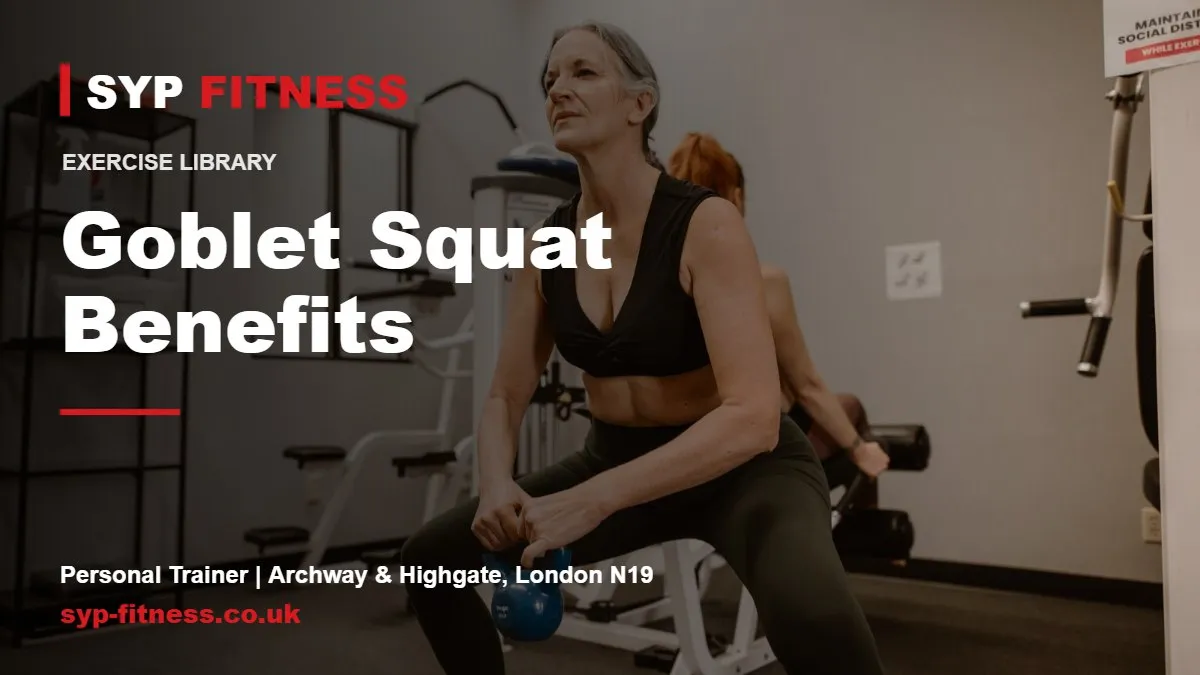
Goblet Squat: Benefits, Daily Life Uses and How to Start
The goblet squat is a squat where you hold one dumbbell or kettlebell against your chest, and it is the best place for most beginners to learn to squat well. Holding the weight in front of you keeps your chest up and your back in a strong position, so you build leg strength without needing a barbell. It is the first loaded squat I teach almost every new client.
Why the goblet squat is a must
Squatting is one of the basic movement patterns your body needs for life: bending your knees and hips together to lower yourself down and stand back up. The goblet squat trains that pattern with a load that is easy to control.
It works your thighs (quadriceps), your glutes, your inner thighs (adductors) and, because the weight sits at your chest, your upper back and deep core muscles too. The front load acts like a counterweight, which helps many people sit deeper with better balance than they can with no weight at all.
If you want the step-by-step technique, my guide on how to squat properly covers foot position, depth and common mistakes.
How it helps in everyday life
Every time you sit down and stand up, you are doing a squat. Making that movement stronger pays off all day long:
Getting up from a low sofa, a car seat or the floor without pushing off your knees.
Picking up a child, a box or a heavy bag of shopping with your legs rather than your lower back.
Climbing stairs, walking up the hills around Highgate and Archway, or carrying a suitcase up to a flat.
Holding a front load close to your body, much like carrying a toddler or a laundry basket.
Sport and hobbies that need strong legs, from football and tennis to skiing and gardening.
What it can help prevent
No single exercise prevents injury on its own, but the goblet squat builds qualities that are linked with fewer problems as we age:
Knee niggles: stronger quads and glutes can help the knee cope better with stairs and impact. If you already have knee pain, see my wall sit guide for a gentler starting point.
Lower back strain: learning to lift with your legs and keep a braced trunk can reduce the load that ends up on your lower back.
Muscle loss with age: we tend to lose muscle from our thirties onwards, and the legs are where it shows most. Regular strength work can help slow that down.
Falls: leg strength and control in a deep position are both linked with better balance later in life.
Who it suits (and who should be careful)
The goblet squat suits almost everyone: complete beginners, people returning to exercise after a long break, busy professionals with stiff hips from sitting, and experienced lifters using it as a warm-up or a lighter leg day.
Be careful if you have current knee, hip or back pain, a recent injury or surgery, or a condition that affects your joints. In those cases, check with your GP or a physio first, and start with a reduced range, for example squatting to a box or bench.
How to start safely
Start with a light dumbbell or kettlebell held vertically at your chest, elbows pointing down.
Stand with feet about shoulder width apart, toes turned out slightly.
Breathe in, brace your stomach, then sit down between your heels, keeping your chest tall and knees moving in line with your toes.
Go only as low as you can while keeping your heels down and back neutral, then drive up through your whole foot.
Begin with 2-3 sets of 8-10 reps, two or three times a week, leaving 2-3 reps in the tank each set.
Easier version: a box squat, where you sit lightly onto a bench and stand back up, with or without a weight.
Harder version: a heavier goblet squat with a three second lowering phase and a pause at the bottom, or progress to the barbell back squat.
The NHS recommends that adults do strengthening activities that work all the major muscle groups on at least 2 days a week, and the goblet squat covers a large part of that in one move.
FAQs
Is the goblet squat good for beginners?
Yes. It is one of the easiest squats to learn because the weight at your chest helps you stay upright and balanced, and you can start with a very light dumbbell.
Is the goblet squat good for weight loss?
It builds muscle and uses a lot of energy because it works large muscle groups, which can support fat loss alongside sensible eating and daily movement. On its own, it will not cause weight loss.
How heavy should my goblet squat be?
Choose a weight you can lift for your target reps with good form and about two or three reps left in reserve. Increase it gradually once every set feels comfortable.
If you want this coached 1-to-1, my 12-week body transformation in Archway builds exercises like the goblet squat into a plan around your body and goals, or see my personal training prices.


