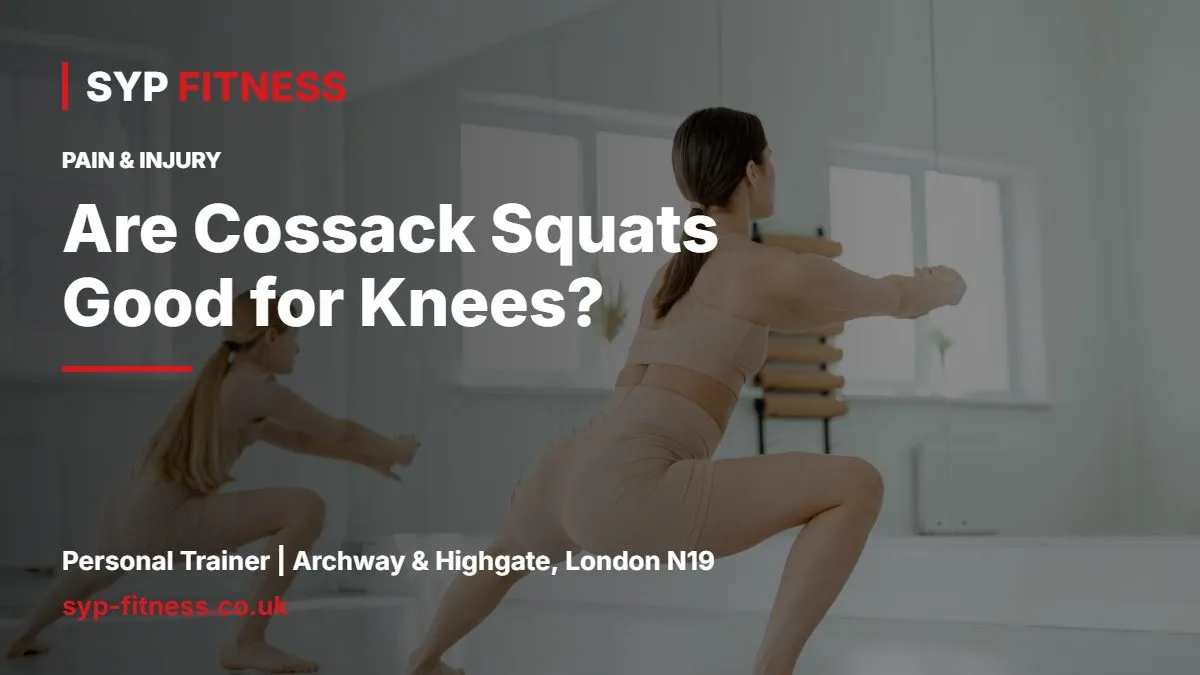
Are Cossack Squats Good for Knees? When to Use Them or Skip
Are Cossack squats good for knees? For many people with healthy knees, yes. Done with control and at the right depth, they build strength and mobility through the knees, hips and ankles in a sideways direction that most training programmes ignore. For some people, especially anyone with current knee pain or a recent injury, they are the wrong exercise for now.
This post is about the knee question specifically: when Cossack squats tend to help, when to avoid them, and how to scale them down so your knees can handle them. For the full technique and general benefits, read my Cossack squat benefits guide.
What a Cossack squat asks of your knees
A Cossack squat is a wide-stance side squat. You sit down into one leg while the other leg stays straight with the toes pointing up. The bent knee goes through a deep range of bending, while the straight leg's inner thigh gets a big stretch.
That means the working knee needs:
- Enough bend to sit low without the heel lifting.
- Control in a sideways position, so the knee tracks over the toes rather than caving in.
- Help from the hips and ankles. If your hips or ankles are stiff, the knee often takes up the slack, which is where people get into trouble.
Are Cossack squats good for knees? When they help
Knees generally like being strong through a full, controlled range of motion. Cossack squats can be a good choice if:
- Your knees feel fine in normal squats and lunges and you want to train them in a new direction.
- You play sports with side-to-side movement, such as football, tennis or martial arts, where the knee needs to cope with lateral loading.
- Your hips and inner thighs are tight and you want strength and mobility in the same exercise.
- You want to build control on one leg at a time, which can highlight differences between your left and right side.
The key word is control. Slow, steady reps to a depth you own will usually build tolerance. Bouncing into the bottom does not.
When to avoid Cossack squats
Skip them for now, and speak to your GP or a physiotherapist, if any of these apply:
- You have current knee pain, swelling, clicking with pain, or the knee gives way.
- You have had recent knee surgery or a ligament or meniscus injury and have not been cleared for deep loaded bending.
- Deep knee bending causes sharp pain rather than the normal feeling of working muscles.
- You have been told by a clinician to avoid deep squatting.
Some general muscle burn or stretch in the inner thigh is normal. Sharp, pinching or lingering pain in the knee joint is not. If you are working around a niggle, my article on training around injury explains how I approach it with clients.
Knee-friendly regressions
If a full Cossack squat feels too much, these steps let you build up gradually. Spend a week or two on each level before moving on.
Level 1: side lunge to a box
Place a box or bench behind you. Step wide and sit back onto it with one knee bent and the other leg straight. This limits depth and gives you confidence.
Level 2: supported Cossack squat
Hold a pole, doorframe or TRX strap. Lower slowly to a comfortable depth, using your hands to take some weight. Keep the heel down and the knee tracking over the toes.
Level 3: partial range bodyweight
No support, but only go halfway down. Pause for two seconds at the bottom, then stand up.
Level 4: full bodyweight
Lower as deep as you can while keeping your heel flat and your chest up. A counterweight such as a light plate held in front can actually make balance easier.
Level 5: goblet Cossack squat
Hold a dumbbell or kettlebell at your chest. Only add load once you can do 8 smooth reps each side at full bodyweight.
Build the foundations first
Often the knee is not the problem. Stiff ankles or hips make the knee do too much. Before or alongside Cossack squats, it helps to work on:
- Ankle mobility - my ankle mobility guide has simple drills you can do in a few minutes.
- Hip mobility - the 90/90 hip stretch is a good partner exercise.
- Basic leg strength - goblet squats, step-ups and glute bridges build a base. See my knee strengthening exercises for a full list.
Sample knee-friendly lower body session
- Ankle rocks - 2 x 10 each side.
- 90/90 hip switches - 2 x 6 each side.
- Goblet squat to box - 3 x 10.
- Supported Cossack squat - 3 x 5 each side, slow.
- Glute bridge - 3 x 12.
- Side plank - 2 x 20 seconds each side.
Two sessions a week is plenty to start with. Keep your knees feeling the same or better the next day. If they feel worse, scale back a level.
Want help with this? Many of the busy professionals I coach come in with stiff hips or knees that do not like certain exercises. I start by checking how you move, then pick the right level for you so you can train hard without flaring things up. If you have a history of joint problems, my injury-safe personal training in Archway is built around that. Book a free consultation to get started.
Frequently asked questions
Are Cossack squats bad for your knees?
Not for most people with healthy knees, as long as you work to a depth you can control and keep your heel down. Problems usually come from going too deep too soon, bouncing at the bottom or letting the knee cave in. If you already have knee pain or a recent injury, check with your GP or a physiotherapist before trying them.
Why do I feel Cossack squats in my knee?
A mild feeling of effort around the knee is normal, because it is bending a long way under load. Sharp or pinching pain is different. It often means stiff ankles or hips are forcing the knee to compensate, or you are going too deep. Reduce the depth, use support, and seek advice from a physiotherapist if pain continues.
How deep should I go in a Cossack squat?
Go only as deep as you can while keeping the heel of your bent leg flat, your knee in line with your toes and your chest fairly upright. For some people that is halfway, for others it is full depth. Depth improves over weeks as your hips and ankles loosen, so there is no need to force it.
Can Cossack squats help knee pain?
They are not a treatment for knee pain. Strength work can play a part in a rehab plan, but the right exercises depend on the cause of the pain. A physiotherapist can assess your knee and tell you whether deep side squats suit you yet, or which simpler exercises to use first.
Start your transformation
SYP Fitness is a private 1-to-1 personal training studio at 2-4 Navigator Square, Archway, London N19 3UB, 2 minutes from Archway tube. Rated 5.0 from 100+ Google reviews.
Apply for a free consultation · WhatsApp Artem · Call 07301 512215 · See prices


