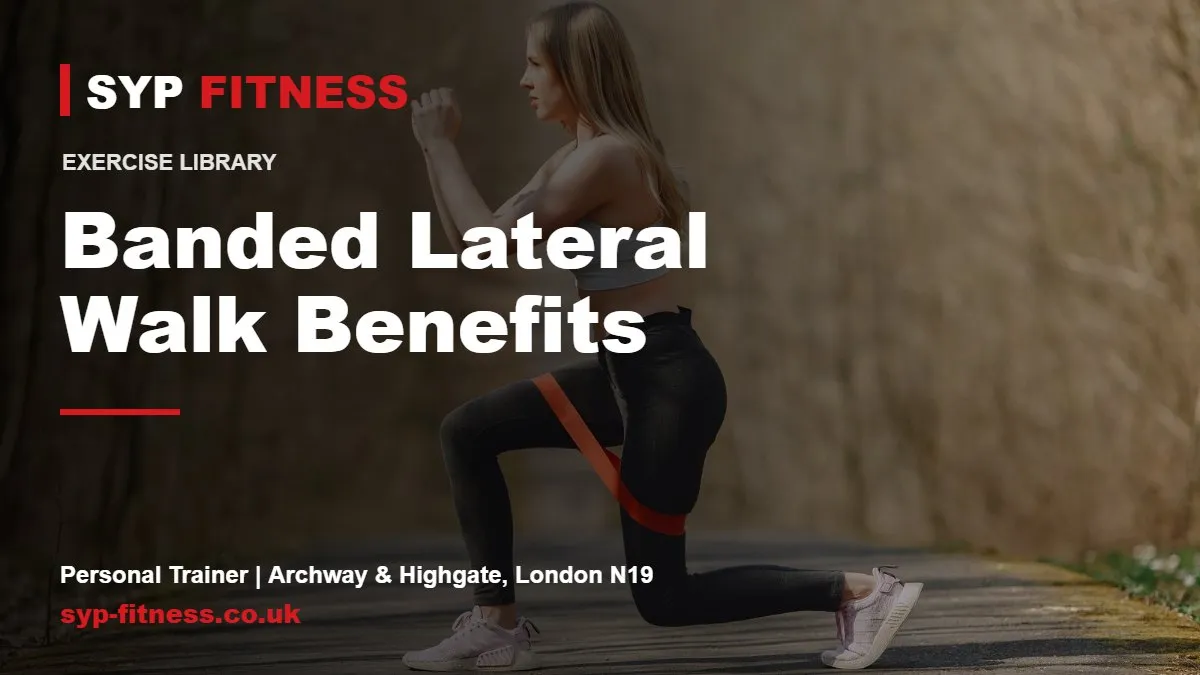
Banded Lateral Walk: Benefits and How to Do It Right
The banded lateral walk, sometimes called the monster walk or crab walk, is a side-stepping exercise with a resistance band around your legs. You stay in a half squat and step sideways against the band's pull. The biggest reason to do it: it trains the side hip muscles that keep your knees and pelvis steady when you are on your feet.
Why the Banded Lateral Walk is a must
Most training and most daily life happens moving forwards. Your body also needs strength to resist sideways forces, like when someone bumps into you or you step off a kerb at an angle. The lateral walk is one of the simplest ways to build that, and it does it in a standing position that carries over to real life.
It is also a brilliant warm-up. A few sets before squats, lunges or a run switch on the glutes so that they, and not your knees or back, take the load during the main session.
How it helps in everyday life
Stepping sideways in a crowd. Moving round people on a busy pavement or train platform calls on exactly these muscles.
Walking on uneven ground. Strong side hips help you stay steady on grass, gravel and wet paths.
Climbing stairs. They stop your knee drifting inwards as you push up on each step.
Getting in and out of a car or bath. Stepping your leg out to the side and over an edge needs hip strength and control.
Playing sports with quick changes of direction. Tennis, football and dancing all involve sideways moves that this exercise prepares you for.
What it helps prevent
When the side hip muscles are weak, the knees tend to cave inwards during squats, stairs and landings, which can contribute to knee pain over time. The banded lateral walk builds the strength that makes this less likely, and it can help protect against hip and lower back niggles that come from poor pelvic control.
It is also good for balance, because every step means briefly standing on one leg against resistance. The NHS falls prevention advice recommends strength and balance work at least twice a week, which can help lower your risk of falls as you get older.
Muscles worked
Gluteus medius and minimus: the main movers on the side of the hip.
Gluteus maximus: keeps you in the half squat and helps control the knee.
Tensor fasciae latae: a small muscle at the front of the hip that assists.
Quads and core: hold your squat position and keep your trunk upright.
How to do the Banded Lateral Walk
Place a mini band just above your knees or around your ankles. Above the knees is easier to start with.
Stand with your feet hip-width apart so there is light tension in the band.
Bend your knees and hips slightly into a quarter squat, chest up and stomach braced.
Step sideways with your leading foot, about shoulder-width, pushing your knee out against the band.
Bring your trailing foot in, but not all the way, so the band stays tight.
Keep your toes pointing forwards and your hips level, without bobbing up and down.
Take 10-15 steps one way, then the same number back the other way.
Breathing: Breathe steadily and evenly with each step. Do not hold your breath.
Common mistakes
Standing up tall. Stay in a slight squat the whole time so the glutes keep working.
Letting the knees cave in. Push your knees out against the band on every step.
Swaying the upper body. Keep your shoulders level and move from the hips, not by leaning.
Feet snapping together. Control the trailing foot so the band never goes slack.
Make it easier or harder
Easier: use a light band above the knees, stand a little taller and take smaller steps. Clamshells on the floor are a good starting point too.
Harder: use a stronger band, move it down to your ankles or feet, sink lower into the squat, or add a forward and diagonal step pattern (a monster walk). Pausing for a second on each step adds extra challenge.
Sets, reps and how often
Start with 2-3 sets of 10-15 steps each way, 2-3 times a week. As a warm-up, 1-2 sets before leg training or a run is plenty.
Progress by using a stronger band or moving it lower down your legs. Add it to your strength sessions as part of the NHS advice to strengthen all major muscle groups on at least 2 days a week.
Who should take care
If you have hip or knee pain during the movement, recent hip or knee surgery, or a hip replacement, check with a GP or physio first. Use a band that is not too tight if you have sensitive skin or circulation problems. In pregnancy, check with your midwife or GP, especially if you have pelvic girdle pain.
Related exercises
Clamshell isolates the same muscles lying down and is a good first step.
Single-Leg Glute Bridge builds glute strength on each side.
Prehab exercises for more ways to protect your knees and hips.
FAQs
What does the banded lateral walk work?
Mainly the gluteus medius on the side of your hip, with help from the rest of the glutes, thighs and core.
Should the band go above the knees or around the ankles?
Above the knees is easier and a good start. Around the ankles or feet is harder and works the hips more.
Is the banded lateral walk good for knee pain?
It can help by strengthening the muscles that keep your knees in line. If your knee is already painful, get advice from a physio first.
Want help with your technique?
Artem coaches banded lateral walks and hip stability work 1-to-1 at his private studio in Archway, North London, often using them in warm-ups so your main lifts feel stronger and safer.
See how the 12-Week Body Transformation works, check the personal training prices, or book a free assessment and we will look at your movement together.
Last updated: October 2026


