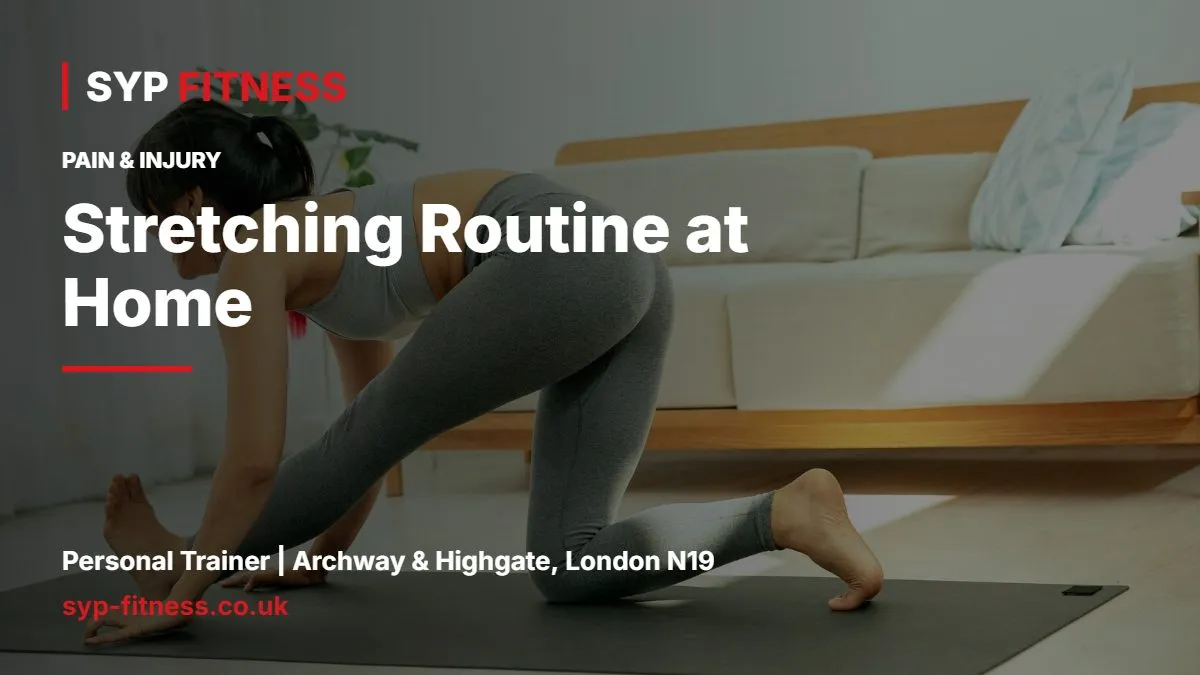
Stretching Routine at Home: 10 Minutes for Stiff Desk Workers
A good stretching routine at home does not need an hour, a yoga studio or a flexible body to start with. If you sit at a desk for 8 hours, then sit on the tube, then sit on the sofa, 10 minutes of the right moves each day will do more for how your back, neck and hips feel than one long session at the weekend.
This is the exact routine I give to busy clients in their 30s, 40s and 50s who tell me they feel "tight everywhere". It is six moves, done in order, on the floor next to your bed or desk. No kit apart from a mat or a rug and a doorway.
Why desk workers get so stiff
Your body gets good at the positions you spend the most time in. Sitting for long spells means your hips stay bent, your upper back rounds forward, your shoulders roll in and your chest muscles stay in a shortened position. None of this is dangerous on its own, but over months it often shows up as a stiff mid back, a sore neck by 4pm and hips that feel locked when you stand up.
Stretching will not undo a whole day of sitting by itself, but it takes your joints through the range they are missing. Combined with getting up every 30-60 minutes and some strength work, it makes a real difference. On busy days, a 3 minute version (cat-cow, 4 thread the needle reps and one doorway stretch each side) keeps the habit alive.
The 10 minute stretching routine at home
Do the moves in this order. Breathe slowly through your nose and never push into sharp pain. A mild pulling feeling is fine; pinching or tingling is not.
- Cat-cow, 60 seconds. On hands and knees, slowly round your back up towards the ceiling, then let your belly drop and lift your chest. Move one segment of the spine at a time. My full guide to the cat-cow stretch covers the details.
- Thread the needle, 6 slow reps each side. From hands and knees, slide one arm under your body along the floor, letting your shoulder and head drop, then reach the same arm up to the ceiling. This is the best single move I know for a stiff upper back. See the thread the needle stretch breakdown for common mistakes.
- Side-lying thoracic rotation, 8 reps each side. Lie on your side with knees bent to 90 degrees and arms out in front. Open the top arm across your body towards the floor behind you, following your hand with your eyes. Keep the knees stacked so the twist comes from your upper back, not your lower back. More on the thoracic rotation exercise here.
- Doorway chest stretch, 30-45 seconds each side. Place a forearm on a door frame, elbow at shoulder height, and step through gently until you feel the front of your chest and shoulder open. Read the pec doorway stretch guide for the three arm heights I use.
- Half-kneeling hip flexor stretch, 45 seconds each side. Kneel on one knee, the other foot in front. Squeeze the glute of the back leg and tuck your pelvis under slightly, then shift forward a few centimetres. Most people lean forward too far and miss the stretch; the hip flexor stretch article shows why.
- World's greatest stretch, 4 reps each side. Step into a long lunge, place both hands inside your front foot, drop the back knee if needed, then rotate and reach the inside arm to the ceiling. It ties the hips, hamstrings and upper back together, which is why I finish with it. Full instructions in the world's greatest stretch guide.
That is roughly 9-11 minutes depending on how slowly you go. Slow is better.
When to do it and how often
Daily beats perfect. I would rather you did this routine 6 days a week for 10 minutes than twice a week for 30. Pick a slot that already exists in your day so it becomes automatic:
- Straight after you shut the laptop. It works as a full stop on the working day, which helps if you work from home.
- Before bed. The slow breathing and floor work suit winding down. Skip anything that feels too energetic.
- Mid-morning on a work-from-home day. A 10 minute break after 2-3 hours of sitting.
You do not need to warm up first. The cat-cow is the warm-up. If you are going straight into a workout afterwards, swap the long holds for slower reps so the muscles stay ready to work.
How to tell if it is working
Do not judge it by how far you can reach after one week. Look for practical signs instead:
- Getting out of a chair or the car feels less creaky.
- You can turn your head to check a blind spot without moving your whole body.
- The 4pm neck or upper back ache arrives later, or not at all.
- On thread the needle and the thoracic rotation, your hand gets a little closer to the floor each fortnight.
Common mistakes with a home stretching routine
Rushing the reps
Fast, bouncy reps make your muscles tighten up to protect you. Take 3-4 seconds to move into each position and breathe out as you go deeper.
Stretching through pain
Mild tension is the target. If a stretch gives you pins and needles, numbness or a sharp pain, stop that move. Pain that runs down an arm or a leg, or that does not ease, is a reason to speak to your GP or a physiotherapist rather than stretch harder.
Only stretching, never strengthening
Stretching on its own often gives a nice feeling that fades by the next afternoon. The longer-lasting change comes when you also strengthen the muscles that hold you in better positions, like the upper back and glutes. UK guidance says adults should do strength work on at least 2 days a week as well as at least 150 minutes of moderate activity, and that applies to desk workers too.
Want help with this? If stiffness or nagging aches are stopping you training properly, I build sessions around what your body can do today and progress from there. You can read how I work on the injury-safe personal training in Archway page, or Book a free consultation and we can go through your routine together at the studio.
Frequently asked questions
How long should a stretching routine at home take?
For most desk workers, 10 minutes a day is enough to feel a difference within a few weeks. Doing it often matters more than doing it for a long time. If you have more time, add slower reps or a second round rather than more new stretches. On busy days a 3 minute version still keeps the habit going.
Is it better to stretch in the morning or at night?
Both work, so choose the time you will actually stick to. Morning stretching can ease the stiffness you wake up with, while evening stretching helps you switch off after work. If you train in the evening, do the routine afterwards. Just avoid long, deep holds on cold muscles straight out of bed.
Can stretching fix bad posture?
Stretching helps you move into better positions, but it rarely changes posture on its own. Posture improves most when you combine mobility work with strength training for the upper back, core and glutes, and when you change position more often during the day. Think of stretching as one part of the plan, not the whole thing.
Should I stretch if my back hurts?
Gentle movement often helps general stiffness, but it is not the answer to every back problem. If your pain is severe, follows an injury, spreads down a leg or comes with numbness or weakness, see your GP or a physiotherapist before starting any routine. If a stretch makes your symptoms worse, stop it.
Start your transformation
SYP Fitness is a private 1-to-1 personal training studio at 2-4 Navigator Square, Archway, London N19 3UB, 2 minutes from Archway tube. Rated 5.0 from 100+ Google reviews.
Apply for a free consultation · WhatsApp Artem · Call 07301 512215 · See prices


