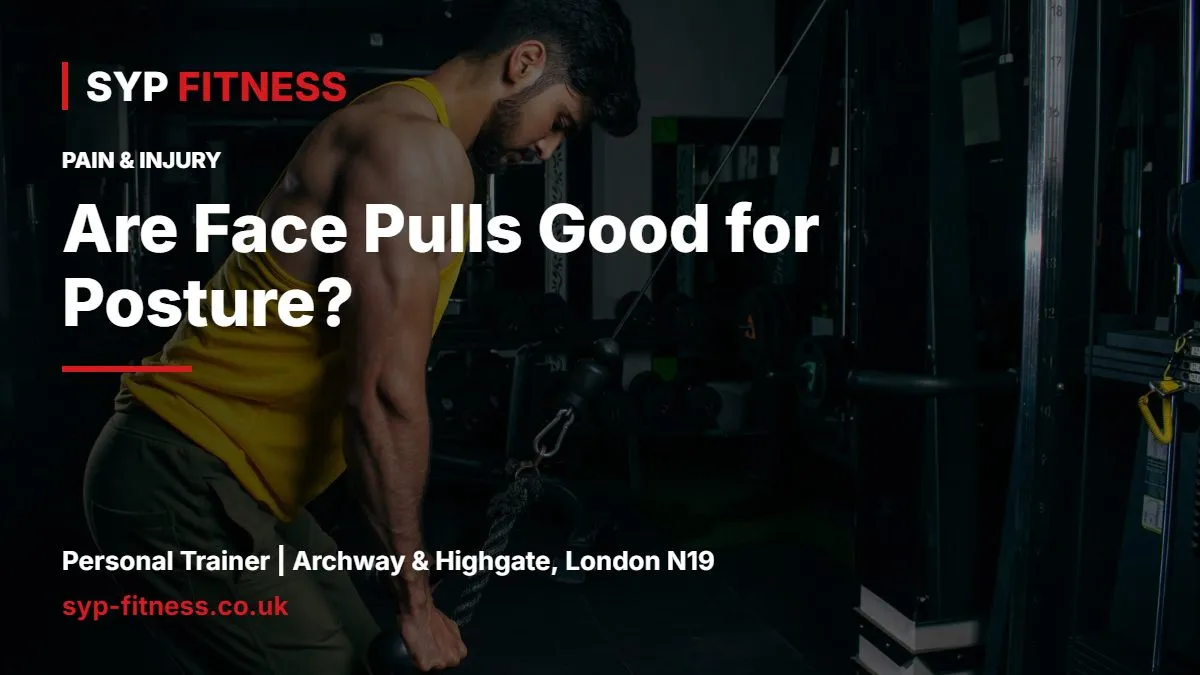
Are Face Pulls Good for Posture? What They Can and Can't Do
Are face pulls good for posture? Yes, they are one of the most useful exercises you can do if your shoulders roll forward after years at a desk, but they are not a magic fix on their own. Face pulls strengthen the muscles at the back of your shoulders and upper back, the ones that help hold your shoulder blades in a better position.
In this post I want to be honest about what face pulls can and cannot do for rounded shoulders, show you how to do them properly, and give you a simple posture routine built around them. If you want the full exercise breakdown, my face pull benefits guide covers the muscles and technique in more depth.
What face pulls actually work
A face pull is a rope or band pull towards your face, with your elbows high and your hands finishing either side of your ears. It mainly trains:
- Rear deltoids - the back of the shoulder, which is often weak compared with the front.
- Middle and lower trapezius and rhomboids - the muscles that pull your shoulder blades back and down.
- Rotator cuff, especially the external rotators - small muscles that turn the upper arm outwards and help keep the shoulder joint centred.
Most people who sit all day spend hours with their arms in front of them: typing, driving, scrolling. Their chest and the front of their shoulders get plenty of use, while the back of the shoulders does very little. Face pulls train the opposite direction, which is why they are so popular for posture work.
Are face pulls good for posture? What they can and cannot do
What they can do
- Build strength and endurance in the upper back so it is easier to sit and stand tall for longer.
- Balance out a programme heavy in pressing (bench press, push-ups, shoulder press).
- Improve your awareness of where your shoulder blades are, which helps you notice when you slump.
- Give your shoulders a healthier mix of work, which many lifters find makes pressing feel better.
What they cannot do
- They cannot undo eight hours of slumping with three sets. Posture is mostly about habits and how often you change position.
- They do not stretch a tight chest. If your chest and front shoulders are stiff, you also need mobility work.
- They do not fix thoracic stiffness. If your mid-back is stuck in a rounded position, you need to work on rotation and extension too.
- They are not a treatment for pain. If you have shoulder, neck or upper back pain, see your GP or a physiotherapist before assuming it is a posture problem.
It is also worth saying that there is no single "perfect" posture. The aim is to be strong and comfortable in a range of positions, and to move often, not to hold yourself rigid all day.
How to do a face pull properly
Technique matters more than load here. Most people go too heavy and turn it into a messy row.
- Set a cable with a rope attachment at roughly forehead height, or loop a resistance band around something sturdy at the same height.
- Hold the rope with your thumbs pointing back towards you. Step back until your arms are straight and there is tension.
- Stand tall with ribs down, not leaning back.
- Pull the rope towards your face, leading with your elbows high and wide.
- At the end, pull the rope apart and rotate your hands back so your fists finish beside your ears, like a double bicep pose.
- Pause for one second, then return slowly over two to three seconds.
Common mistakes
- Leaning back and using bodyweight to move the stack.
- Shrugging the shoulders up towards the ears.
- Elbows dropping so it becomes a low row.
- Rushing the lowering part.
Use a weight you can control for 12-20 reps. If you feel it mostly in your upper traps or neck, go lighter and focus on the elbows and the rotation at the end.
A simple posture routine built around face pulls
This takes about 15 minutes and works well two or three times a week, either on its own or added to the start or end of your normal session.
Part 1: open up (5 minutes)
- Pec doorway stretch - 2 x 30 seconds each side.
- Thoracic rotation - 2 x 8 slow reps each side.
Part 2: strengthen (8-10 minutes)
- Face pulls - 3 x 15, with a one second pause at the end.
- Band pull-aparts - 2 x 20.
- Wall angels - 2 x 8 slow reps, keeping your lower back and arms as close to the wall as you comfortably can.
Part 3: one bigger pull
Face pulls are a smaller "accessory" exercise. For real upper back strength, also include a heavier row each week, such as a dumbbell row or seated cable row. My guide on how to do rows properly explains the technique.
Rest 45-60 seconds between sets. Add a few reps or a little weight every week or two, as long as your form stays clean.
Daily habits that matter as much as the exercise
Training two or three times a week helps, but what you do for the other 160-odd hours makes a big difference. A few things I suggest to the desk workers I coach:
- Move every 30-45 minutes. Stand up, roll your shoulders, take a short walk to refill your water.
- Raise your screen. The top of the screen roughly at eye level stops you craning forward.
- Bring your phone up towards eye level rather than dropping your head to it.
- Do a few band pull-aparts during the day if you keep a band at your desk.
For a wider look at the topic, my guide on how to improve posture covers the lower body and core as well as the shoulders.
Want help with this? I work with a lot of busy professionals over 30 who sit for most of the day and want to feel stronger and stand taller. In private 1-to-1 personal training in Archway we look at how you move, then build a plan that fits your week. Book a free consultation and we can start with your shoulders and upper back.
How long before you notice a difference?
Most people notice their upper back feels more "switched on" within two to three weeks of regular face pulls and mobility work. Visible changes in how you hold yourself take longer, usually a couple of months of consistent training plus better desk habits.
Frequently asked questions
How often should I do face pulls for posture?
Two to three times a week works well for most people. Face pulls are a low-stress exercise, so you can do them more often if you keep the weight light, but more is not always better. Aim for 2-4 sets of 12-20 controlled reps and focus on clean form and steady progress rather than chasing heavy weights.
Can face pulls fix rounded shoulders on their own?
Not on their own. Face pulls strengthen the upper back and the back of the shoulders, which helps, but rounded shoulders usually come from long hours sitting, a stiff chest and a stiff mid-back as well. Combine face pulls with chest stretches, thoracic mobility, heavier rows and regular movement breaks during the day for the best results.
Can I do face pulls with a resistance band at home?
Yes. Anchor a band at about forehead height, for example around a sturdy post or in a door anchor, and follow the same technique: elbows high, pull towards your face, rotate your hands back at the end. Bands are ideal for posture work because they are light, quiet and easy to use for a few sets during a work-from-home day.
Should face pulls hurt my shoulders?
No. You should feel the back of your shoulders and upper back working, but not sharp or pinching pain in the joint. If you feel pain, lower the weight and check your elbows are not dropping. If pain continues, stop the exercise and speak to your GP or a physiotherapist before carrying on.
Start your transformation
SYP Fitness is a private 1-to-1 personal training studio at 2-4 Navigator Square, Archway, London N19 3UB, 2 minutes from Archway tube. Rated 5.0 from 100+ Google reviews.
Apply for a free consultation · WhatsApp Artem · Call 07301 512215 · See prices


