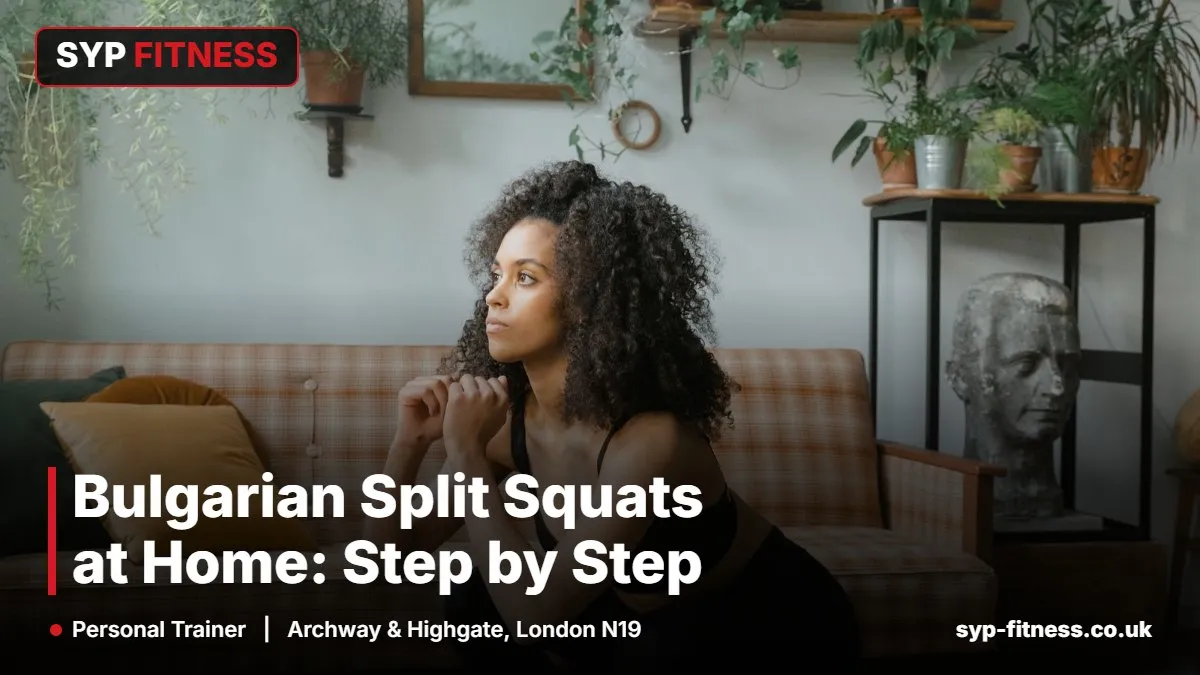
Bulgarian Split Squats at Home: How to Do Them Safely
Bulgarian split squats at home are one of the best leg exercises you can do without a gym. All you need is a sturdy chair, sofa or step and a bit of floor space. They build strong legs and glutes one side at a time, and they test your balance too. This guide shows you how to set up, how to do them with good form and how to make them harder with things you already own.
As a personal trainer in Archway, I often set this exercise as homework between sessions. It is simple, it needs no kit, and it works hard even with just your bodyweight.
What is a Bulgarian split squat?
A Bulgarian split squat is a single-leg squat where your back foot rests on a raised surface behind you and your front leg does most of the work. You lower straight down until your back knee is close to the floor, then push back up through your front foot. Because one leg carries most of your weight, it feels much harder than a normal squat.
It mainly trains your quads, glutes and adductors, with your hamstrings, calves and core helping to keep you steady. For the full list of reasons to do it, read my guide to Bulgarian split squat benefits.
How to set up Bulgarian split squats at home
Getting the set-up right is most of the battle. Here is what you need:
A stable surface about knee height. A dining chair pushed against a wall, the edge of a sofa, a bed frame or the bottom stair all work. It must not slide or tip.
A non-slip floor. Train barefoot or in trainers on carpet or a mat. Avoid socks on wood or tiles.
Space around you. Keep a wall or door frame within reach for balance while you learn.
To find your foot position, sit on the edge of the chair, then stand up and take one big step forward. Turn around, place the top of your back foot on the seat, and check your front foot is far enough ahead that your front knee stays roughly over your foot at the bottom.
How to do a Bulgarian split squat step by step
Get in position. Front foot flat, back laces resting on the chair, feet about hip width apart side to side, not in a straight line.
Stand tall and brace. Ribs down, a light squeeze through your stomach.
Lower slowly. Bend both knees and drop your back knee towards the floor over 2 to 3 seconds.
Stop just above the floor. Go as deep as you can while your front heel stays down and it feels comfortable.
Drive up. Push the floor away through your whole front foot to stand back up.
Finish all reps, then switch. Do every rep on one leg before changing sides.
A slight forward lean of your body puts more work on your glutes. Staying more upright puts more work on your quads. Both are fine.
Common mistakes and how to fix them
Front foot too close. Your heel lifts and your knee shoots far forward. Move your front foot further away.
Feet in a straight line. You wobble side to side. Give yourself a little width, like standing on two train tracks.
Pushing off the back leg. The back foot is only there for balance. Most of the effort should come from the front leg.
Rushing. Bouncing out of the bottom makes it easier and less useful. Slow down on the way down.
Surface too high. If you feel a strong pull at the front of your back hip, use a lower step.
Sets and reps for training at home
For most beginners, start with 2 to 3 sets of 6 to 10 reps on each leg, 2 times a week. Rest about a minute between sides. Stop each set with 1 or 2 good reps still in the tank.
Once you can do 3 sets of 12 slow, controlled reps on each leg, it is time to make it harder. Add it to a simple routine like my leg workout at home with no equipment.
How to make Bulgarian split squats harder at home
You do not need a gym to keep progressing. Try these, one at a time:
Slow the lowering phase. Take 4 to 5 seconds on the way down.
Add a pause. Hold for 2 seconds just above the floor.
Use a backpack. Fill it with books or water bottles and wear it on your back.
Hold something heavy. A full shopping bag, a kettlebell or a pair of dumbbells by your sides.
Add a half rep. Go down, come halfway up, go back down, then stand up. That counts as one rep.
For more ideas on getting stronger with little kit, see strength training at home.
Easier options if they feel too hard
If you cannot balance yet or your knees complain, start with a regular split squat with both feet on the floor. Hold a wall or door frame for support. Reduce how deep you go and build up over a few weeks.
Check with your GP or a physio first if you have a current knee, hip or back injury, recent surgery, or pain that gets sharper as you train. Mild muscle soreness the next day is normal. Sharp or joint pain is not.
Want this coached 1-to-1? I can check your set-up and build Bulgarian split squats into a plan that fits your home and your week, with sessions at the studio and online coaching support in between. Book a free consultation at our Archway studio.
Frequently asked questions
Can you do Bulgarian split squats without weights?
Yes. Bodyweight is plenty for most beginners. Slow reps, pauses or a loaded backpack make them harder when you are ready.
What can I use instead of a bench for Bulgarian split squats?
A sturdy chair against a wall, the edge of a sofa, a bed or the bottom stair. It should be roughly knee height and must not move.
How many Bulgarian split squats should a beginner do?
Start with 2 to 3 sets of 6 to 10 reps on each leg, twice a week. Add reps before you add weight.
Are Bulgarian split squats bad for your knees?
For most healthy people they are fine with good form and sensible depth. Keep your front heel down and your knee in line with your toes, and get any pain checked by a GP or physio.
Start your transformation
SYP Fitness is a private 1-to-1 personal training studio at 2-4 Navigator Square, Archway, London N19 3UB, 2 minutes from Archway tube. Rated 5.0 from 106 Google reviews.
Apply for a free consultation · WhatsApp Artem · Call 07301 512215 · See prices


