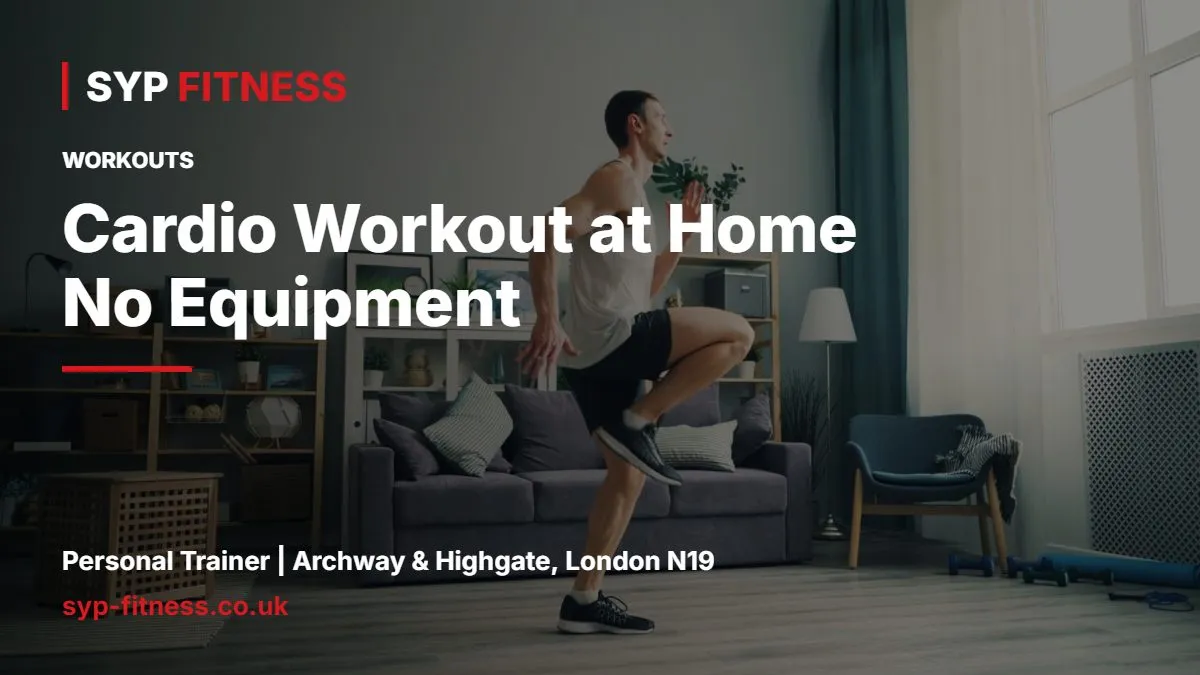
Cardio Workout at Home No Equipment: Low and High Impact
A cardio workout at home no equipment can be as effective as a session on the treadmill, as long as you work at the right effort and pick moves that suit your joints and your neighbours. Not everyone wants to jump around in a flat with someone living below, and not everyone's knees will thank them for it.
So this guide gives you two versions of the same session: a low impact one with no jumping at all, and a higher impact one for when you are ready. You will also learn how to judge your effort without a heart rate monitor, and how often to do it.
How hard should home cardio feel? Use the talk test
You do not need a fitness watch to know if you are working hard enough. The talk test is simple and reliable:
- Easy (recovery): you could hold a full conversation or sing.
- Moderate: you can talk in full sentences but could not sing. This is what UK guidance means by moderate activity.
- Vigorous: you can only say a few words before needing a breath.
- Very hard: you cannot talk at all. Only sustainable for short intervals.
The UK Chief Medical Officers recommend at least 150 minutes of moderate activity a week, or 75 minutes of vigorous activity, or a mix. A 20-minute home cardio session at moderate to vigorous effort counts towards that.
Low impact cardio workout at home (no jumping)
Good for beginners, people carrying extra weight, anyone with sore knees or ankles, and anyone living in a flat. One foot stays on the floor at all times. Do each move for 40 seconds, rest for 20 seconds, and go straight to the next. Complete 3-4 rounds with 1 minute of rest between rounds.
- Fast marching with arm drive - lift knees to hip height, pump your arms.
- Squat to calf raise - sit back into a squat, stand and rise onto your toes.
- Step-back lunge with reach - alternate legs, reaching your arms overhead as you step back.
- Standing cross-body knee drive - drive one knee up towards the opposite elbow, alternate sides quickly.
- Incline mountain climber - hands on a sofa or worktop, step your knees in one at a time.
- Skater step - big side step, swing the trailing leg behind, alternate sides.
That is 18-24 minutes of work plus a warm-up. If you can talk easily throughout, move faster and make the movements bigger.
Higher impact cardio workout at home
Same structure, but with jumping and floor work. Only move to this once the low impact version feels comfortable at a vigorous effort, and land softly through the balls of your feet with bent knees.
- High knees - running on the spot, knees to hip height.
- Squat jump - small jumps to start, landing quietly.
- Switch lunges - or alternate step-back lunges if you lose balance.
- Floor mountain climbers - hands under shoulders, hips level.
- Skater hops - jump side to side, landing on one leg.
- Burpees - with or without the push-up. See my burpee guide for a version that is easier on the wrists and back.
You can also swap in a bear crawl forwards and backwards if you have a few metres of floor space. It is quiet and harder than it looks.
Interval options for different fitness levels
Change the work-to-rest ratio as you get fitter, keeping the same exercises:
- Starting out: 20 seconds work, 40 seconds rest. 2-3 rounds.
- Building: 30 seconds work, 30 seconds rest. 3 rounds.
- Fitter: 40 seconds work, 20 seconds rest. 3-4 rounds.
- Hard intervals: 20 seconds very hard, 10 seconds rest, 8 times through on one or two moves. Once or twice a week at most.
Short, very hard intervals are effective, but they are tiring and easy to overdo. My guide to interval training and HIIT explains when they help and when they just leave you wiped out. For a structured follow-along session, try the bodyweight HIIT workout (level 6).
How often to do cardio at home
A sensible week for most busy adults looks like this:
- 2-3 home cardio sessions of 15-25 minutes, mixing moderate and harder days.
- 2 strength sessions, as UK guidance recommends, which can be done at home too.
- Daily walking. Easy, low stress and it adds up. A brisk walk at lunchtime counts as moderate activity.
Avoid doing hard intervals on consecutive days. Your heart and lungs recover fast, but your legs and joints take longer. If you are brand new to exercise, start with my cardio for beginners guide and build up over a few weeks.
Want help with this? Cardio is great for heart health and fitness, but on its own it is rarely the thing that changes how you look. My clients combine strength training, a nutrition plan and sensible cardio, with weekly check-ins to keep it on track. I train people 1-to-1 in Archway and across North London. Book a free consultation and we can plan the right mix for you.
Safety tips for home cardio
- Warm up for 3-5 minutes with marching, arm circles and slow squats before you speed up.
- Wear trainers on hard floors, even at home. Bare feet on laminate is asking for a slip.
- Clear the space and move furniture out of the way.
- Stop if you feel chest pain, dizziness or unusual breathlessness.
If you have a heart condition, high blood pressure, are pregnant, or have not exercised for a long time, speak to your GP before starting vigorous cardio.
Frequently asked questions
Can you do cardio at home without equipment?
Yes. Marching, step-back lunges, squats, mountain climbers, skater steps and burpees will all raise your heart rate without any kit. Arranged as intervals, they make a complete cardio session in 15-25 minutes. Use the talk test to check you are working at a moderate or vigorous effort rather than going through the motions.
What is the best low impact cardio at home?
Fast marching with strong arm drive, squat to calf raises, step-back lunges and incline mountain climbers on a sofa are all effective and quiet. Keeping one foot on the floor reduces stress on your knees and ankles. Do them as a circuit with short rests to keep your heart rate up.
Is 20 minutes of cardio at home enough?
For most people, 20 minutes at a moderate to vigorous effort, done 2-3 times a week, is a solid base. Combined with daily walking and two strength sessions, it helps you reach the UK target of 150 minutes of moderate activity a week. More is not always better if it affects your recovery.
Is home cardio good for weight loss?
It helps, because it burns extra calories and improves fitness, but it works best alongside a calorie deficit and strength training. Cardio on its own makes it easy to eat the calories straight back. For fat loss, think of food as the main tool, strength training to keep muscle, and cardio and walking as useful extras.
Start your transformation
SYP Fitness is a private 1-to-1 personal training studio at 2-4 Navigator Square, Archway, London N19 3UB, 2 minutes from Archway tube. Rated 5.0 from 100+ Google reviews.
Apply for a free consultation · WhatsApp Artem · Call 07301 512215 · See prices


