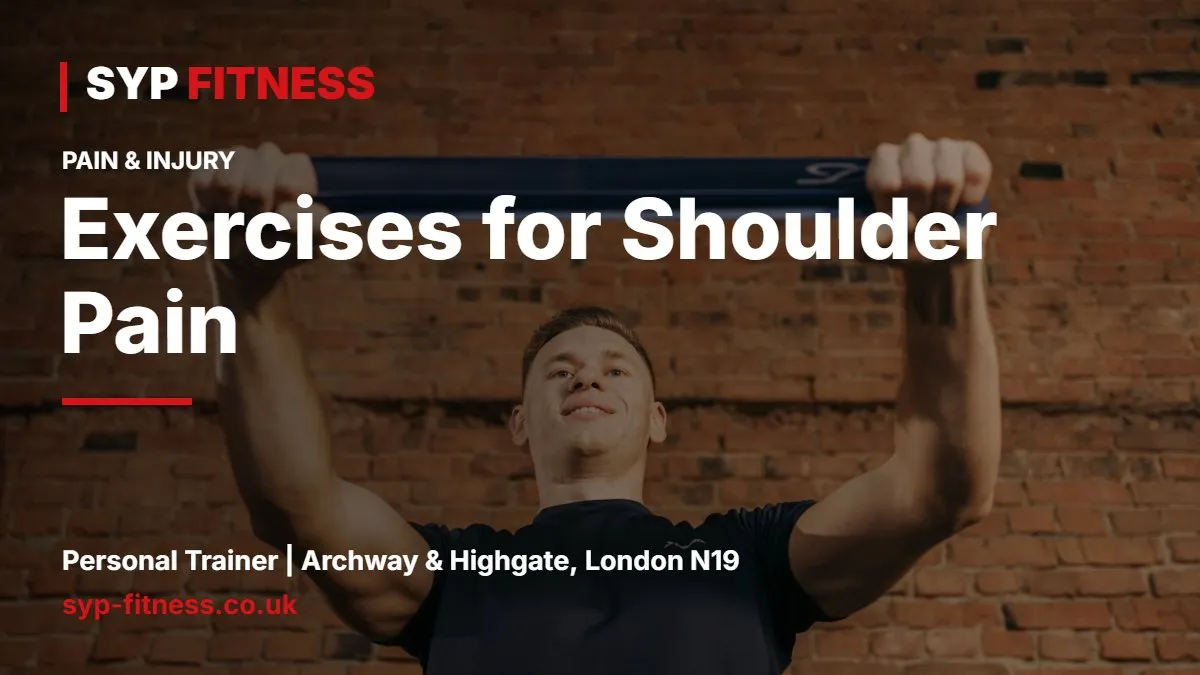
Exercises for Shoulder Pain: 6 Moves for Gym Shoulder Niggles
The right exercises for shoulder pain can make a big difference if your shoulder grumbles during bench press, overhead pressing or even reaching for the top shelf. In my experience most of these gym niggles come from a mix of weak rotator cuff muscles, a stiff upper back and too much pressing compared with pulling.
This guide is for that everyday, low level discomfort in people who train. It is not a treatment plan for an injury. If your pain is sharp, getting worse, keeps you awake or followed a fall or a pop, please see your GP or a physiotherapist before you do anything else.
First: when to see a GP or physio
Book an appointment rather than self managing if you have any of these:
- Pain after a fall, accident or a sudden "pop" or tearing feeling
- You cannot lift your arm, or it feels weak and drops
- Pain at night that wakes you, or pain that is getting steadily worse
- Numbness, tingling or pain travelling down the arm
- Swelling, heat, redness or a change in the shape of the shoulder
- Pain that has not improved after 2 weeks of sensible rest and modification
Sudden chest, jaw or left arm pain with breathlessness is a medical emergency, so call 999. The NHS shoulder pain page is a good, clear reference.
Why gym-goers get shoulder niggles
The shoulder is a ball and socket joint that trades stability for a huge range of movement. A group of four small muscles called the rotator cuff keeps the ball centred in the socket. When those muscles are weak or tired, and the big pressing muscles like the chest and front delts are strong, the joint can start to feel pinchy or achy.
The usual culprits I see:
- Too much pressing, not enough pulling. Bench, push-ups and shoulder press every week, with few rows or rear delt work.
- A stiff upper back. Long days at a desk make it harder for the shoulder blade to move well overhead.
- Load jumps. Adding weight faster than your tendons can adapt.
- Poor setup. Elbows flared wide on the bench, or pressing overhead with a big arch in the lower back.
6 exercises for shoulder pain and niggles
These are low load, controlled moves. They should feel like effort in the muscles, not pain in the joint. A mild ache of 2-3 out of 10 that settles quickly is usually fine. Anything sharp means stop.
1. Side lying or band external rotation
The classic rotator cuff exercise. Elbow tucked to your side at 90 degrees, rotate the forearm out against a light band or a 1-3kg dumbbell. Slow and controlled for 12-15 reps. My full guide to external rotation exercise benefits covers the variations.
2. Face pull
Using a rope on a cable at head height, pull towards your face and rotate your hands back so your fists finish beside your ears. It trains the rear delts, upper back and external rotators together. More on face pull benefits and form.
3. Band pull-apart
Hold a light band at shoulder height with straight arms and pull it apart until it touches your chest. Great as a warm up before any pressing session. See band pull-apart benefits.
4. Wall angel
Stand with your back to a wall and slide your arms up and down like a snow angel, keeping contact where you can. It builds upper back mobility and shoulder blade control. Here is a guide to the wall angel.
5. Scapular push-up
In a push-up or box push-up position, keep your arms straight and let your chest sink between your shoulder blades, then push the floor away. Small movement, big benefit for the serratus muscle that helps the shoulder blade rotate overhead.
6. Isometric holds
If moving hurts, static holds are a gentle starting point. Press the back of your wrist into a door frame (as if rotating out) at about 30-50% effort and hold for 20-30 seconds. Repeat 3-5 times.
A 10-minute shoulder routine
Do this before upper body sessions, or on its own 3 times a week:
- Band pull-apart: 2 x 15
- Wall angel: 2 x 8 slow reps
- Band external rotation: 2 x 12-15 each side
- Scapular push-up: 2 x 10
- Face pull: 2 x 12-15
Use light resistance. The goal is control and blood flow, not fatigue. Over 4-6 weeks you can slowly increase the resistance, but keep the reps smooth.
Want help with this? I work with plenty of clients who come in with cranky shoulders from years of desk work or pressing heavy. I will adapt your programme around it and work alongside any advice from your physio. Book a free consultation and we can look at how you move.
How to keep training with a sore shoulder
Complete rest is rarely needed for a minor niggle, but your training should change for a few weeks:
- Swap barbells for dumbbells or a neutral grip. Palms facing each other is often far more comfortable.
- Reduce range. A floor press or board press limits how deep the shoulder goes.
- Pull more than you push. Aim for roughly two sets of rows or pulldowns for every set of pressing.
- Drop overhead work temporarily if it aggravates things, then reintroduce it with a landmine press.
- Keep training your legs and core. A sore shoulder is no reason to stop everything.
I go into this approach in more detail in training around injury. If you want hands-on support, I offer injury-safe personal training in Archway for people who need their sessions built around a problem area.
Frequently asked questions
What is the best exercise for shoulder pain?
For general gym shoulder niggles, external rotation with a light band or dumbbell is the best single starting point because it strengthens the rotator cuff directly. Pair it with face pulls and band pull-aparts for the upper back. If an exercise causes sharp pain, stop and get the shoulder checked by a GP or physiotherapist.
Should I stop going to the gym with shoulder pain?
Usually not completely. For mild niggles you can keep training your legs, core and pain-free upper body movements while you modify or pause whatever aggravates the shoulder. Stop and see a GP or physio if the pain is severe, followed an injury, causes weakness or numbness, or is not improving after a couple of weeks.
How long does it take to strengthen the rotator cuff?
Most people notice the shoulder feels more stable within 3-4 weeks of doing rotator cuff work two or three times a week. Real strength changes in muscles and tendons take longer, typically 8-12 weeks or more. Consistency matters more than heavy weight, so keep the resistance light and the reps controlled.
Is bench press bad for your shoulders?
Bench press is not bad for most shoulders, but poor setup and too much volume can irritate them. Keep your shoulder blades pulled back, tuck your elbows to roughly 45 degrees and balance pressing with plenty of rows. If the barbell bench still bothers you, dumbbells with a neutral grip are often more comfortable.
Start your transformation
SYP Fitness is a private 1-to-1 personal training studio at 2-4 Navigator Square, Archway, London N19 3UB, 2 minutes from Archway tube. Rated 5.0 from 100+ Google reviews.
Apply for a free consultation · WhatsApp Artem · Call 07301 512215 · See prices


