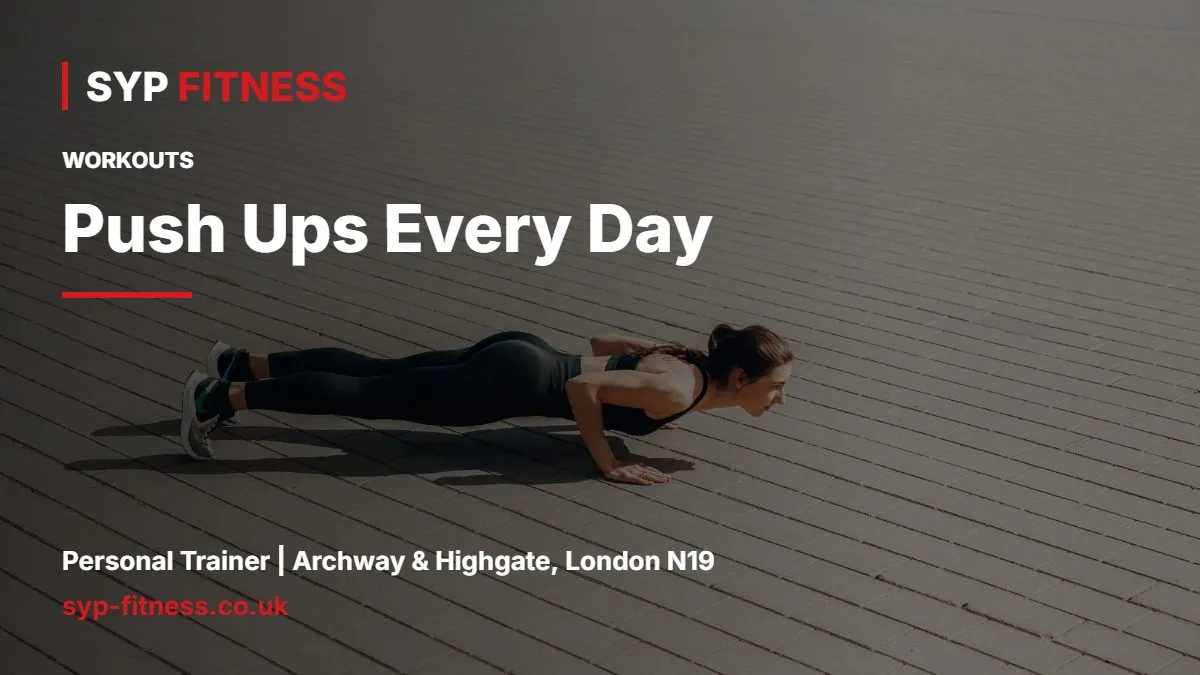
Push Ups Every Day: What Happens and a Better 30-Day Plan
Doing push ups every day is one of the most popular fitness challenges there is, and it is easy to see why: no kit, no gym, five minutes on the bedroom floor. But does it actually work, and is it the best way to use those five minutes?
Below I cover what really happens when you do push-ups daily, the benefits, the risks people do not mention, a smarter weekly approach and a 30-day progression you can start tomorrow. If you need help with the movement itself first, read how to do a push-up properly before you start.
What happens if you do push-ups every day?
For the first couple of weeks, most people see a fast jump in how many reps they can do. A lot of that early progress is your nervous system getting better at the movement, not new muscle. You learn to brace, keep your body straight and push in a better line.
After that, what happens depends on how hard each day is:
- Easy daily sets (well short of failure) build skill and a bit of endurance, and you recover easily.
- Max-effort sets every day usually lead to sore elbows or shoulders, stalled numbers and a challenge that quietly ends in week three.
- Moderate daily volume with built-in easy days can keep you progressing for a month or two, then you need a change.
Muscles grow and get stronger during recovery, not during the set. Doing the same hard session every day, for the same muscles, leaves little room for that.
The real benefits of daily push-ups
- Consistency. The biggest benefit is the habit. A daily anchor can be the thing that gets a busy person training again.
- Better push-up technique. Frequent practice of a skill makes it smoother.
- Upper-body endurance. Your chest, shoulders and triceps get better at doing many reps.
- Core control. A good push-up is a moving plank, so your trunk works every rep.
For a full rundown of what the exercise does for your body, see my post on push-up benefits. This post is about the daily part.
The risks nobody mentions
Overuse aches
The same angle, every day, loads the same tissues in the same way. Elbows, wrists and the front of the shoulder are the usual complaints. If you feel sharp pain or an ache that lingers into the next day, take a few days off.
Muscle imbalance
Push-ups only push. If you do hundreds a week with no pulling, your shoulders get pulled forward over time, which is not ideal for anyone who already spends the day hunched over a laptop. Balance them with rows. An inverted row under a sturdy table is a great home option.
Bad reps
Chasing a number leads to sagging hips, flared elbows and half-range reps. Fifty bad push-ups do less for you than twenty good ones.
If you have a shoulder, elbow or wrist injury, a heart condition or are pregnant, speak to your GP before starting a daily challenge.
A better weekly approach to push ups
If you love the daily habit, keep it, but vary the effort. I use a simple heavy, light, medium idea:
- Hard days (2 per week): 3-5 sets close to failure, or a harder variation such as feet-elevated or slow-tempo push-ups.
- Medium days (2 per week): 3-4 sets stopping 3-4 reps short of failure.
- Easy days (2-3 per week): a couple of easy sets for practice, or an easier variation like incline push-ups.
Even better, include push-ups in two or three full-body sessions a week with squats, rows and hinges. That way you meet the UK recommendation of strength work on at least two days, train your whole body and still get plenty of push-up practice. The full-body bodyweight workout in my home series is a good place to slot them in.
A 30-day push-up progression
First, test yourself. Do as many good push-ups as you can with a straight body and chest close to the floor. If you get fewer than 5, do this plan with your hands on a kitchen worktop or sturdy chair. If you get more than 25, use a slow 3-second lowering on every rep.
Your daily target is based on your test number (call it T).
Week 1
- Days 1-6: 4 sets of half T, resting 60-90 seconds. Day 7: rest.
Week 2
- Days 8, 10, 12: 5 sets of half T plus 1. Days 9 and 11: 2 easy sets of a third of T. Day 13: 3 sets with a 2-second pause at the bottom. Day 14: rest.
Week 3
- Days 15, 17, 19: 5 sets of half T plus 2, or move to a harder variation. Days 16 and 18: easy sets. Day 20: 3 sets of slow 3-second lowering reps. Day 21: rest.
Week 4
- Days 22-26: repeat week 3 but cut every set by 2 reps to let your body freshen up. Days 27-29: rest or easy sets. Day 30: retest.
Most people beat their first test, and many beat it comfortably. Write your numbers down so you can see it. To keep improving after the 30 days, follow the rules in progressive overload explained.
Want help with this? Push-up challenges are a great start, but they only train one pattern. If you want a balanced plan that builds strength across your whole body around a busy schedule, at my private studio or through online coaching, Book a free consultation with me. You can also see how my private personal training in Archway works.
Frequently asked questions
Is it OK to do push-ups every day?
For most healthy people, yes, as long as not every day is a maximum effort. Keep most sets a few reps short of failure, include easy days and at least one full rest day a week. Stop and rest if you get joint pain, and balance push-ups with pulling exercises such as rows.
How many push-ups a day should I do?
There is no magic number. Base it on your current ability: a daily total of two to four times your single-set maximum, split into sets, works for many people. Quality matters more than the total. If your form breaks down, the set is over.
Will 100 push-ups a day build muscle?
It can for beginners, but once 100 becomes easy, it stops being much of a challenge. Muscle grows from hard sets that get harder over time. Use slower reps, pauses, feet-elevated or weighted push-ups, and add other exercises, rather than just repeating the same 100 forever.
Do daily push-ups give you a bigger chest?
They can add some size to the chest, shoulders and triceps, especially if you are new to training and eat enough protein. For noticeable growth you need progressive overload, enough food and recovery. Daily max sets often hurt recovery more than they help, so plan hard and easy days.
Start your transformation
SYP Fitness is a private 1-to-1 personal training studio at 2-4 Navigator Square, Archway, London N19 3UB, 2 minutes from Archway tube. Rated 5.0 from 100+ Google reviews.
Apply for a free consultation · WhatsApp Artem · Call 07301 512215 · See prices


