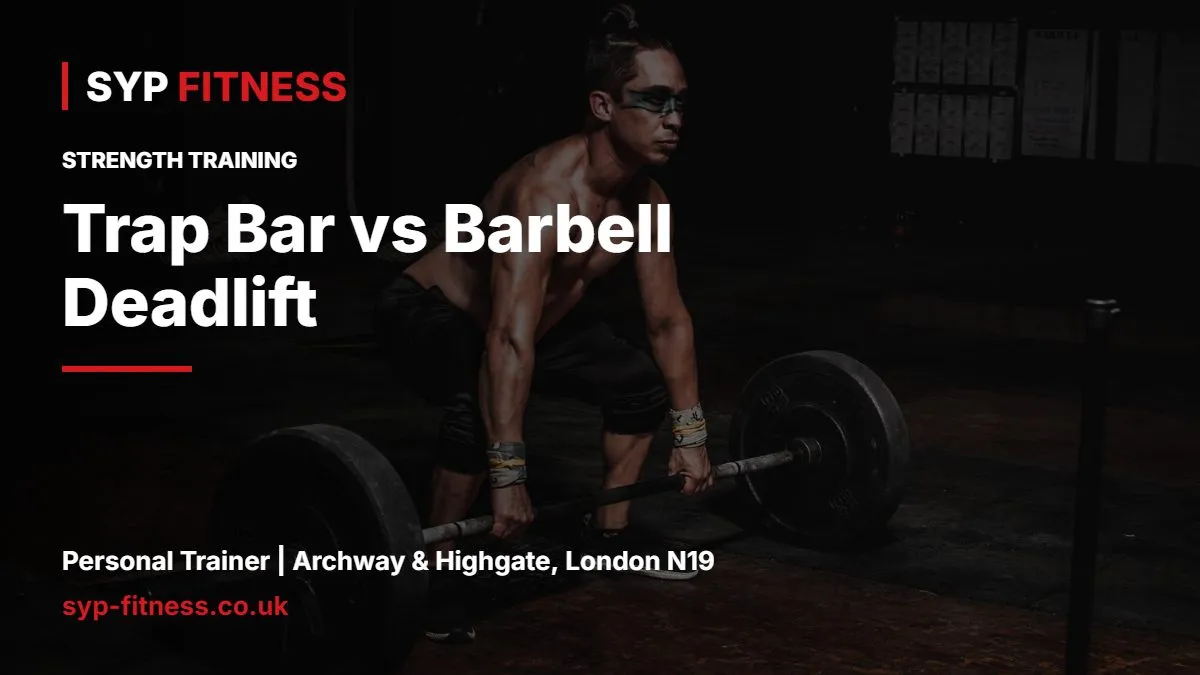
Trap Bar vs Barbell Deadlift: Which Should You Choose?
The trap bar vs barbell deadlift question comes up with almost every new client who wants to lift properly. Both are deadlifts, both pick a heavy weight up off the floor, and both build serious strength. But they load your body differently, they feel different to learn, and one is usually a better starting point than the other.
I have already written separate guides on trap bar deadlift benefits and barbell deadlift benefits. This post puts them side by side so you can decide which belongs in your programme right now.
The key difference: where the weight sits
With a straight barbell, the bar sits in front of your shins. To keep it close and balanced, you have to push your hips back and lean your chest forward more. With a trap bar (also called a hex bar), you stand inside the frame and the weight sits at your sides, in line with your centre of mass.
That one change affects almost everything else:
- Torso angle: the trap bar lets you stay more upright.
- Knee bend: the trap bar lets you bend the knees more, so it moves a little towards a squat.
- Bar path: with a trap bar, the handles go straight up and down beside you. With a barbell, the bar has to travel around your knees.
- Grip: trap bar handles use a neutral grip, palms facing in, which most people find more comfortable on the shoulders and wrists.
Muscles worked: trap bar vs barbell
Both lifts work the whole back of the body plus the legs, grip and trunk. The difference is emphasis, not a completely different set of muscles.
Barbell deadlift
- More work for the hamstrings and glutes because of the bigger hip hinge.
- More demand on the lower and upper back to hold position as the torso is more horizontal.
- Great for building a strong hinge pattern you will use in everything from Romanian deadlifts to picking up shopping.
Trap bar deadlift
- More work for the quads, because the knees bend further.
- Still plenty of glute and hamstring work, just spread a bit more evenly with the legs.
- Most people can lift a bit more weight on a trap bar, because the leverage is kinder.
If your main goal is bigger hamstrings and a stronger posterior chain, the barbell edges it. If you want an all-round lower body lift that is easy to load heavy, the trap bar is excellent.
Back stress and safety
This is the part most people care about, especially if they have had back pain or sit at a desk all day.
Because the trap bar keeps you more upright and the weight sits closer to your centre, the load on the lower back is generally less than in a conventional barbell deadlift at the same weight. That does not make the barbell dangerous. With good technique and sensible loading, it is a safe and very effective lift. It just asks more of your back and your technique.
A few honest points from coaching:
- Most deadlift problems come from load creeping up faster than skill, not from the bar itself.
- Rounding through the lower back under heavy weight is the main thing to avoid with either bar.
- If you have current back pain, a disc problem or a recent injury, get it checked by your GP or physio before deadlifting at all. My page on exercises for lower back pain is a better place to start in that case.
Learning curve: which is easier for beginners?
For most beginners, the trap bar is easier to learn. You step in, grip the handles, push the floor away and stand up. There is less to think about with bar path and less chance of the bar drifting away from you.
The barbell deadlift takes more coaching. You have to learn to hinge at the hips, keep the bar dragging up the legs, set your upper back and lock out without leaning back. None of that is hard with practice, but it does take practice. My deadlift technique guide breaks it down step by step.
Practical issues worth knowing
- Not every gym has a trap bar, while every gym has barbells.
- Many trap bars have high and low handles. The high handles shorten the range and are useful for taller people or anyone still building mobility.
- Barbell deadlifts are the standard in powerlifting. If you ever want to compete, you will need to learn them.
Which should you choose?
Choose the trap bar if
- You are new to lifting and want a heavy lift you can learn quickly.
- You have a history of lower back niggles (once cleared by a professional).
- You play sport or want strength that carries over to jumping and sprinting.
- You are over 40 and want strength with less technical risk.
Choose the barbell deadlift if
- You want to build the hip hinge and hamstrings as a priority.
- You are interested in powerlifting or testing a classic one-rep max.
- Your gym does not have a trap bar.
Or use both
Plenty of my clients do both. A common setup is trap bar deadlifts as the main heavy lift for a block of 8-12 weeks, with lighter barbell Romanian deadlifts as an accessory to keep the hinge sharp. Later, we might swap them over.
A simple way to programme each lift
Deadlifts are tiring, so you do not need many sets. Once or twice a week is enough for most people. Always warm up first, as I explain in how to warm up before lifting.
- Beginner (either bar): 3 sets of 5-6 reps, leaving 2-3 reps in the tank. Add 2.5-5kg a week while form stays clean.
- Intermediate trap bar: 4 sets of 4-6 reps heavy, then 2 sets of 8 lighter.
- Intermediate barbell: 3-4 sets of 3-5 reps, with each rep reset on the floor.
Fit them into a sensible weekly plan, like the ones in my strength training for beginners guide, rather than adding them on top of everything else.
Want help with this? I coach both deadlift variations every week at my studio, mostly with busy professionals over 30 who want to get strong without hurting their back. If you want someone to check your setup and build a plan around your body, Book a free consultation or read more about injury-safe personal training in Archway.
Frequently asked questions
Is the trap bar deadlift easier than a barbell deadlift?
For most people, yes. The handles sit at your sides, so you can stay more upright and the bar path is simple. Most lifters can also handle a bit more weight on a trap bar thanks to better leverage. That does not make it an easy lift, it just has a gentler learning curve than the conventional barbell deadlift.
Is a trap bar deadlift a squat or a deadlift?
It sits somewhere in between. You still pick the weight up from the floor and hinge at the hips, so it is a deadlift. But the knees bend more than in a barbell deadlift, so the quads do more work. Many coaches call it a hybrid lift, which is part of why it is such a useful all-round exercise.
Is the trap bar deadlift safer for your back?
It generally puts less stress on the lower back than a conventional barbell deadlift at the same weight, because you stay more upright and the load is closer to your centre. Technique still matters, and either lift can cause problems if the weight goes up too fast. Speak to your GP or physio first if you have back pain.
Can I replace barbell deadlifts with trap bar deadlifts?
Yes, for most goals. If you want general strength, muscle and better fitness, the trap bar does the job very well. The exception is powerlifting, where the barbell deadlift is the competition lift. If you swap, keep some hinge work such as Romanian deadlifts so your hamstrings and hip hinge still get trained.
Start your transformation
SYP Fitness is a private 1-to-1 personal training studio at 2-4 Navigator Square, Archway, London N19 3UB, 2 minutes from Archway tube. Rated 5.0 from 100+ Google reviews.
Apply for a free consultation · WhatsApp Artem · Call 07301 512215 · See prices


