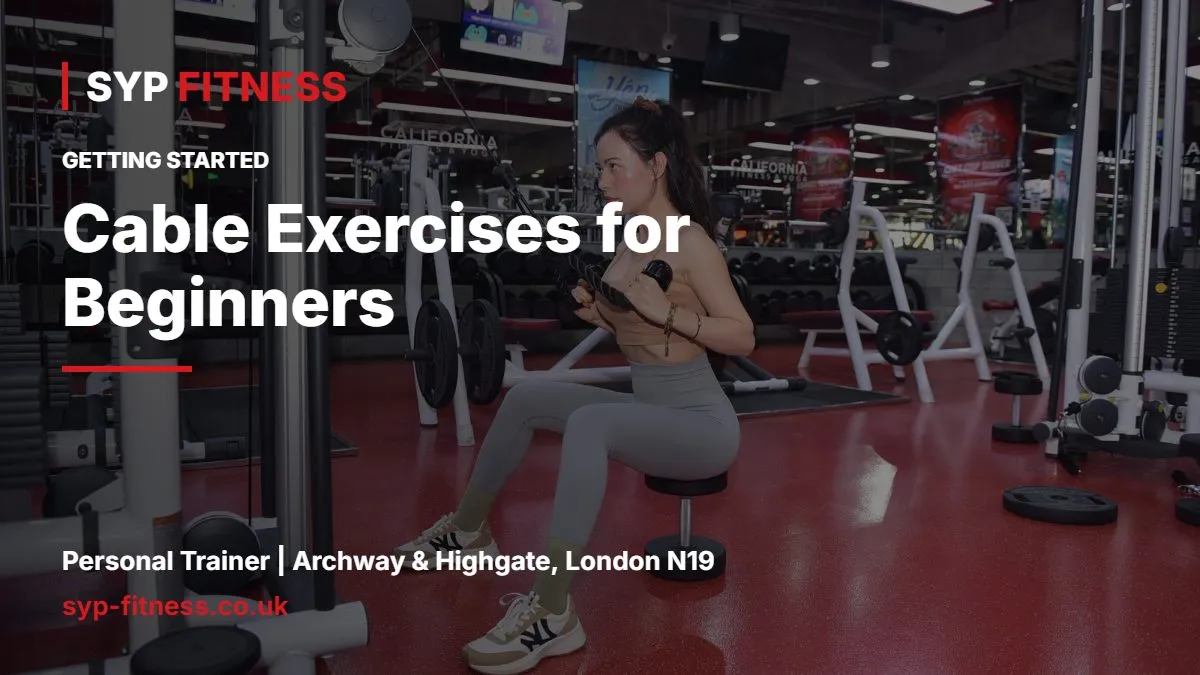
Cable Exercises for Beginners: 8 Moves and a Full Workout
Cable exercises for beginners are one of the easiest ways to start strength training in a gym, yet the cable machine is often the piece of kit new members avoid because it looks confusing. Pulleys, pins, handles and ropes everywhere. Once you understand how it works, though, it becomes one of the most useful and joint-friendly tools in the building.
In this guide I explain how the cable machine works, give you 8 beginner cable exercises with simple cues, and finish with a full-body cable session you can do on your next gym visit.
How the cable machine works
A cable machine is a weight stack attached to a steel cable that runs through one or more pulleys. You clip a handle to the end of the cable and pull. Most gyms have a "cable crossover" or "functional trainer" with two adjustable pulleys, plus a fixed seated row and lat pulldown station.
The three settings to know
- Pulley height: slide the pulley up or down the column. High for pulldowns and face pulls, middle for rows and rotations, low for pull-throughs and curls.
- Weight: move the pin in the stack. Start lighter than you think. Numbers on cable stacks vary between machines, so a "20" on one may feel very different on another.
- Attachment: single D-handle, rope, straight bar or ankle strap. Each changes your grip and the feel of the exercise.
Why cables suit beginners
Unlike free weights, cables keep tension on the muscle through the whole movement. The path is smooth, it is easy to adjust the load in small jumps, and there is no heavy weight to drop. You still have to control your body, so you build stability as well as strength. If machines in general feel daunting, start with my overview of gym machines for beginners.
8 cable exercises for beginners
1. Seated cable row
Sit tall, feet on the platform, knees soft. Pull the handle to your lower ribs, squeezing your shoulder blades together, then let your arms straighten slowly. 3 x 10-12. A great back builder and a staple for desk workers. Technique tips in my seated cable row guide.
2. Lat pulldown
Grip the bar a little wider than shoulder width, lean back slightly and pull the bar to your upper chest, leading with your elbows. Control it back up. 3 x 10-12. It builds the lats and prepares you for pull-ups.
3. Cable pull-through
Set the pulley low with a rope. Face away from the machine, rope between your legs. Push your hips back, then drive them forward to stand tall and squeeze your glutes. 3 x 12-15. One of the best ways to learn the hip hinge without loading your spine. More in my cable pull-through benefits post.
4. Cable goblet squat
Set the pulley low, hold the handle at your chest and step back so there is light tension. Squat down between your legs and stand up. The cable gives you a little counterbalance, which helps beginners sit back and stay upright. 3 x 10.
5. Cable chest press
Set both pulleys at chest height, take a handle in each hand and stand in a split stance in the middle. Press the handles forward until your arms are straight, then return with control. 3 x 10-12. Easier on the shoulders than the bench press for many beginners.
6. Face pull
Set a rope at upper chest to head height. Pull the rope towards your face, splitting the ends and turning your thumbs back. 3 x 15. Brilliant for shoulder health and posture.
7. Pallof press
Stand side-on to a pulley set at chest height. Hold the handle at your chest and press it straight out, resisting the pull that tries to twist you. Hold 2 seconds, return. 3 x 8 per side. A core exercise that trains you not to rotate, explained further in my Pallof press guide.
8. Cable woodchop
Set the pulley high. Stand side-on, hold the handle with both hands and pull it diagonally down across your body to the opposite hip, rotating through your hips and upper back. 3 x 10 per side. Keep it smooth rather than heavy. See my cable woodchop post for the reverse low-to-high version.
A full-body cable workout for beginners
This session uses only the cable station, so you can stay in one spot. It takes around 40-45 minutes including a short warm-up. Rest 60-90 seconds between sets.
- Cable goblet squat: 3 x 10
- Seated cable row: 3 x 12
- Cable pull-through: 3 x 12
- Cable chest press: 3 x 10
- Face pull: 2 x 15
- Pallof press: 2 x 8 per side
Do this twice a week on non-consecutive days, for example Monday and Thursday. When you can do every set with good form at the top of the rep range, increase the weight by the smallest step on the stack. Swap the woodchop in for the Pallof press every other session for variety. Along with walking or other cardio, this fits UK guidance of strength work on at least 2 days a week.
If you want a programme that mixes cables with dumbbells and barbells, my beginner gym workout plan is the next step.
Want help with this? A lot of beginners tell me the hardest part of the gym is not the training, it is knowing how to set up the equipment without feeling watched. At SYP Fitness I coach 1-to-1 in a private studio, so you can learn every exercise properly in a calm space. Book a free consultation and we will plan your first few weeks together.
Beginner mistakes on the cable machine
- Too much weight. If you have to lean, jerk or swing, drop the pin.
- Letting the weight slam. Control the return. The lowering half builds strength too.
- Standing too close. Step out so there is tension at the start of each rep.
- Forgetting your core. Brace lightly on every standing exercise so your trunk stays still.
If you would rather learn in private before using a busy gym, I offer private personal training in Archway for exactly this.
Frequently asked questions
Are cable machines good for beginners?
Yes. Cable machines are very good for beginners because the movement is smooth, the weight is easy to adjust in small steps and there is no bar to balance or drop. They also keep tension on the muscle through the whole range. You still need to control your body, which helps you build stability as you get stronger.
Can you build muscle with only cables?
You can build a good amount of muscle with cables, especially as a beginner, as long as you train close to effort and gradually increase the weight. Over time most people benefit from adding free weights like squats and deadlifts for heavier loading, but cables can be the main tool for your first months.
How much weight should I use on cable exercises?
Pick a weight you can lift for the target reps with good form and 2-3 reps left in the tank. Because cable stacks vary between machines and pulley set-ups, ignore the number and focus on how it feels. If your form breaks down or you need to swing, it is too heavy.
Are cable exercises better than free weights?
Neither is better overall, they do different jobs. Cables give constant tension and are kinder on the joints, which makes them great for learning and for accessory work. Free weights allow heavier loading and train balance. A good beginner programme usually uses both.
Start your transformation
SYP Fitness is a private 1-to-1 personal training studio at 2-4 Navigator Square, Archway, London N19 3UB, 2 minutes from Archway tube. Rated 5.0 from 100+ Google reviews.
Apply for a free consultation · WhatsApp Artem · Call 07301 512215 · See prices


