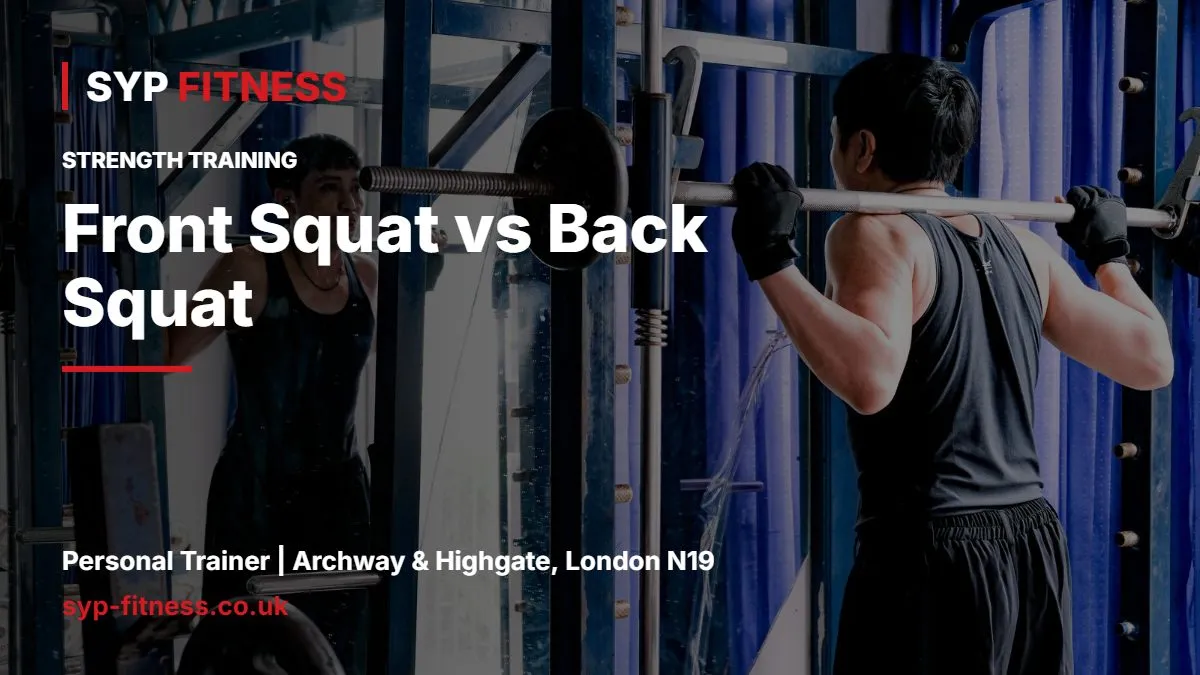
Front Squat vs Back Squat: Differences and Which to Pick
The front squat vs back squat debate is mostly about where the bar sits and what that does to your body. Put the bar on your upper back and you can lift more weight with a slight forward lean. Put it on the front of your shoulders and you are forced to stay tall, which shifts the work towards the front of your legs and your upper back.
Neither is better in every case. I have covered each lift on its own in front squat benefits and back squat benefits. This post compares them directly so you know which to prioritise.
Front squat vs back squat: the basic difference
- Back squat: the bar rests across your upper back (traps or slightly lower). You lean forward a little, sit the hips back and down, and stand up.
- Front squat: the bar sits on the front of your shoulders, close to your throat, held with either a clean grip (fingers under the bar) or crossed arms. You must stay very upright or the bar rolls forward.
Because the load is in front of you, the front squat is self-correcting. If you lean too far, you drop the bar. The back squat is more forgiving of a forward lean, which is one reason people can load it heavier.
What do front squats work compared to back squats?
Both lifts train the quads, glutes, adductors (inner thighs) and trunk. The difference is in the balance.
Front squat emphasis
- Quads: the upright torso and forward knee travel make the front of the thigh do more.
- Upper back: you need a strong upper back to keep the elbows up and stop the chest folding.
- Trunk: holding a load in front of you asks a lot of your abs, similar to a heavy goblet squat.
Back squat emphasis
- Glutes and hamstrings: the slight hip hinge brings more of the back of the body in.
- Overall load: most people back squat noticeably more weight than they front squat, so it is the better lift for total leg strength.
- Lower back: works harder to hold position because of the lean.
Mobility you need for each
This is often the deciding factor for beginners, because many people simply cannot get into one position comfortably yet.
Front squat mobility
- Wrists and lats: the clean grip needs the elbows high, which requires wrist and lat flexibility. Crossed arms or lifting straps on the bar are fine workarounds.
- Ankles: staying upright means the knees travel forward, so stiff ankles show up fast. Ankle mobility drills help here.
- Thoracic spine: you need to keep the upper back extended.
Back squat mobility
- Shoulders: you need enough shoulder rotation to get your hands on the bar behind you without pain. A wider grip helps.
- Hips and ankles: still important for depth, but slightly less demanding at the ankle than the front squat.
If either position is painful rather than just stiff, stop and get it looked at. A few weeks of the drills in mobility for lifters usually makes a big difference.
Back and knee stress
Lower back
Because you stay upright and the weights are lighter, the front squat generally puts less load through the lower back. That makes it a useful option for people who find heavy back squats aggravate their back, once a professional has cleared them to train.
Knees
The front squat moves the knees further forward and works the quads harder. That is not bad for healthy knees, and it is how knees get stronger. But if you have a current knee problem, the extra forward travel can feel more irritating at first. The back squat, with a slightly more hip-dominant pattern, can feel friendlier for some knees. Everyone is different, so let comfort and a professional's advice guide you. For general knee work, see my knee strengthening exercises.
Which should you pick?
Pick the back squat if
- You want to build maximum overall leg strength.
- Your goal includes bigger glutes as well as quads.
- You are interested in powerlifting, where the back squat is the competition lift.
Pick the front squat if
- You want more quad development with lighter loads.
- Heavy back squats bother your lower back.
- You want better posture under load and a stronger upper back.
- You do Olympic lifting or sport where the front rack position matters.
If you are a complete beginner
Neither barbell lift has to be first. I usually start people with goblet squats, then move to the back squat once the pattern is solid. Front squats come in later as a variation. My guide on how to squat properly covers that first stage, and barbell back squat technique covers the next one.
Using both in one programme
You do not have to choose forever. A sensible approach for an intermediate lifter:
- Day 1: back squat, 4 sets of 4-6 reps, heavy.
- Day 2: front squat, 3 sets of 6-8 reps, moderate, focus on staying tall.
Or run one as the main lift for 8-12 weeks, then swap. The front squat often helps the back squat by strengthening the upper back and teaching you to stay upright out of the bottom.
Want help with this? Squat technique is one of the things I spend the most time on with new clients at the studio, and most people move better within a few sessions once the position is right for their body. If you want your squat checked and a plan built around your goals, Book a free consultation. You can also read about personal training in North London with SYP.
Frequently asked questions
Is the front squat harder than the back squat?
Most people find the front squat harder at the same weight, because the load sits in front of you and the upper back and trunk have to work hard to keep you upright. That is why front squat numbers are usually lower. Technically, the front squat is also less forgiving, since leaning too far forward simply makes you drop the bar.
Do front squats build bigger legs?
Front squats are excellent for the quads, the muscles on the front of the thigh. For overall leg size, including the glutes, the back squat usually lets you move more weight and train more muscle. The best results often come from using both, or using whichever you can train consistently and progress over time.
Are front squats better for your back?
They generally put less stress on the lower back, because you stay upright and use lighter weights. That makes them a good choice for people whose backs feel heavy back squats. They still load the spine, so technique and sensible progression matter. If you have back pain or an injury, ask your GP or physio before training.
Should beginners do front squats or back squats?
Most beginners do best starting with goblet squats, then moving to the back squat once the pattern is consistent. The back squat is easier to set up and lets you progress steadily. Front squats need more wrist, ankle and upper back mobility, so they usually work better as a variation a few months in.
Start your transformation
SYP Fitness is a private 1-to-1 personal training studio at 2-4 Navigator Square, Archway, London N19 3UB, 2 minutes from Archway tube. Rated 5.0 from 100+ Google reviews.
Apply for a free consultation · WhatsApp Artem · Call 07301 512215 · See prices


