Glute Workout at Home No Equipment: 5 Moves, Made Harder
A proper glute workout at home with no equipment can absolutely build stronger, firmer glutes, but only if it gets harder over time. Most bodyweight glute routines online are 100 reps of the same easy bridge, which feels like a burn but stops working within a few weeks.
This post gives you one structured session built on four movement patterns: bridges, single leg bridges, split squats and hip hinges. Then it shows you exactly how to make each one harder without buying a single weight.
What your glutes actually need
Your glutes are the biggest muscles in your body. They extend your hip (driving you up from a squat or a bridge), move your leg out to the side and keep your pelvis level when you stand on one leg. A complete glute workout trains all three jobs.
To grow or get stronger, a muscle needs enough challenge that the last few reps of a set are genuinely hard. With weights you add kilos. At home you add difficulty in other ways: one leg instead of two, slower reps, pauses, longer range and more total sets. That idea is called progressive overload, and it is the reason this plan works.
The bodyweight glute workout
Warm up for 3-4 minutes with marching on the spot, 10 bodyweight squats and 10 slow bridges. Then do the session below 2-3 times a week, with at least a day between sessions.
1. Glute bridge with a 3 second hold, 3 sets of 12-15
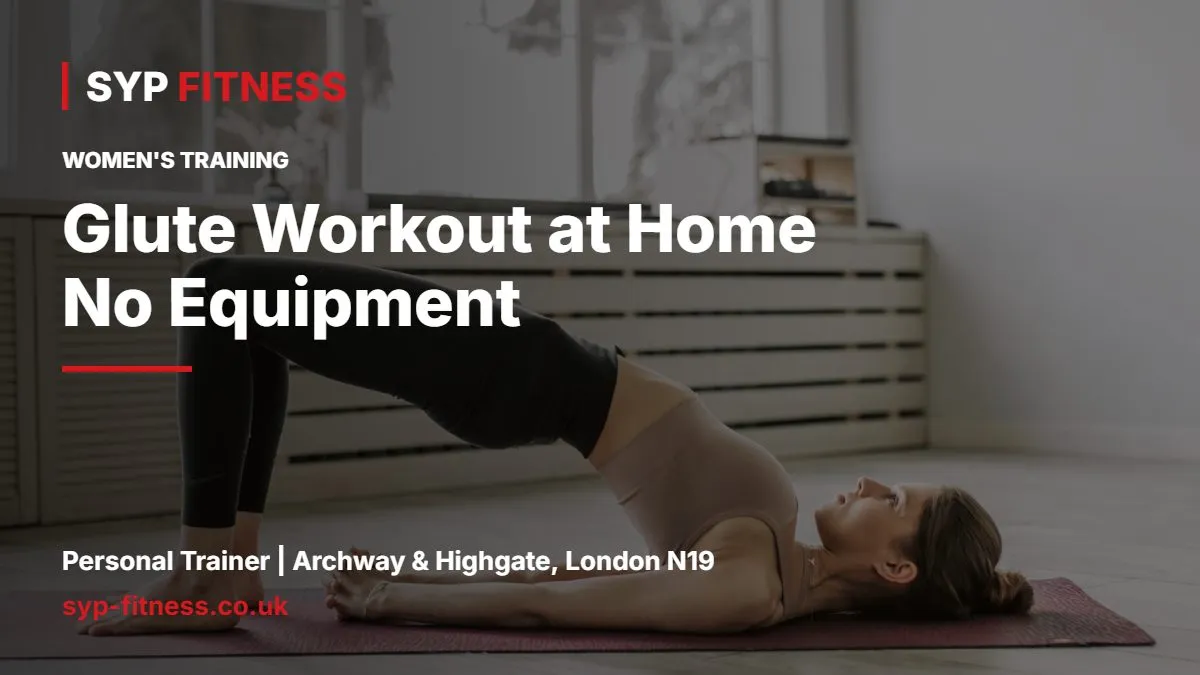
Lie on your back, feet flat and hip-width apart, heels about a hand's length from your bum. Push through your heels, squeeze your glutes and lift until your body is in a straight line from knees to shoulders. Hold for 3 seconds at the top, lower slowly. If you feel it mostly in your hamstrings, bring your feet a little closer. My glute bridge exercise guide covers foot position in detail.
2. Single leg glute bridge, 3 sets of 8-12 each side
Same set-up, but lift one foot off the floor and hug that knee towards your chest. This doubles the load on the working glute and makes your hips work to stay level. Keep the hips from dropping on the side of the lifted leg. See the single leg bridge post for progressions.
3. Rear-foot elevated split squat, 3 sets of 8-12 each side
Put your back foot on a sofa or a low chair, front foot a big step forward. Lean your chest slightly forward and lower until your back knee is a few centimetres above the floor. A slight forward lean and a longer stride shift the work from your thighs to your glutes. If balance is hard, start with a normal split squat with both feet on the floor.
4. Single leg hip hinge, 3 sets of 8-10 each side
Stand on one leg with a soft knee. Push your hips back and tip your chest forward, letting the free leg float behind you, until you feel a strong stretch in the back of your standing leg. Squeeze the glute to stand tall. Hold a wall or a chair for balance at first. If the movement feels unfamiliar, learn the basic hip hinge exercise on two legs first.
5. Side-lying leg raise, 2 sets of 15-20 each side
Lie on your side, bottom knee bent, top leg straight and slightly behind your body with toes pointing forward. Lift the top leg slowly and lower it over 3 seconds. This trains the side of the glute that stabilises your pelvis when you walk and run.
Rest 60-90 seconds between sets. The whole session takes about 30 minutes.
How to make a no equipment glute workout harder
Once you can hit the top of every rep range with good form, use one of these methods to keep progressing. Change one thing at a time.
- Go from two legs to one. The single leg bridge and the split squat already do this. It is the biggest jump in difficulty you can make at home.
- Slow the lowering. Take 4 seconds to lower on every rep. Time under tension goes up and the same rep count becomes much harder.
- Add pauses. Pause for 2 seconds at the bottom of each split squat, where it is hardest, or 5 seconds at the top of each bridge.
- Increase range. Raise your shoulders onto the sofa for a hip thrust, or put your front foot on a step for a deeper split squat.
- Use 1.5 reps. On the split squat, go all the way down, come halfway up, go back down, then stand. That counts as one rep.
- Add a set. Going from 3 to 4 sets is a simple way to add more work once the reps feel easy.
A 4 week progression plan
- Week 1: the session as written, at the lower end of each rep range.
- Week 2: same exercises, aim for the top of each rep range.
- Week 3: add a 4 second lowering to the split squat and single leg bridge.
- Week 4: swap the double leg bridge for a sofa hip thrust and add a fourth set of split squats.
Keep a note on your phone of reps and the version you did. If you are not writing it down, you will not know whether you are progressing.
Want help with this? Glute training at home works best when someone checks your form and tells you when to progress. I coach women of all ages at my private studio, with a plan that fits around work and family, and you can see how on the personal training for women in Archway page. Book a free consultation and I will show you which version of each move suits you.
Why you might not be seeing glute results
If you have been doing glute workouts at home for a while with little change, it is usually one of three things:
- Not enough challenge. If you can do 30 bridges and still chat, it is too easy. Move to a harder version.
- Not enough food, especially protein. Muscle needs building material. Very low calorie diets make it hard to build shape anywhere.
- Not enough time. Visible change in muscle shape takes months, not weeks. Strength improves first, so track that.
For the bigger picture on shape, food and training split, read my guide on how to grow glutes.
Frequently asked questions
Can you grow glutes without weights?
Yes, especially if you are new to training. Single leg exercises, slow lowering, pauses and extra sets can make bodyweight moves hard enough to build muscle. The key is to keep making the session harder as you get stronger. More experienced lifters may eventually need added weight, but most people have plenty of room to progress at home first.
How many times a week should I do a glute workout at home?
Two to three sessions a week is a good target for most people, with at least one rest day between them. Your glutes need time to recover and adapt. Doing the same workout every day usually means it is too easy to cause change, or you are too tired to push the last reps properly.
Why do I feel glute bridges in my hamstrings?
This is very common. It usually means your feet are too far from your hips, or you are pushing through your toes. Move your heels closer, push through the whole foot with the weight in the heels, and tuck your pelvis slightly before you lift. Squeeze your glutes hard at the top rather than arching your lower back.
How long does it take to see results from glute workouts?
Most people notice they are stronger within 3-4 weeks. Visible changes in shape usually take 2-3 months of consistent training with enough protein and good sleep. Results vary from person to person. Measuring your reps, taking photos every 4 weeks and noting how clothes fit gives you a better picture than the mirror alone.
Start your transformation
SYP Fitness is a private 1-to-1 personal training studio at 2-4 Navigator Square, Archway, London N19 3UB, 2 minutes from Archway tube. Rated 5.0 from 100+ Google reviews.
Apply for a free consultation · WhatsApp Artem · Call 07301 512215 · See prices


