Home Workout for Beginners: Level 1 Bodyweight Plan
SYP Home Workouts: Level 1 of 10. All 10 levels | Level 2 >
This home workout for beginners is where I start anyone who has never trained, is coming back after years off, or simply feels stiff and out of shape. It uses a chair, a wall and the floor. Nothing else.
Level 1 builds the foundations everything else sits on: getting up and down with control, pushing, using your glutes, and keeping your trunk steady while your arms and legs move. A session takes about 15-20 minutes, so it fits into a lunch break or before the school run.
It is the first step of a 10-level bodyweight ladder you can do at home with no equipment. Each level has a clear test, and when you pass it you move up. No guessing, no random workouts.
Is Level 1 right for you?
Start here if most of these sound like you:
- You have not done any regular exercise for a year or more, or never have.
- Getting out of a low chair without using your hands feels hard.
- A few minutes of brisk walking leaves you puffed out.
- You are older, carrying extra weight, or rebuilding confidence after a long break.
- You can stand up and sit down from a chair, get down to the floor and back up (using furniture is fine), and walk for 5 minutes.
If getting to the floor is not possible yet, do the standing exercises only and do the bridge, bird dog and dead bug on a firm bed until the floor feels manageable. If you are carrying a lot of weight and worried about starting, read my guide on starting exercise when overweight first.
Safety: anyone with a heart condition, high blood pressure, recent surgery, pregnancy, or joint pain should check with their GP first. Stop if you feel chest pain, dizziness or sharp joint pain.
What you need
A space about the size of a yoga mat, a sturdy chair without wheels (pushed against a wall so it cannot slide), a clear bit of wall, and a mat, rug or folded towel for the floor work. Wear trainers or go barefoot on a non-slip surface.
Warm-up (5 minutes)
Do each move for 40 seconds, one after the other, at an easy pace.
- March on the spot
- Arm circles
- Sit-to-stand or squat to a chair
- Hip hinges with hands on hips
- Wall push-ups
- Slow reverse lunges holding a wall
The Level 1 workout: home workout for beginners
Do 2 rounds of the circuit below. Rest 45-60 seconds between exercises and 60-90 seconds between rounds. The whole thing takes about 15-20 minutes including the warm-up. Train 3 times a week on non-consecutive days, for example Monday, Wednesday and Friday, and stay on this level for 2-4 weeks.
- Sit-to-stand from a chair: 8-10 reps
- Wall push-up: 8-10 reps
- Glute bridge: 10 reps
- Bird dog: 5 each side
- Dead bug (bent knees): 5 each side
- Marching on the spot: 30 seconds
Aim for about 6 out of 10 effort. You should finish each set feeling you could have done a few more reps.
Exercise demonstrations
Each animation shows one rep. Watch it a couple of times before you start, then use the cues below.
1. Sit-to-stand from a chair
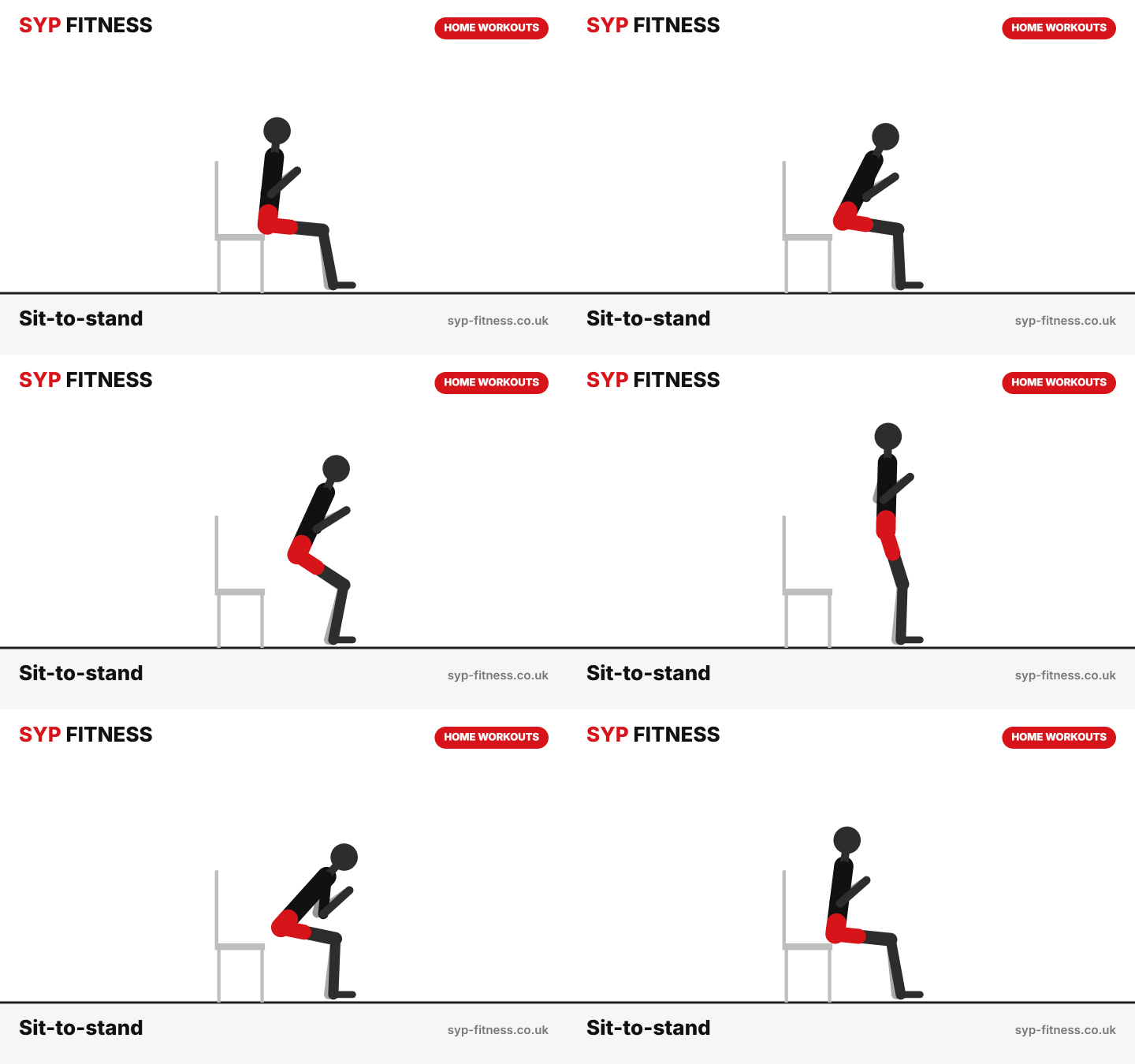
How to do it: Sit near the front of the chair with your feet flat and hip-width apart, slightly behind your knees. Lean your chest forward, push through your whole foot and stand tall, squeezing your glutes at the top. Breathe out as you stand, then sit back down slowly, reaching your hips back as if the chair is further away than it is.
Coach's tip: Do not flop into the seat. Take a slow count of three on the way down and just touch the chair before standing again.
Easier: Use your hands on your thighs, or sit on a cushion to raise the seat. Harder: Cross your arms over your chest and pause for one second just above the seat.
More detail: sit-to-stand benefits and technique
2. Wall push-up
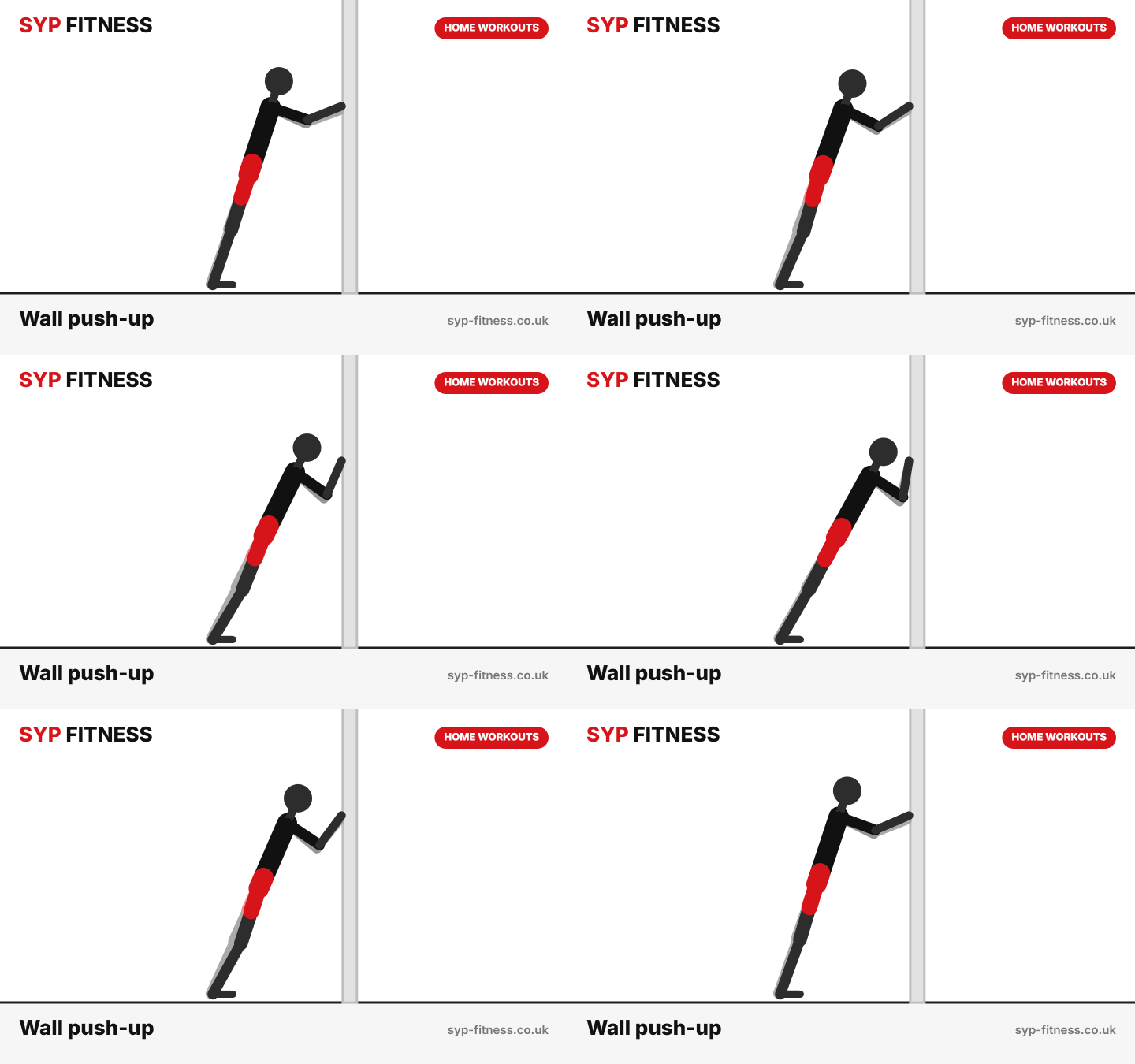
How to do it: Stand an arm's length from the wall and place your hands on it at chest height, a little wider than your shoulders. Keep your body in one straight line from head to heels and bend your elbows to bring your chest towards the wall. Breathe in on the way in, then press the wall away as you breathe out.
Coach's tip: Keep your elbows at roughly 45 degrees to your body, not flared out to the sides like a T. Your shoulders will thank you.
Easier: Step your feet closer to the wall. Harder: Step your feet further back, or take three seconds to lower.
3. Glute bridge
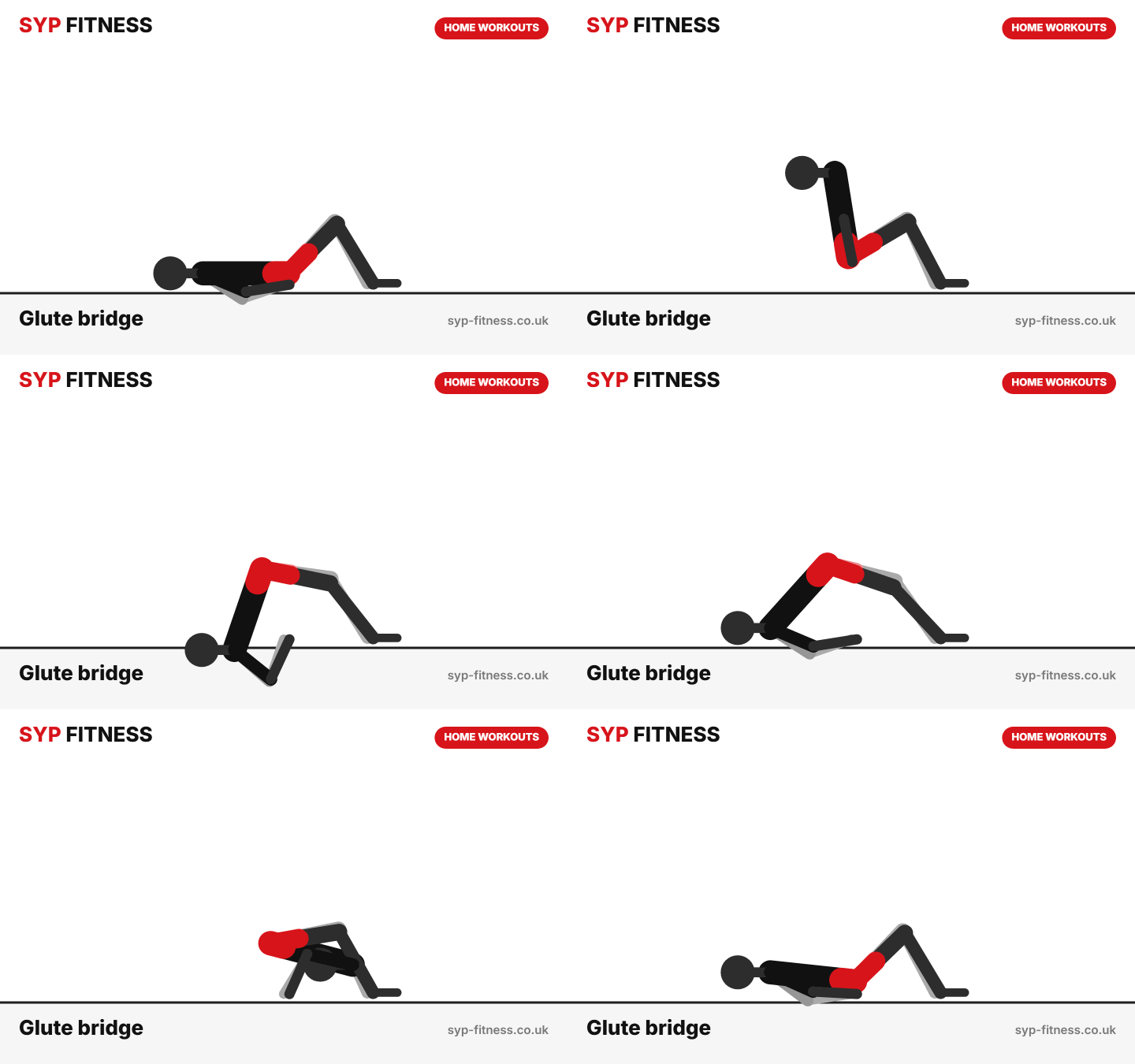
How to do it: Lie on your back with your knees bent, feet flat and hip-width apart, arms by your sides. Breathe out, press through your heels and lift your hips until your body makes a straight line from shoulders to knees. Pause, then lower slowly as you breathe in.
Coach's tip: Squeeze your glutes before you lift, and stop when your hips are level with your knees. Arching higher only puts pressure on your lower back.
Easier: Make the lift smaller and build up the range. Harder: Hold the top for 3 seconds on every rep.
More detail: glute bridge benefits and technique
4. Bird dog
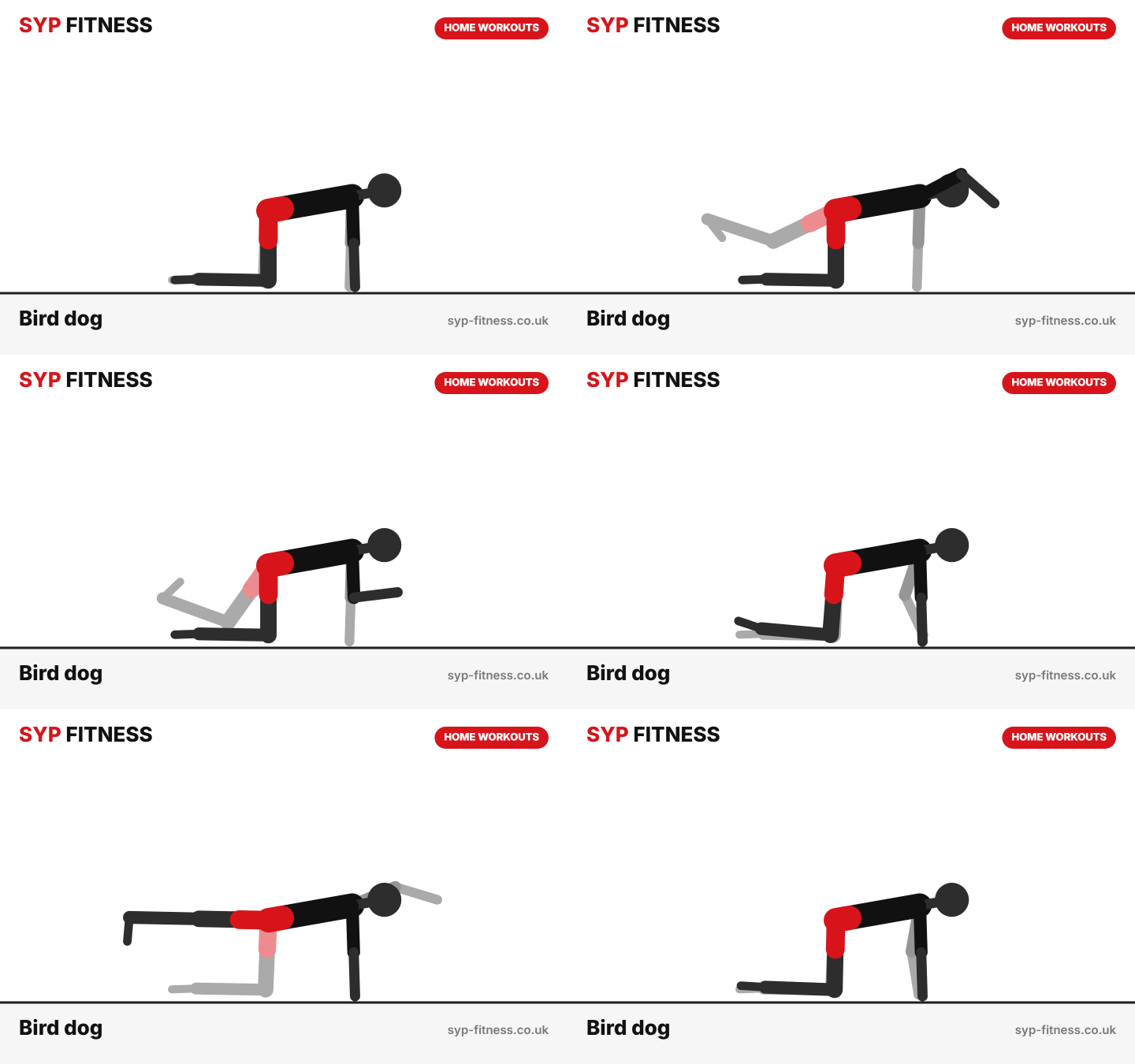
How to do it: Start on hands and knees, hands under shoulders and knees under hips. Slowly reach one arm forward and the opposite leg back until both are level with your body. Hold for a breath, return under control, then switch sides.
Coach's tip: Imagine a cup of tea balanced on your lower back. If it would spill, you are reaching too far or moving too fast.
Easier: Move only the leg, or only the arm. Harder: Hold each rep for 3 seconds at full reach.
More detail: bird dog benefits and technique
5. Dead bug (bent knees)
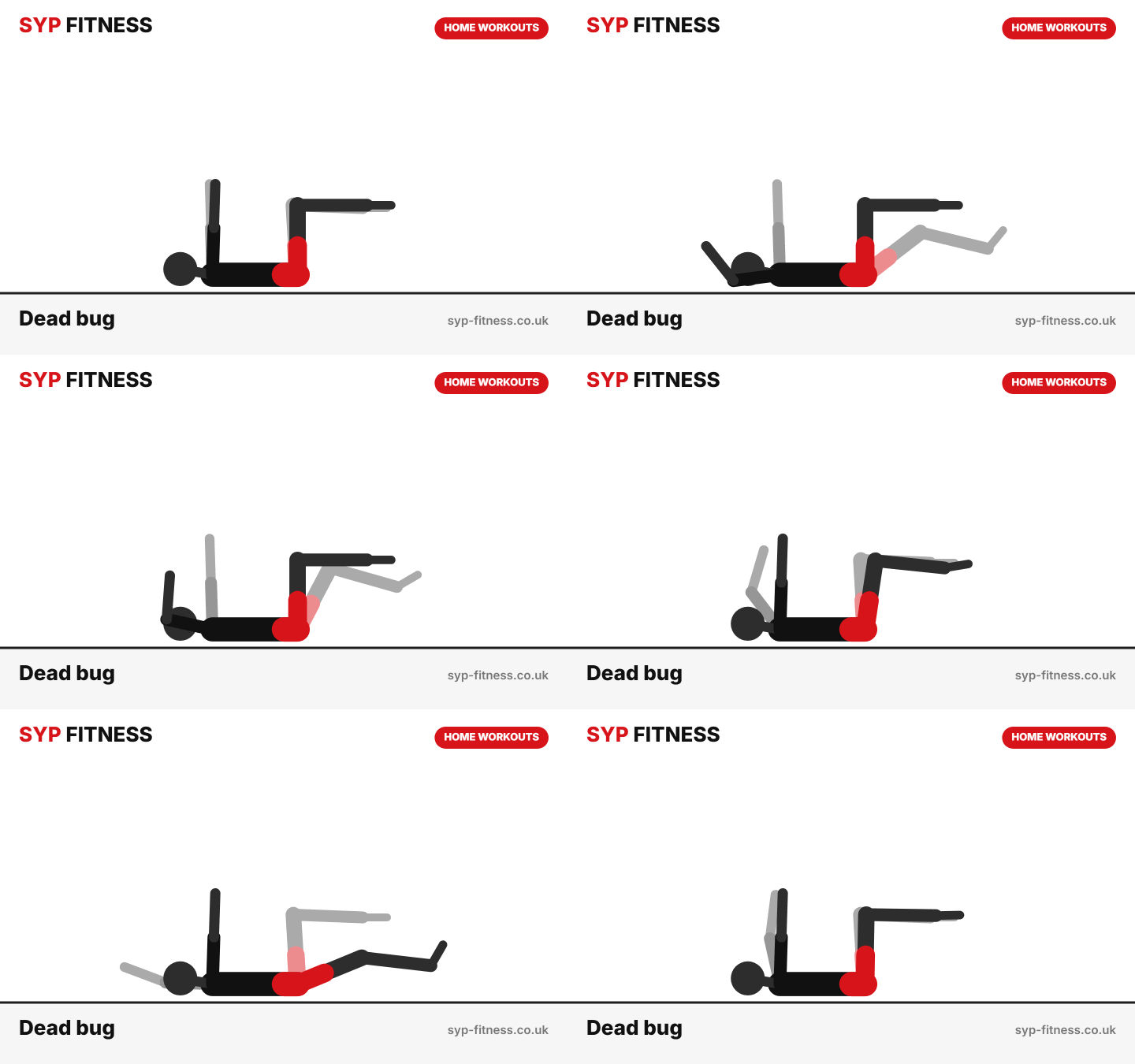
How to do it: Lie on your back with your arms pointing to the ceiling and your knees bent at 90 degrees above your hips. Gently press your lower back into the floor. Breathe out as you lower one arm behind your head and tap the opposite heel to the floor, keeping that knee bent, then return and swap sides.
The animation shows the full version with the leg straightened. At Level 1, keep that knee bent and just tap the heel to the floor.
Coach's tip: Your lower back stays in contact with the floor the whole time. If it lifts, shorten the movement.
Easier: Move the legs only and keep the arms still. Harder: Pause for 2 seconds with the heel just off the floor.
More detail: dead bug benefits and technique
6. Marching on the spot
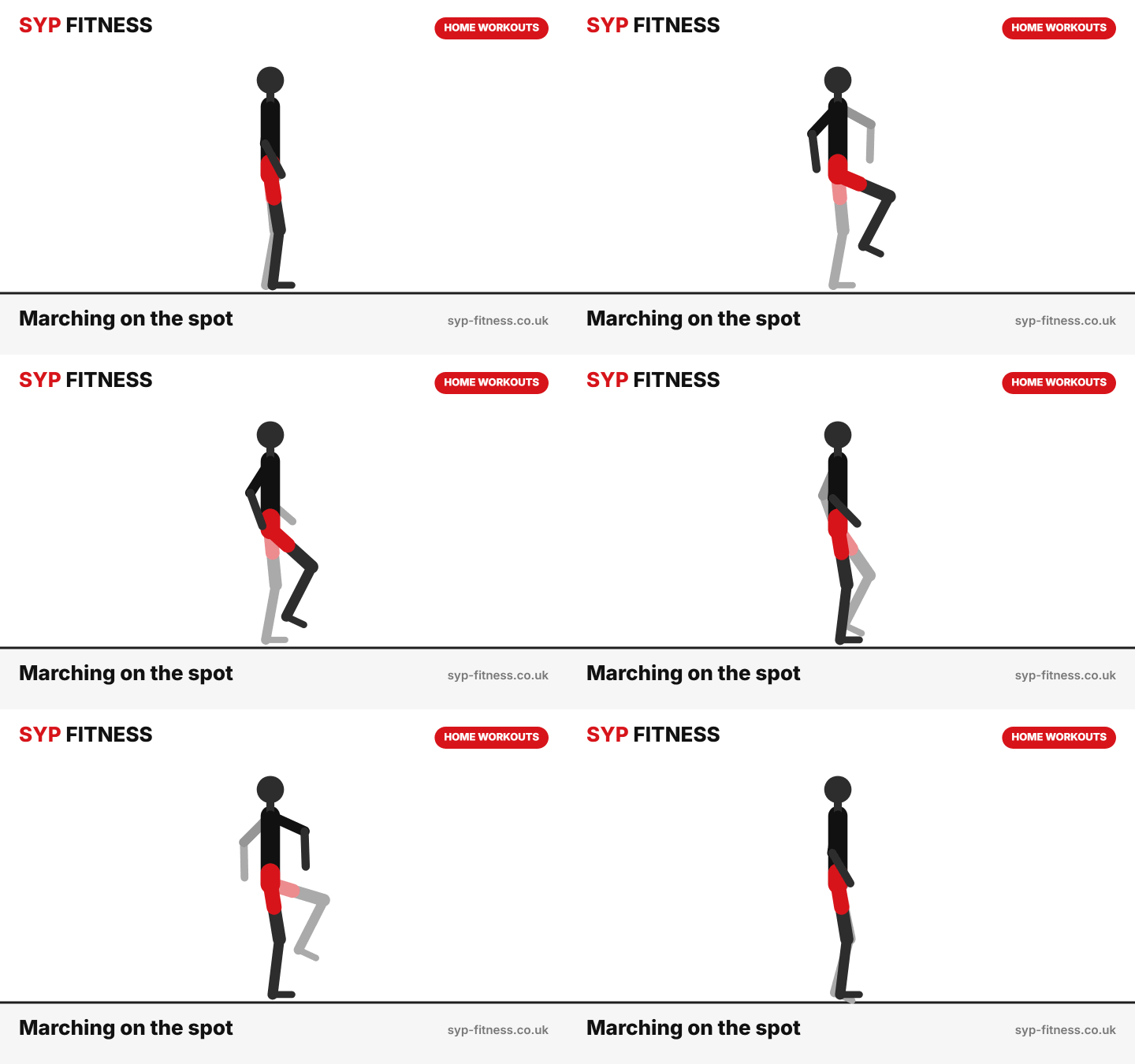
How to do it: Stand tall and march, lifting each knee towards hip height and swinging the opposite arm. Keep a steady rhythm and breathe through your nose if you can.
Coach's tip: Stand tall rather than leaning back. Think "head up, ribs down".
Easier: Hold the back of the chair and lift your knees lower. Harder: March faster and drive your knees higher.
Your 2-3 week plan
Most people spend 2-3 weeks here, and up to 4 is perfectly fine. The goal is to make the same workout feel easier before you make it harder.
- Week 1: 2 rounds at the bottom of each rep range (8 sit-to-stands, 8 wall push-ups). Rest the full 60 seconds. Focus on learning the movements.
- Week 2: Add 1-2 reps to each exercise and slow down the lowering part of every rep.
- Week 3: Work towards the top of each range and cut your rest to 45 seconds between exercises.
- Week 4 (if needed): Repeat week 3 and try the move-up test at the end of the week.
A simple week looks like this: workout on Monday, Wednesday and Friday, and a 20-30 minute walk on Tuesday, Thursday and at the weekend. That walking adds up towards the UK guideline of at least 150 minutes of moderate activity a week, and these 3 sessions cover the advice to do strengthening activities that work all the major muscles on at least 2 days a week.
When to move up to Level 2
Move up when you can do all of this in one session:
- 12 sit-to-stands without using your hands
- 12 wall push-ups
- 15 glute bridges
- Both rounds feel comfortable, at about 6/10 effort
If you can't yet, stay here for another week and add one rep to each exercise every session. If sit-to-stands are the sticking point, use a slightly higher seat and lower it again as you get stronger. When you pass, go to Level 2: Building the Base.
Common mistakes
- Rushing the reps. Slow, controlled reps build more strength than fast sloppy ones. Count to three on the way down.
- Holding your breath. Breathe out on the effort (standing up, pushing away, lifting the hips).
- Skipping the warm-up. Five minutes is enough to make the first round feel much better.
- Doing it every day. Your body gets stronger in the rest days. Walk on the days in between instead.
- Moving up too soon. Pass the test first. A solid Level 1 makes every level after it easier.
Frequently asked questions
How many times a week should I do this home workout for beginners?
Three times a week on non-consecutive days. That gives your muscles a day to recover between sessions and meets the UK guideline of strength work at least 2 days a week. Walk on the days in between.
Will this help me lose weight?
It helps, but weight loss mainly depends on a calorie deficit, which comes from what you eat. Exercise builds strength, protects muscle and makes daily life easier. To find a sensible starting point, use my free calorie calculator.
Can I do this if I'm over 50?
Yes. Level 1 was designed with older and deconditioned beginners in mind. Use the easier options, keep the chair against a wall, and check with your GP first if any of the health points in the safety note apply to you.
I'm sore after the first session. Is that normal?
Some mild stiffness for a day or two is common when you start, and it tends to ease as your body gets used to training. Gentle walking helps. Sharp pain in a joint is not normal. Stop that exercise and get it checked.
Want a coach to take you further?
A home workout for beginners is a brilliant start, and plenty of people climb the first few levels on their own. If you want someone to check your form, set your nutrition and keep you accountable, that is what I do every day as a personal trainer in Archway. On my 12-Week Body Transformation, clients lose 6-16kg in 12 weeks (average, results vary). If you live outside London, my online coaching gives you the same structure from home.
SYP Fitness is a private 1-to-1 personal training studio at 2-4 Navigator Square, Archway, London N19 3UB, 2 minutes from Archway tube. Rated 5.0 from 106 Google reviews.
Book a free consultation | WhatsApp Artem | Call 07301 512215 | See prices
SYP Home Workouts: Level 1 of 10. All 10 levels | Level 2 >


