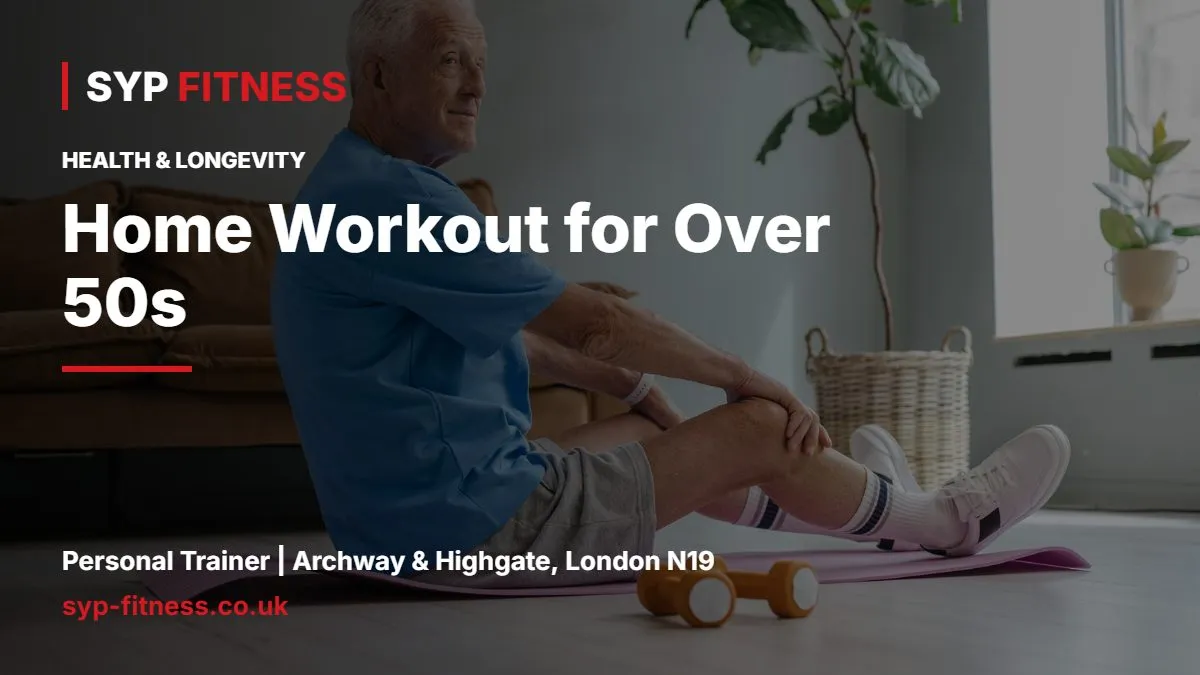
Home Workout for Over 50s: Strength and Balance With a Chair
A sensible home workout for over 50s has three jobs: keep your muscles strong, keep your balance sharp and keep your joints moving comfortably. It does not need to be fast, sweaty or complicated. It needs to be done regularly, with good control, and made a little harder as you improve.
This guide gives you a chair-supported routine you can do in your living room, with easier and harder options for each exercise. If you have a heart condition, high blood pressure, osteoporosis, joint replacements, a recent injury or take medication that affects your balance, check with your GP before you start.
Why strength and balance matter after 50
From middle age onwards, most people slowly lose muscle and strength unless they do something about it. That loss shows up in small ways first: getting up from a low sofa takes a push from your hands, stairs feel harder, carrying shopping is tiring. Balance can also fade if you do not challenge it.
The good news is that muscle still responds to training at 50, 60 and beyond. Regular strength and balance work helps you:
- stand up, climb stairs and carry things with less effort
- feel steadier on your feet, which lowers your risk of falls
- support bone health and joint comfort
- stay independent and active for longer
UK guidance for adults is at least 150 minutes of moderate activity a week plus strength work on at least 2 days. For older adults, activities that improve balance are also recommended. My article on strength training for longevity explains the bigger picture.
Before you start: safety basics
- Use a sturdy chair without wheels, placed against a wall, and a kitchen worktop or the back of a heavy sofa for balance work.
- Wear supportive shoes or train barefoot on a non-slip floor. Avoid socks on wooden floors.
- Breathe steadily. Do not hold your breath as you push.
- Work in a comfortable range. Mild effort and muscle fatigue are fine. Sharp pain, chest pain, dizziness or unusual breathlessness are signs to stop and seek medical advice.
- Start easier than you think. You can always add more next week.
The chair-supported home workout for over 50s
Do this 2-3 times a week on non-consecutive days. It takes about 25-30 minutes. Rest 60-90 seconds between sets.
Warm-up (5 minutes)
- March on the spot holding the worktop, 1 minute
- Shoulder rolls and arm circles, 10 each way
- Seated knee lifts, 10 each leg
- Ankle circles, 10 each way, each foot
- Gentle side bends, 5 each side
Strength block
- Sit to stand: 2-3 sets of 8-12. Sit near the front of the chair, feet hip-width apart, lean forward slightly and stand up, then sit back down slowly. Easier: use your hands on your thighs or a higher seat. Harder: arms crossed, then a 3-second lowering.
- Wall push-up: 2-3 sets of 8-12. Hands on the wall at shoulder height, step back, lower your chest towards the wall and push away. Harder: hands on the kitchen worktop.
- Standing calf raise: 2-3 sets of 10-15, holding the worktop. Rise onto your toes, pause, lower slowly.
- Glute bridge: 2-3 sets of 8-12 on the floor or a firm bed. Easier: smaller range. Harder: 2-second hold at the top.
- Seated row with a towel: 2 sets of 10. Sit tall, hold a towel at chest height, pull your shoulder blades back and together, then relax. Great for posture.
- Step-up on the bottom stair: 2 sets of 6-8 each leg, holding the banister. Leave this out until sit to stands feel easy.
Balance exercises you can do at home
Balance improves with practice, like any skill. Always hold the worktop at first, then use one finger, then hover your hand just above it.
- Heel to toe walk: walk along the worktop placing the heel of one foot directly in front of the toes of the other. 10-15 steps, 2-3 times.
- Single-leg balance: stand on one leg for up to 30 seconds, holding on lightly. 2-3 times each side.
- Side leg raise: holding on, lift one leg out to the side and lower slowly. 10 each side. This strengthens the hip muscles that keep you steady.
- Tandem stand: one foot directly in front of the other, hold for 20-30 seconds, then swap.
Short balance practice works well while the kettle boils. A few minutes most days adds up.
Joint-friendly mobility to finish
End each session with 5 minutes of gentle mobility. Move slowly and stay in a comfortable range.
- Seated hamstring stretch, one leg straight out in front, 20-30 seconds each side
- Seated spinal twist, 5 each way
- Chest opener with hands clasped behind your back, 20 seconds
- Neck turns side to side, 5 each way
If you have arthritis, gentle regular movement is usually helpful, but your GP or physiotherapist can advise on what suits your joints. My guide to strength training with arthritis covers this in more depth.
Want help with this? Plenty of the people I coach are over 50 and want to stay strong and independent for years to come. In a private studio we can work at your pace, around any health conditions your GP has flagged, and make sure your technique is right. Book a free consultation to talk it through.
How to progress safely
Progress slowly and change one thing at a time:
- Weeks 1-2: 2 sets of each exercise, learning good form.
- Weeks 3-4: 3 sets, or more reps within the range.
- Weeks 5-8: harder versions, such as sit to stand with arms crossed or from a lower chair, and less hand support on balance work.
Keep a simple notebook of sets and reps. Add a daily walk, starting with 10-20 minutes at a comfortable pace and building up. If you would like a coach to guide this, read my guide to choosing a personal trainer for over 50s.
Frequently asked questions
What is the best exercise for over 50s at home?
If you only do one, make it the sit to stand. It strengthens your thighs and hips, the muscles you use to get up, climb stairs and stay steady. It needs nothing more than a chair, and you can make it easier or harder easily. Combine it with balance practice and wall push-ups for a well-rounded routine.
How often should over 50s do strength training?
UK guidance is strength work on at least 2 days a week, and 2-3 sessions suits most people over 50. Leave a day between sessions so your muscles can recover. Balance exercises can be done most days because they are gentle. If you have a health condition, ask your GP what is right for you.
Is it safe to start exercising at 50 or 60?
For most people, yes, and it is one of the best things you can do for your health. Start gently and build up gradually. If you have a heart condition, high blood pressure, osteoporosis, recent surgery, joint problems or take medication that affects balance, speak to your GP before starting a new routine.
How can I improve my balance at home?
Practise a little most days. Heel to toe walking, single-leg stands and tandem stands next to a kitchen worktop are simple and effective. Strengthening your legs and hips with sit to stands and side leg raises also helps. Hold on for support at first, and reduce it only when you feel steady.
Prefer to train with support? As a personal trainer in Archway I coach people over 50 in a quiet private studio near Archway tube.
Start your transformation
SYP Fitness is a private 1-to-1 personal training studio at 2-4 Navigator Square, Archway, London N19 3UB, 2 minutes from Archway tube. Rated 5.0 from 100+ Google reviews.
Apply for a free consultation · WhatsApp Artem · Call 07301 512215 · See prices


