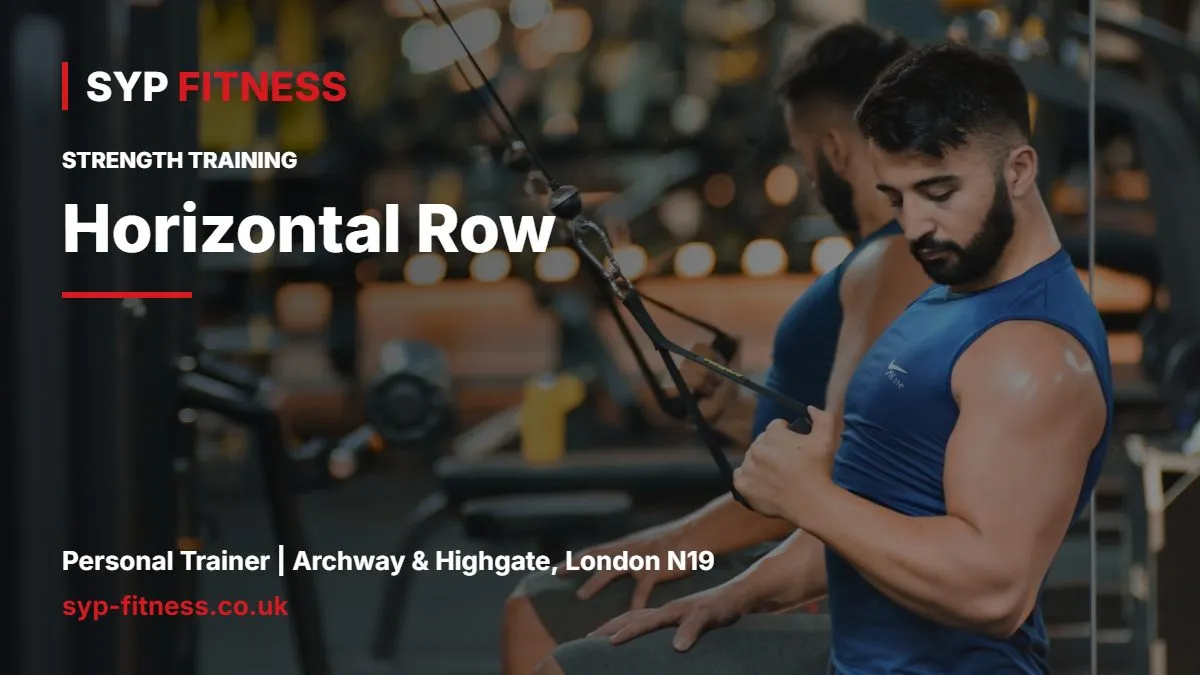
Horizontal Row: Variations, Muscles and How It Differs
A horizontal row is any exercise where you pull a weight towards your chest or stomach along a line roughly level with the floor, as if you were starting a lawnmower or rowing a boat. If you have ever wondered whether rows go up and down or side to side, this is the answer: a row is a horizontal pull, while a pull-up or lat pulldown is a vertical pull.
That difference sounds small, but it changes which muscles do most of the work and how you should plan your week. In this guide I explain what counts as a horizontal row, the best variations, what each one is good for, and how horizontal pulling fits alongside vertical pulling in a balanced programme.
What is a horizontal row?
Coaches sort upper body exercises by the direction your arms move compared with your torso. A horizontal pull means your arms travel in front of you and draw the elbows back past your ribs. The key is the angle between your arms and your body, not whether you are standing, seated or lying face up.
- Horizontal pull: rows of all kinds. The elbows move backwards, in front of the body.
- Vertical pull: pull-ups, chin-ups and lat pulldowns. The elbows move down from overhead.
- Horizontal push: press-ups and bench press, the opposite of a row.
- Vertical push: overhead and shoulder presses.
So is a row vertical or horizontal? A bent-over barbell row looks like you are lifting the bar up towards the ceiling, but relative to your torso your arms are pulling straight back. That makes it a horizontal row, the same as a seated cable row.
Muscles worked in a horizontal row
Horizontal rows hit the middle of your back harder than vertical pulls do.
- Rhomboids and middle trapezius: squeeze the shoulder blades together. These are the main posture muscles.
- Latissimus dorsi: still works hard, especially when you keep the elbows close and pull towards the hip.
- Rear deltoids: the back of the shoulder, which balances all the pressing most people do.
- Biceps and forearms: bend the elbow and hold the handle.
- Spinal erectors, glutes and hamstrings: on free-standing rows, they hold your torso still.
If you sit at a desk, this is the group that tends to get weak and long while your chest gets tight. That is why rows show up in almost every programme I write, and why they feature in my guide to improving your posture.
The best horizontal row variations
Seated cable row
The most beginner-friendly option. The seat and foot plate support you, the cable gives smooth tension and you can change handles easily. A neutral grip handle pulled towards the belly button is a great place to start. More detail in my seated cable row guide.
Single-arm dumbbell row
One hand and knee on a bench, a dumbbell in the other hand. Working one side at a time shows up imbalances and lets you get a longer stretch at the bottom. See my dumbbell row benefits post for setup.
Barbell bent-over row
The heaviest row for most people. You hinge forward to roughly 30-45 degrees above parallel and pull the bar to your lower ribs. It builds a lot of upper back and also trains your hamstrings and lower back to hold the position, so technique matters. My barbell row guide breaks it down.
Inverted row
A bodyweight row where you hang under a bar or rings and pull your chest up to it. The more upright your body, the easier it is, so it scales from total beginner to advanced. Read more in my inverted row post.
Chest-supported row
Lying face down on an incline bench with dumbbells, or using a machine with a chest pad. Your lower back is fully supported, so it is a good choice if you have back niggles.
How to do a horizontal row with good form
- Set a long, neutral spine. No rounding, no arching. Ribs down, neck in line.
- Start with the shoulder blades. Let them move forward slightly at the start, then draw them back as you pull.
- Drive the elbows, not the hands. Think of your hands as hooks and pull your elbows back past your ribs.
- Pause for one second at the end with the shoulder blades squeezed.
- Lower for 2-3 seconds. Control the weight back to a full stretch.
- Keep your torso still. If you need to rock or jerk to move the weight, it is too heavy.
Grip and elbow angle change the focus. Elbows tucked close to your sides pulling towards the hip puts more work on the lats. Elbows flared out to about 45-60 degrees pulling towards the chest shifts it to the upper back and rear shoulders. For a deeper technique breakdown, see how to do rows properly.
Want help with this? Many of the busy professionals I train in Archway come to me with rounded shoulders and a stiff upper back from long days at a desk. Rows are a big part of how we fix that, with the right variation and load for your body. Book a free consultation and I will check your rowing technique in person.
Horizontal row vs vertical pull: how to balance them
Both directions matter. Vertical pulls build width through the lats and strength overhead. Horizontal rows build thickness through the middle of the back and help keep your shoulders healthy. A simple guideline I use:
- Do at least as much pulling as pushing across the week.
- Aim for a ratio of roughly one to two horizontal rows for every vertical pull.
- Most people do well with 6-12 hard sets of rowing a week in total.
Sample week
- Day 1: barbell row 4 x 6-8, lat pulldown 3 x 10-12.
- Day 2: single-arm dumbbell row 3 x 10 each side, inverted row 3 x 8-12.
- Day 3 (optional): seated cable row 3 x 12-15 as a lighter session.
If you train with a push pull legs routine, put one heavy row and one lighter row on each pull day, then add a vertical pull. For more on the up-and-down side, see my guide to the lat pulldown.
If you have shoulder, elbow or back pain, speak to your GP or physio before training through it and start with supported rows.
Frequently asked questions
Do rows go up and down or side to side?
Rows pull the weight towards your body in a line that is horizontal relative to your torso. On a seated cable row that looks like front to back. On a bent-over row it looks like up and down, but because you are leaning forward, your arms are still pulling straight back towards your ribs, so it is still a horizontal pull.
Is a row a vertical or horizontal pull?
A row is a horizontal pull. Coaches classify it by the direction your arms move compared with your body, and in every row the elbows travel backwards in front of the torso. Vertical pulls are exercises where the arms start overhead and pull down, such as pull-ups, chin-ups and lat pulldowns.
What is the best horizontal row for beginners?
The seated cable row is usually the best start because the machine supports you and the load is easy to adjust. Inverted rows on a low bar are a good bodyweight option. Once you can control both with good posture for 10-12 reps, move on to dumbbell rows and then barbell rows if they suit your goals.
How often should I do horizontal rows?
Two to three times a week works well for most people, totalling about 6-12 hard sets. Include at least one heavier row of 6-10 reps and one lighter one of 10-15 reps. Try to do at least as much rowing as pressing, especially if you spend long hours at a desk or do a lot of bench press.
Want a full plan built around your goals? Find out about training with a personal trainer in Archway or see personal training prices.
Start your transformation
SYP Fitness is a private 1-to-1 personal training studio at 2-4 Navigator Square, Archway, London N19 3UB, 2 minutes from Archway tube. Rated 5.0 from 100+ Google reviews.
Apply for a free consultation · WhatsApp Artem · Call 07301 512215 · See prices


