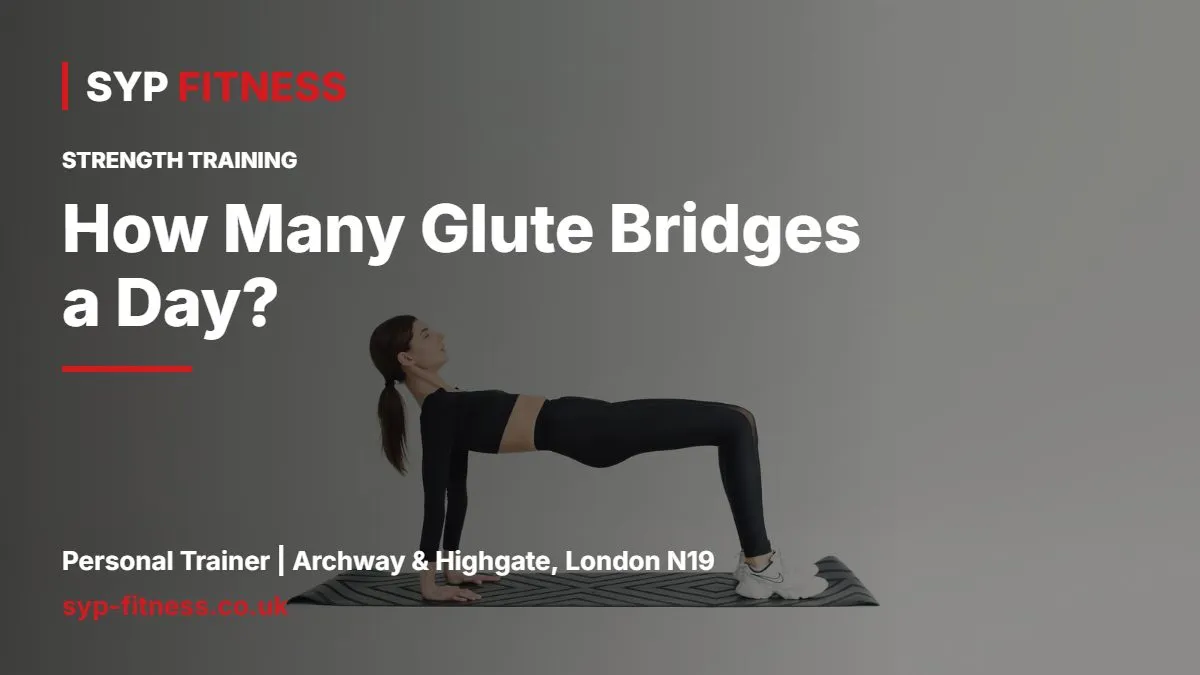
How Many Glute Bridges a Day? Reps for Activation and Strength
How many glute bridges a day you should do depends on why you are doing them. A short daily set to wake your glutes up after sitting is very different from training to make your glutes genuinely stronger, and the numbers for each are not the same.
In this guide I separate the two: daily activation work and real strength work. I give you reps and sets for each goal, explain the muscles involved, and show you how to progress from bodyweight bridges to loaded hip thrusts. For the basics of the movement itself, start with my glute bridge benefits post.
How many glute bridges should you do a day? The quick answer
- Daily activation: 1-2 sets of 10-15 slow reps with a 2 second squeeze at the top. Fine to do every day.
- Beginner strength: 3 sets of 12-20 bodyweight reps, 2-3 days a week.
- Building glute muscle: 3-4 sets of 8-15 reps with added load or single-leg bridges, close to failure, 2-3 days a week. Aim for roughly 10-16 hard glute sets a week across all exercises.
- Rehab or returning from injury: as guided by your physio, usually low load and higher reps.
Glute bridge muscles worked
- Gluteus maximus: the big muscle of your bum and the main mover, extending your hips.
- Gluteus medius and minimus: on the side of the hip, keeping your knees from caving in. They work harder on single-leg versions.
- Hamstrings: help extend the hip. If you feel them cramping, bring your feet a little closer to your bum.
- Core and lower back: hold your pelvis and ribcage in place.
- Quads: a little, especially with feet closer.
Daily activation vs real strength work
This is where most people get confused.
Activation
Activation is low effort. The goal is to feel the glutes working, wake them up after hours in a chair and get the hips moving before a walk, run or workout. Because it is easy, you can do it every day without needing recovery. A set of 10-15 slow bridges in the morning or before training is plenty. Doing 100 easy reps will not add much beyond that.
Strength and muscle
To make the glutes stronger or bigger, they need to work hard against a challenging load, with the last few reps of each set feeling tough. That kind of work needs 48 hours or so between sessions for the same muscle. So for strength, 2-3 sessions a week beats daily bridging.
A good split for many of my clients who sit at a desk: a quick daily activation set, plus two proper glute sessions a week.
How to do a glute bridge properly
- Lie on your back, knees bent, feet flat and hip width apart, about a hand's length from your bum.
- Tuck your ribs down and gently tilt your pelvis so your lower back is close to the floor.
- Drive through your heels and push your hips up until your knees, hips and shoulders form a straight line.
- Squeeze your glutes hard for 1-2 seconds at the top. Do not arch your lower back to get higher.
- Lower slowly over 2-3 seconds and lightly touch the floor before the next rep.
If you feel it in your lower back, you are probably over-arching at the top. If you feel it in your hamstrings, move your feet closer. Good bracing helps, and my guide on bracing your core explains how.
Want help with this? Glute strength is a big part of how I help clients deal with stiff hips, knee niggles and back aches from long days sitting. In a session I will check what you feel and where, and progress your glute work safely. Book a free consultation to find the right starting point.
Progressions: from glute bridges to hip thrusts
Once 3 sets of 20 bodyweight bridges feel easy, more reps is not the answer. Make each rep harder. Here is the order I use:
Stage 1: bodyweight bridge with pauses
Add a 3 second hold at the top of every rep. 3 x 12-15.
Stage 2: banded bridge
Loop a mini band above your knees and push them out slightly as you lift. This brings in the side glutes. 3 x 12-15.
Stage 3: single-leg glute bridge
One foot down, the other leg lifted. Roughly doubles the load and exposes any side-to-side difference. 3 x 8-12 each side. See my single-leg glute bridge guide.
Stage 4: weighted glute bridge
Hold a dumbbell or kettlebell across your hips, or use a barbell with a pad. 3-4 x 10-15.
Stage 5: hip thrust
Upper back on a bench, barbell across your hips. The bench gives you a bigger range than a floor bridge, so you can load the glutes more heavily. 3-4 x 6-12. My post on hip thrusts and glute training covers setup in detail.
Alongside these, hinge movements such as the Romanian deadlift and single-leg work such as split squats round out a strong glute programme.
A simple weekly glute plan
- Every day (optional): 1 x 15 slow bodyweight bridges with a 2 second squeeze.
- Session 1: hip thrust or weighted bridge 4 x 8-12, Romanian deadlift 3 x 8-10, banded bridge 2 x 15.
- Session 2: single-leg glute bridge 3 x 10 each side, split squat 3 x 10 each side, banded lateral walk 2 x 15 steps each way.
Add a rep or a small amount of weight each week when you hit the top of the range. If you are pregnant, have hip or back pain, or are recovering from surgery, check with your GP or physio first. For more on building glutes over time, read how to grow your glutes.
Frequently asked questions
How many glute bridges should I do a day?
For daily activation, 1-2 sets of 10-15 slow reps with a squeeze at the top is enough and safe to do every day. To build strength or muscle, train hard 2-3 times a week instead, with 3-4 sets of 8-15 reps using added load or single-leg bridges, taking each set close to failure.
Is it OK to do glute bridges every day?
Yes, easy bodyweight glute bridges are fine to do every day for most people and can help after long periods of sitting. Hard, heavy or high-effort sets are different, because your glutes need time to recover and grow. Keep challenging glute training to 2-3 days a week, with at least a day between sessions.
What muscles do glute bridges work?
Glute bridges mainly work the gluteus maximus, the large muscle of your bum. They also work the gluteus medius and minimus on the side of your hip, your hamstrings and your core. Single-leg versions put extra demand on the side glutes, while hip thrusts let you load the main glute muscle more heavily.
Are glute bridges or hip thrusts better?
Both are useful. Glute bridges are easier to learn, need no equipment and are great for beginners and daily activation. Hip thrusts use a bench for a bigger range of motion and are easier to load heavily, so they are usually better for building glute strength and size once you have mastered the bridge.
Want a full lower body plan that fits around work? See personal training for women in Archway or learn about training with a personal trainer in Archway.
Start your transformation
SYP Fitness is a private 1-to-1 personal training studio at 2-4 Navigator Square, Archway, London N19 3UB, 2 minutes from Archway tube. Rated 5.0 from 100+ Google reviews.
Apply for a free consultation · WhatsApp Artem · Call 07301 512215 · See prices


