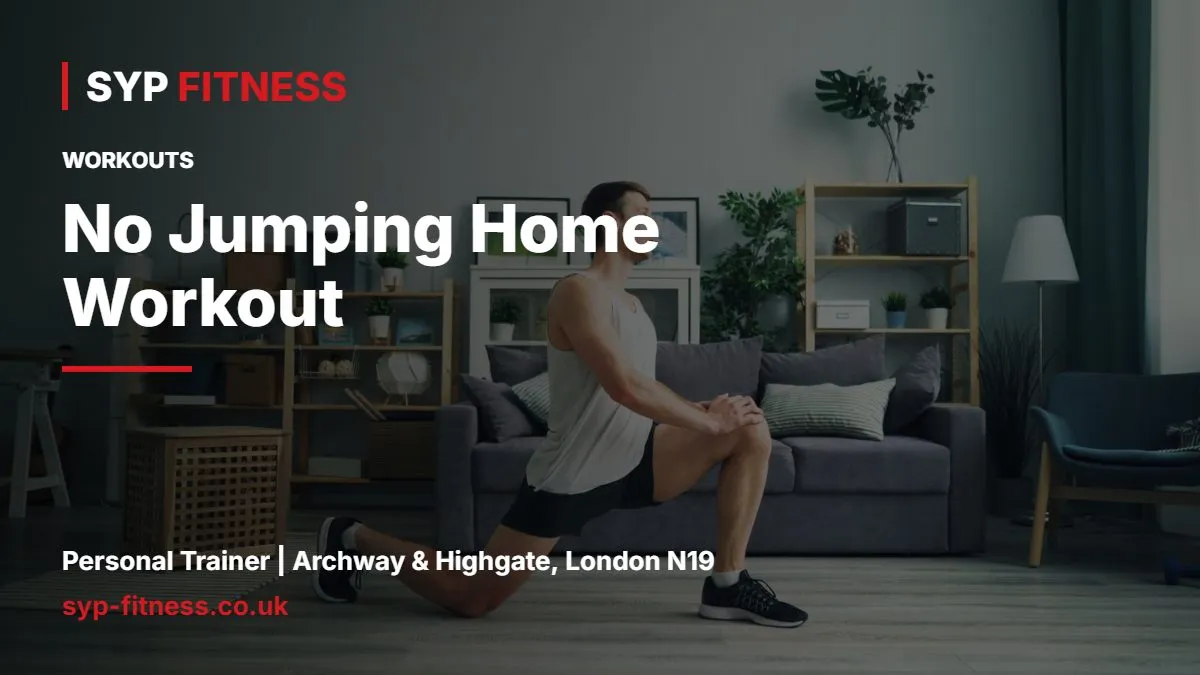
No Jumping Home Workout: Quiet, Knee-Friendly and Still Hard
A no jumping home workout is the answer if you live in a flat, have neighbours below you, train while the kids are asleep or have knees that complain every time you land. Most online workouts are full of burpees, jump squats and star jumps. You do not need any of them to get fit or to get your heart rate up.
In this guide I will show you how to make low-impact training genuinely hard, then give you a 25-minute quiet session you can do on a rug at 6am without anyone below you noticing.
Why skip jumping at home?
Jumping is not bad. It just is not essential, and at home it often causes more problems than it solves.
- Noise. In London flats, especially converted Victorian houses with wooden floors, every landing travels straight through the ceiling below.
- Knees and ankles. If you are heavier, returning after a long break or dealing with sore joints, repeated landings add stress you do not need yet.
- Space. Low ceilings, coffee tables and a small floor area make jumping awkward.
- Technique. Tired people land badly. Without a coach watching, the last 10 jump squats are often the worst ones.
Removing jumps lets you focus on what drives results: strength, control and enough effort to get out of breath.
How to get your heart rate up without jumping
The trick is to keep moving and use big muscles. A no jumping home workout raises your heart rate in four ways:
- Big lower body moves. Squats, lunges and step-ups use the most muscle, so they ask the most of your heart and lungs.
- Short rests. 30-40 seconds of work with 15-20 seconds of rest keeps your heart rate high.
- Fast but quiet tempo. Move with intent on the way up, control the way down, and keep your feet on the floor.
- Floor-based conditioning. Moves like bear crawls, mountain climbers done slowly and plank walk-outs get you breathing hard with no impact at all.
If you want a simple test, you should be able to speak in short sentences but not hold a full conversation by the end of each round.
Quiet swaps for common jumping exercises
Use these swaps for any workout you find online:
- Jump squats become squats with a calf raise at the top, or fast tempo squats.
- Burpees become step-back burpees: hands down, step one foot back, then the other, step in, stand tall.
- Star jumps become step-out jacks: step one foot wide while raising your arms, then the other.
- Jumping lunges become reverse lunges at a steady, quick pace.
- Skipping becomes high-knee marching with a strong arm drive.
- Box jumps become step-ups on the bottom stair.
Each one keeps the muscle work and most of the effort, without the thud.
The 25-minute no jumping home workout
All you need is floor space, a sturdy chair and ideally the bottom step of your stairs.
Warm-up (5 minutes)
- 1 minute high-knee marching
- 1 minute step-out jacks
- 10 slow squats, 10 hip hinges, 10 arm circles each way
- 30 seconds cat-cow on all fours, 30 seconds inchworms
Circuit A: legs and heart rate (3 rounds, 40 seconds on, 20 seconds off)
- Tempo squats, fast up and 2 seconds down
- Reverse lunges, alternating legs
- Step-ups on the bottom stair, alternating legs
- Step-back burpees
Circuit B: upper body and core (2 rounds, 40 seconds on, 20 seconds off)
- Push-ups (hands on the chair seat if needed)
- Bear crawl, 2 steps forward and 2 back
- Glute bridges
- Slow mountain climbers, one knee at a time
Finisher (2 minutes)
- 1 minute wall sit
- 1 minute plank
Finish with 2 minutes of easy stretching for your hips, quads and chest. Do this session 2-3 times a week on non-consecutive days.
Want help with this? A lot of my clients start with sore knees or a long break from training, and we build them up with exactly this kind of low-impact work before adding anything harder. If you want a plan around your joints and your schedule, Book a free consultation and we can talk it through.
Looking after sore knees during home workouts
If your knees are the reason you avoid jumping, a few rules help:
- Control depth. Squat to a chair at first. Go only as low as you can without pain.
- Keep knees in line with toes. Do not let them cave inwards on squats and lunges.
- Strengthen around the knee. Glutes, quads and calves all help. My guide to knee strengthening exercises has a simple progression.
- Use mild discomfort as a guide. A little achiness that settles within a day is usually fine. Sharp pain, swelling or pain that gets worse is a sign to stop.
If you have an existing knee injury, arthritis or ongoing pain, speak to your GP or a physiotherapist before starting a new routine. Once you are cleared, an injury-safe personal trainer can help you build up without flare-ups.
Progressing a quiet workout so it stays hard
Low impact does not mean easy forever. Every couple of weeks, change one of these:
- Add a round to Circuit A.
- Move from 40/20 to 45/15 work and rest.
- Slow the lowering phase to 3-4 seconds.
- Use harder versions: split squats with the back foot on the sofa, full push-ups, longer bear crawls.
- Hold a backpack with books in it for squats and step-ups.
For a longer bodyweight programme to follow, see my home workout with no equipment, and simply apply the quiet swaps above.
Frequently asked questions
Can you lose weight with a no jumping workout?
Yes. Fat loss comes from a steady calorie deficit, and low-impact strength training helps by keeping or building muscle while you lose fat. Add daily walking and decent protein and you will make good progress. Jumping burns slightly more energy per minute, but you can match it by training a little longer or with less rest.
What is the quietest cardio to do in a flat?
Step-ups on the bottom stair, high-knee marching, step-out jacks, bear crawls and fast reverse lunges are all quiet. Doing them on a rug or yoga mat helps further. Brisk walking outside is also excellent, low-impact cardio and does not bother anyone. Mix two or three of these into short intervals for a real challenge.
Are low-impact workouts good for bad knees?
Usually, yes. Low-impact work lets you strengthen the muscles around the knee without repeated landing forces. Start with partial range squats, glute bridges and step-ups on a low step. If you have a diagnosed knee condition or pain that does not settle, get advice from your GP or a physiotherapist before you progress.
How long should a no jumping home workout be?
Around 20-30 minutes is plenty for most people, including a warm-up. Done 2-3 times a week, that covers the UK guidance of strength work on at least 2 days. On very busy days even 15 minutes is worthwhile. Consistency over weeks matters far more than the length of any single session.
Prefer coaching in person? I am a personal trainer in Archway and work with plenty of people who start exactly where you are.
Start your transformation
SYP Fitness is a private 1-to-1 personal training studio at 2-4 Navigator Square, Archway, London N19 3UB, 2 minutes from Archway tube. Rated 5.0 from 100+ Google reviews.
Apply for a free consultation · WhatsApp Artem · Call 07301 512215 · See prices


