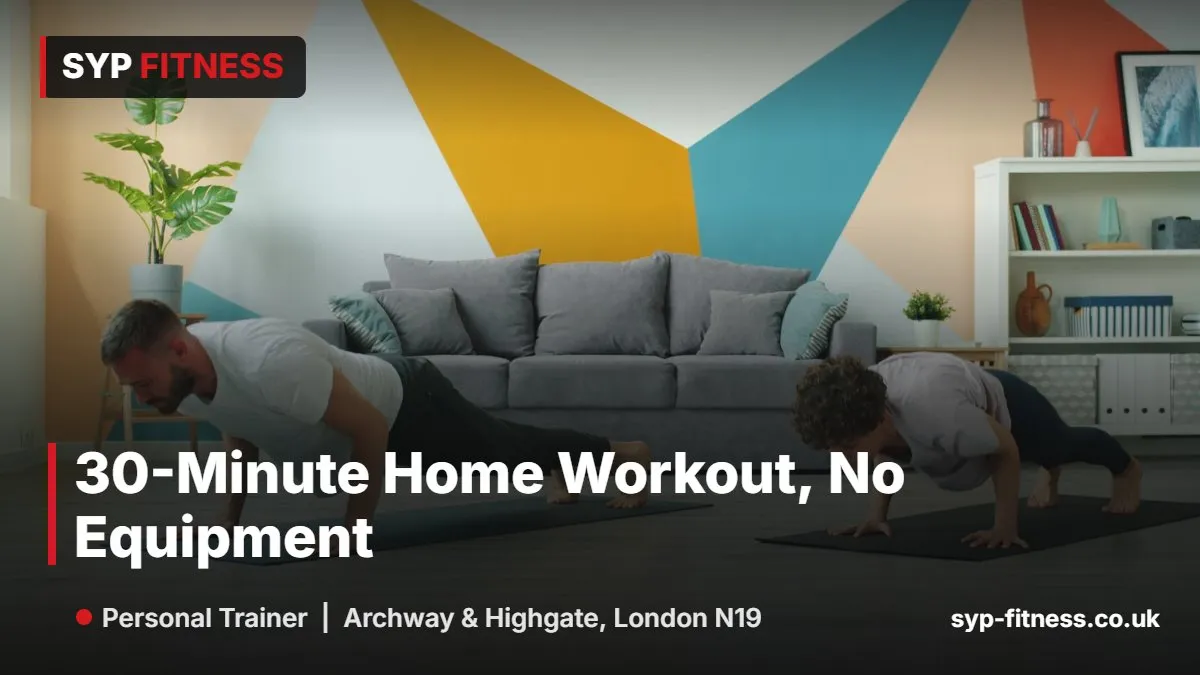
Home Workout No Equipment: 30-Minute Full-Body Plan
A good home workout with no equipment can build strength, fitness and confidence using just your bodyweight and a bit of floor space. This 30-minute bodyweight workout covers your whole body, comes in three levels and shows you how to keep making it harder without buying any weights.
New: Bodyweight Home Workouts, Level 1 to 10. Want a plan that grows with you? My free 10-level bodyweight ladder takes you from total beginner to elite calisthenics, with animated demos for every exercise. Find your level
Before you start
You need a clear space about the size of a yoga mat, a sturdy chair or sofa edge, and a wall. A mat or towel helps for floor exercises. Wear trainers or train barefoot on a non-slip surface.
If you’re new to exercise or returning after a long break, start with the beginner level even if it looks easy. Getting the technique right on simple movements makes the harder versions safer and more effective later. A timer on your phone keeps you on track and stops rests creeping up.
Do this workout 2-3 times a week on non-consecutive days. On other days, walking is a great addition.
A simple week might look like this: the full workout on Monday, Wednesday and Friday, a 30-45 minute walk on Tuesday and Thursday, and something active you enjoy at the weekend. Write down your level, reps and rounds each time so you can see your progress.
Warm-up (5 minutes)
Do each for 40 seconds, moving at an easy pace:
Marching on the spot, building to a light jog if comfortable
Arm circles forwards and backwards
Bodyweight squats to a comfortable depth
Hip hinges with hands on hips
Walk-outs: bend down, walk your hands forward, walk them back
Alternating reverse lunges, slow and controlled
The 30-minute home workout: no equipment
Do the circuit below, moving from one exercise to the next. Rest 60-90 seconds at the end of each round. Complete 3-4 rounds, about 20 minutes in total. Choose the level that lets you finish every round with good form.
Beginner
Sit-to-stand from a chair: 10-12 reps
Wall push-up: 10-12 reps
Glute bridge: 12-15 reps
Split squat holding a wall for balance: 8 each leg
Dead bug: 6 each side
Side plank from knees: 20 seconds each side
Intermediate
Bodyweight squat: 15-20 reps
Push-up on a sofa edge or knees: 8-12 reps
Single-leg glute bridge: 10 each leg
Reverse lunge: 10 each leg
Plank shoulder taps: 10 each side
Side plank: 30 seconds each side
Harder
Rear-foot elevated split squat (back foot on the sofa): 10-12 each leg
Push-up with a 3-second lowering: 8-12 reps
Single-leg hip thrust from the sofa: 12 each leg
Skater squat or assisted pistol to a chair: 6-8 each leg
Hollow body hold: 20-30 seconds
Bear crawl forwards and back: 30 seconds
The core work here builds on our guide to strengthening your core muscles.
Cool down (5 minutes)
Walk around slowly for a minute to bring your breathing down.
Hip flexor stretch: 30 seconds each side.
Hamstring stretch: 30 seconds each side.
Chest stretch in a doorway: 30 seconds.
Child’s pose: 45 seconds with slow breathing.
How to progress a bodyweight workout without weights
Your body adapts quickly, so you need to keep making the workout a bit harder. Without dumbbells, you have plenty of tools:
Add reps: once you can hit the top of the range on every round, add 2-3 reps.
Slow the tempo: take 3-4 seconds to lower into each squat or push-up. Slower reps are much harder.
Add pauses: hold for 2 seconds at the bottom of a squat, lunge or push-up.
Go single-leg or single-arm: split squats, single-leg bridges and step-ups put more load through each side.
Raise or lower your hands and feet: push-ups get harder as your hands get lower; split squats get harder with the back foot raised.
Cut rest: shorter rests make the workout more demanding for your heart and lungs.
Change one thing at a time and move up a level only when the current one feels controlled. Bodyweight training takes you a long way, though for heavy strength goals you may eventually want weights. Our comparison of home workouts vs the gym explains when that point comes.
Stay safe: stop if you feel sharp pain, chest pain, dizziness or unusual breathlessness. Check with your GP first if you have a heart condition, high blood pressure, joint problems, a recent injury or you’re pregnant. Make sure any chair or sofa you use is stable and won’t slide.
How long until you see results?
Most people notice they can do more reps and recover faster within two to three weeks. Changes in body shape take longer, often two to three months, and depend heavily on what you eat. Bodyweight training builds the muscle and fitness, but fat loss comes mainly from a sensible calorie deficit. Our free calorie calculator gives you a starting point.
Fitting it into a busy day
Short on time? Do two rounds in a lunch break workout and save the full version for the weekend. If you work from home, our guide to staying fit while working from home has more ways to move during the day.
If you’d like a plan that’s written for you, progresses each week and comes with check-ins, our online coaching is designed for training at home or in your own gym.
Want this coached 1-to-1? Want a home plan built for you? Ask about online coaching. Book a free consultation at our Archway studio.
How to do each exercise properly
Good form matters more than speed. If you are unsure about any move, these step-by-step guides from our Exercise Library show the set-up, the common mistakes and easier or harder versions:
Legs: bodyweight squat, split squat, Bulgarian split squat (the rear-foot elevated version), reverse lunge and step-ups
Glutes: glute bridge and single-leg glute bridge
Upper body: incline push-up on a wall or sofa, then the full push-up
Core: dead bug, plank, side plank and hollow body hold
Full body: bear crawl, plus burpees if you want a harder finisher
A 4-week home workout plan with no equipment
Follow this plan to keep progressing without buying any kit. Do the workout on 3 non-consecutive days each week and walk on 2 of the other days.
Week 1: beginner level, 3 rounds, 90 seconds rest. Focus on clean technique and write down your reps.
Week 2: beginner level, 4 rounds, 75 seconds rest. Add 2 reps to any exercise that felt easy.
Week 3: intermediate level, 3 rounds, 90 seconds rest. Take 3 seconds to lower on squats and push-ups.
Week 4: intermediate level, 4 rounds, 60 seconds rest. If every round feels controlled, swap in one exercise from the harder level next week.
Then repeat the cycle at the next level up. If a week feels too hard, repeat it rather than moving on. There is no prize for rushing.
5 common home workout mistakes
Rushing the reps. Fast, bouncy reps take the work off your muscles. Slow down, especially on the way down.
Doing the same workout for months. If nothing gets harder, your body stops changing. Use the progression tips above every 1-2 weeks.
Skipping the warm-up. Five minutes of easy movement makes the workout feel better and lowers the risk of tweaks and strains.
Training hard every single day. Muscles get stronger between sessions, so leave a day between workouts and walk on rest days.
Expecting exercise alone to shift fat. Bodyweight training builds muscle and fitness, but what you eat decides most of your fat loss. Our guide to how many calories it takes to lose 1kg of fat explains the maths.
Frequently asked questions
Can you get fit with a home workout and no equipment?
Yes. A bodyweight workout done 2-3 times a week can build strength, fitness and muscle, especially for beginners, as long as you keep making it harder over time.
How long should a home workout with no equipment be?
About 30 minutes including a warm-up and cool down is plenty. Even 15-20 minutes of focused work is worthwhile on busy days.
How do I make bodyweight exercises harder?
Add reps, slow the lowering phase, add pauses at the bottom, switch to single-leg or single-arm versions, change the angle or cut your rest time.
Can you build muscle with bodyweight workouts?
Yes, particularly as a beginner. Progressing to harder variations keeps building muscle, though many people eventually add weights to keep progressing.
Is a 20-minute home workout enough?
Yes, if you work hard and train 3 times a week. Two or three focused rounds of the circuit with short rests are enough to build strength and fitness, especially when you are starting out.
Can I do a home workout every day?
You can move every day, but keep this full-body workout to 3 days a week with a rest day in between. On the other days, walk, stretch or do some light mobility work so your muscles can recover and get stronger.
Will a home workout with no equipment help me lose weight?
It helps by building muscle and burning extra calories, but weight loss mainly depends on eating in a calorie deficit. Pair this workout with daily steps and our free calorie calculator for the best results.
Start your transformation
SYP Fitness is a private 1-to-1 personal training studio at 2-4 Navigator Square, Archway, London N19 3UB, 2 minutes from Archway tube. Rated 5.0 from 106 Google reviews.
Apply for a free consultation · WhatsApp Artem · Call 07301 512215 · See prices


