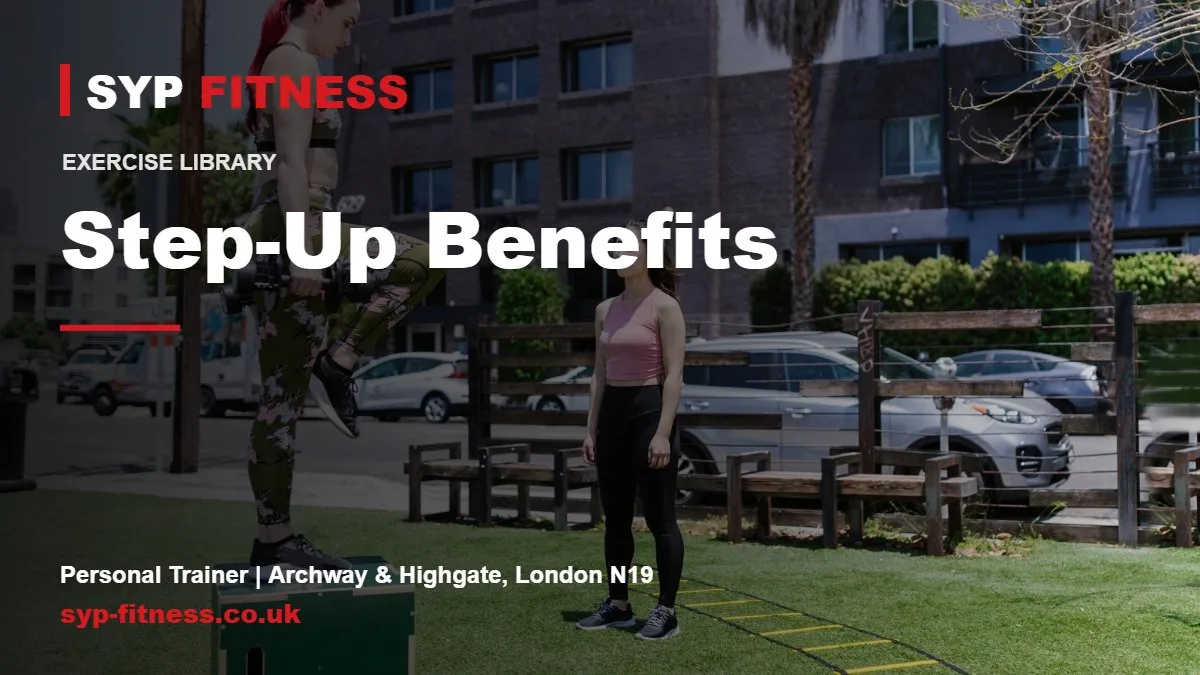
Step-Up Exercise: Benefits, Muscles Worked and How to Do It
The step-up is exactly what it sounds like: you step onto a box or bench with one foot, drive yourself up until you are standing tall, then step back down under control. It is the most direct way to train the movement you use every time you climb stairs, and that is the single biggest reason to do it.
Why the Step-Up is a must
Most of daily life happens on one leg at a time. Walking, climbing stairs and stepping off a kerb all ask one leg to carry your whole body while the other is in the air. The step-up trains that exact job, so it builds strength in your quads and glutes and also teaches your hip, knee and ankle to stay lined up while you balance.
It is also very easy to scale. A low step with no weight suits a complete beginner, while a knee-height box holding dumbbells will challenge a strong lifter. Because each leg works on its own, you quickly see if one side is weaker and can even it out before it causes trouble.
How it helps in everyday life
Climbing stairs at home or on the Tube. Stairs are a repeated step-up, so the stronger each leg is, the less you have to grip the handrail.
Carrying shopping up to a flat. Loaded step-ups prepare your legs to climb while your hands are full and your balance is under pressure.
Walking up steep hills. Hilly streets and park paths feel easier when your glutes and quads can push you up one stride at a time.
Stepping onto a bus or over a kerb. A confident step up with a high first step is far easier when one leg can lift you without wobbling.
Hiking and getting over stiles. Big uneven steps on a walk in the countryside are just step-ups in hiking boots.
Getting up a loft ladder or step stool. Controlled single-leg strength means you feel steady when you reach the top.
What it helps prevent
Step-ups build the leg strength and single-leg control that make trips and falls on stairs less likely. The NHS advises strength and balance work on at least two days a week for older adults, and says these exercises can help you feel stronger and more confident moving around if you are worried about falling (NHS guidelines for older adults).
They can also help protect against knee niggles. When your glutes and quads are strong, your knee is less likely to collapse inwards as you climb, which is a common source of discomfort. And like all leg strength work, regular step-ups help lower your risk of the gradual loss of leg muscle that makes stairs harder with age.
Muscles worked
Quadriceps (front of the thigh)
Glutes, especially gluteus maximus and medius
Hamstrings
Calves
Core and hip stabilisers for balance
How to do the Step-Up
Stand facing a sturdy box, bench or step. Start at mid-shin height.
Place your whole right foot on the box, heel included.
Lean your chest slightly forward so your weight is over the front foot.
Push through the front heel and midfoot to stand up straight on the box.
Bring the back foot up to meet it, or hold it in the air for extra balance work.
Step the back foot down slowly, keeping the front leg working to control the descent.
Complete all reps on one leg, then switch.
Breathe in before you step, breathe out as you drive up, and breathe in again on the way down.
Common mistakes
Pushing off the back foot. Fix: keep the back foot light, almost hovering, so the front leg does the work.
Knee caving inwards. Fix: keep your knee in line with your second and third toes.
Box too high. Fix: choose a height where your thigh is no higher than parallel to the floor.
Dropping down fast. Fix: lower yourself over two to three seconds. The way down is half the exercise.
Only half the foot on the box. Fix: plant the whole foot so you can push through your heel.
Make it easier or harder
Easier: use a low step like the bottom stair, hold a wall or rail for balance, and use bodyweight only.
Harder: hold dumbbells by your sides or a kettlebell at your chest, raise the box to knee height, add a slow three-second lowering, or finish with a knee drive at the top for balance and power.
Sets, reps and how often
Start with 2-3 sets of 8-12 reps on each leg, 2-3 times a week. This fits the NHS advice to do muscle-strengthening activity on at least two days a week.
Once you can do 12 smooth reps per leg with good control, add a little weight or raise the box slightly. Change one thing at a time.
Who should take care
If you have knee pain, start on a low step and stop if pain rises during or after the session. If you have had recent knee or hip surgery, a balance problem, or you are pregnant, check with your GP or physio first, and keep a wall or rail within reach.
Related exercises
Reverse Lunge builds the same single-leg strength with a stepping-back pattern.
Bulgarian Split Squat is the next step when you want a tougher single-leg leg builder.
Stair Climbing turns the step-up pattern into cardio.
Single-Leg Balance sharpens the balance you need at the top of each step.
Single-leg exercises guide for more ways to train one leg at a time.
FAQs
Are step-ups good for beginners?
Yes. Step-ups are one of the best beginner leg exercises because you can start on a low step with a rail for support and progress slowly.
Are step-ups better than squats?
Neither is better, they do different jobs. Squats train both legs together for strength, while step-ups train one leg at a time and carry over more directly to stairs and balance.
How high should a step-up box be?
Start at mid-shin height. Work up to a box where your thigh is roughly parallel to the floor when your foot is on it, usually around knee height.
Want help with your technique?
Artem coaches the step-up 1-to-1 at his private studio in Archway, North London, checking your knee line, box height and loading so it feels strong and safe. If you want structure and accountability, the 12-Week Body Transformation is 24 sessions for £1,080, with clients averaging 6-16kg in 12 weeks (average, results vary). Single sessions are £75: see personal training prices or book a free assessment.
Last updated: October 2026


