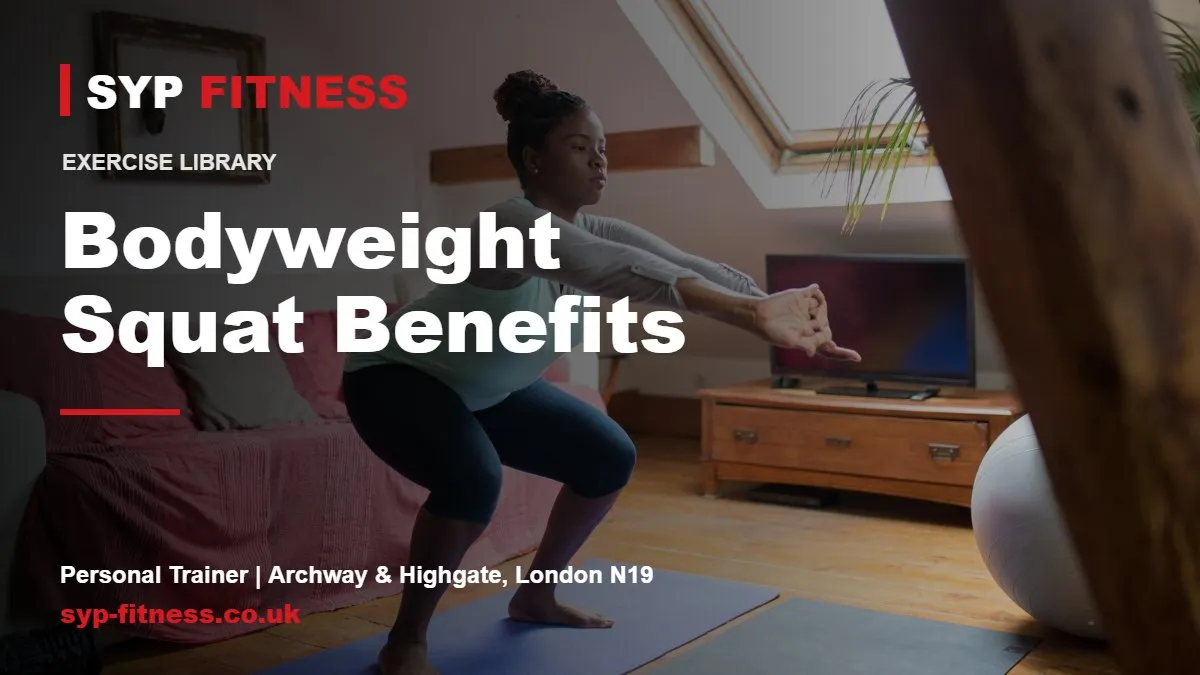
Bodyweight Squat: Benefits, Muscles Worked and How to Do It
The bodyweight squat is the simplest way to train the movement you use every time you sit down and stand up. You need no kit, no gym and about two square metres of floor. Do it well and often, and getting up from a low sofa or the floor stays easy for decades.
Why the Bodyweight Squat is a must
Squatting is one of the basic human movement patterns. Your hips, knees and ankles bend together while your trunk stays tall, and your legs and glutes do the work. If you stop doing it, the range shrinks and the muscles weaken, and one day the low chair feels like a climb. The NHS physical activity guidelines ask adults to do strengthening activities that work all the major muscle groups on at least 2 days a week, and the bodyweight squat covers the biggest of them in one move.
It is also the best place to learn squat technique. Before you load a goblet squat or a barbell, you need to own the pattern with just your body: feet planted, knees tracking over your toes, chest proud, depth you can control. Get that right here and every heavier variation becomes safer.
How it helps in everyday life
Getting up from a low sofa or car seat. You drive up through your legs instead of rocking forward and pushing on your hands.
Getting up off the floor. Playing with kids or pets on the carpet is easier when your legs are used to deep bending.
Using the toilet without help later in life. It sounds blunt, but this is exactly the motion you are training and keeping.
Climbing stairs at the tube station. Stronger quads and glutes make each step take less effort.
Picking things up from a low shelf. You can drop into a squat to reach the bottom of the fridge instead of bending your back.
Breaking up long desk days. A set of squats between meetings gets blood moving through your legs after hours of sitting.
What it helps prevent
Regular squatting builds the leg strength that makes slips and stumbles less likely to become falls, because your legs can catch you. The NHS recommends strength and balance work at least twice a week as part of preventing falls. It can also help protect against knee niggles, since stronger quads and glutes share the load around the joint, and against the gradual loss of muscle that comes with age if you keep progressing it.
Squatting through a comfortable range keeps your hips and ankles moving, which can help reduce the stiffness many people feel after long days in a chair.
Muscles worked
Quadriceps (front of the thigh)
Glutes
Adductors (inner thigh)
Hamstrings, as stabilisers
Calves and the small muscles of the feet
Core and lower back muscles, to keep your trunk upright
How to do the Bodyweight Squat
Stand with your feet about shoulder width apart, toes turned out slightly.
Spread your weight across the whole foot: heel, big toe and little toe.
Reach your arms forward or clasp your hands at your chest for balance.
Push your hips back and bend your knees at the same time, as if sitting into a chair behind you.
Let your knees travel forward over your toes, pointing the same way as your feet.
Go as low as you can while keeping your heels down and your back long, ideally thighs level with the floor or lower.
Drive through your whole foot to stand tall, squeezing your glutes at the top.
Breathing: Breathe in as you lower, breathe out as you stand up.
Common mistakes
Heels lifting. Widen your stance a little and sit back more, or put small plates under your heels while your ankles loosen up.
Knees caving in. Think about spreading the floor apart with your feet so your knees follow your toes.
Rounding the back at the bottom. Only go as deep as you can with a long spine, and build depth over weeks.
Rushing the reps. Take two or three seconds to lower. Control is what builds strength without weights.
Make it easier or harder
Easier: Squat down to a chair or bench and stand back up, holding a door frame or rail for support if needed. Shorten the depth and build it gradually.
Harder: Slow the lowering to four seconds, pause for two seconds at the bottom, add a jump at the top, or move on to the goblet squat when 20 controlled reps feel easy.
Sets, reps and how often
Start with 2-3 sets of 10-15 reps, 2-3 times a week. Rest about a minute between sets.
Once you can do 3 sets of 20 with good form, make it harder with a slower tempo or pauses rather than endless reps, or pick up a weight. Small steady progress is the point.
Who should take care
If you have knee or hip pain, recent surgery on a leg or your back, or you are pregnant, check with your GP or physio first. Squat to a box to control depth and stop if pain is sharp or builds during the set.
Related exercises
Sit to Stand: the easiest starting point if full squats are too much
Goblet Squat: the next step once you want to add load
Deep Squat Hold: builds the hip and ankle range for a deeper squat
Glute Bridge: strengthens the glutes that drive you up
knee strengthening exercises: if your knees need extra care
FAQs
Are bodyweight squats enough to build muscle?
Yes, for beginners they are. As you get stronger you need to make them harder with tempo, pauses or added weight to keep progressing.
How many bodyweight squats should I do a day?
You do not need to do them every day. Two or three sessions a week of 2-3 sets of 10-20 good reps works well, plus a few here and there to break up sitting.
Are squats bad for your knees?
Not when done with control and a sensible range. For most people, squatting builds the strength that supports the knee.
Want help with your technique?
Squats look simple, but small fixes to stance and depth make a big difference. Artem coaches the Bodyweight Squat 1-to-1 at his private studio in Archway, North London, and adjusts it to your body, your history and your goals. Start with the 12-Week Body Transformation, check the personal training prices or book a free assessment.
Last updated: October 2026


