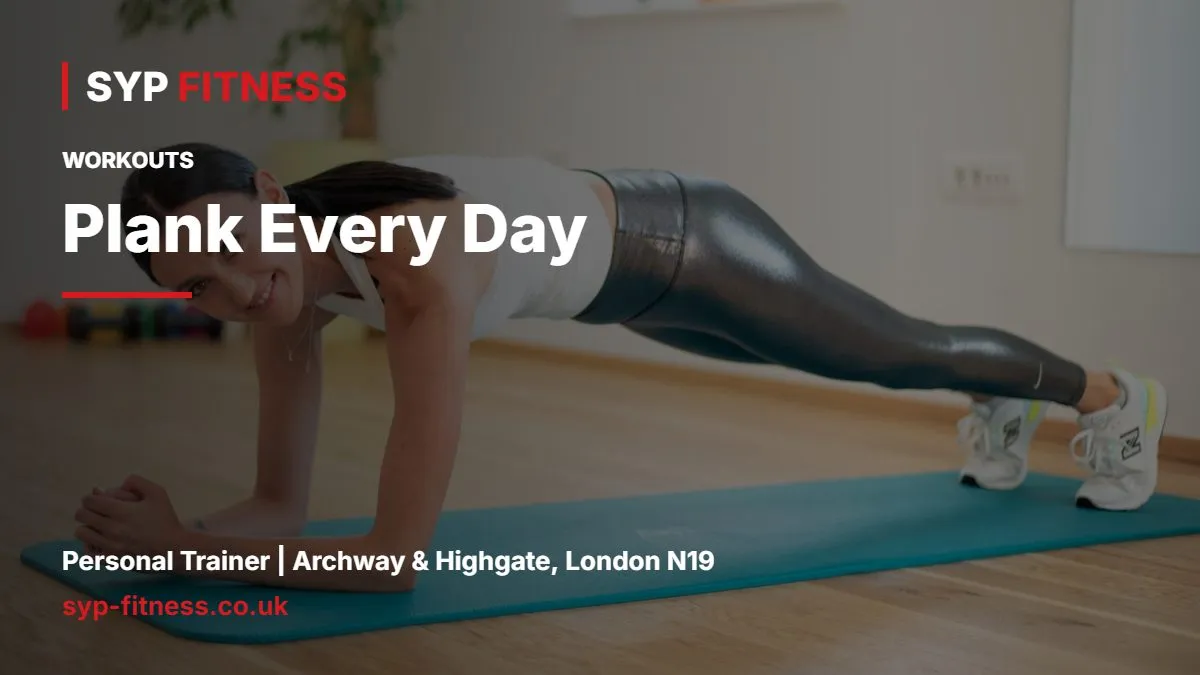
Plank Every Day: How Long to Hold and What Works Better
Doing a plank every day is a popular habit, and it is not a bad one. It takes a minute, needs no kit and teaches your trunk to stay still under load. But a daily plank will not flatten your stomach on its own, and after a few weeks a longer hold is usually not the best next step.
In this post I explain what daily planks do and do not do, how long you actually need to hold one, and the core progressions I use with clients instead of chasing a five-minute plank. For the full benefits of the exercise itself, read my post on plank benefits.
What a daily plank actually does
A plank is an anti-extension exercise. Your job is to stop your lower back sagging towards the floor while your weight sits on your forearms and toes. Done well, it trains:
- The deep and front core muscles, including the abs and obliques, to hold your spine in position.
- Your glutes, which help keep your pelvis level.
- Your shoulders, which support the front end.
- Body awareness: knowing what a braced, neutral trunk feels like, which carries over to squats, deadlifts and push-ups.
Doing it daily helps you learn that position fast. Like any skill, frequent practice makes it feel natural. For many people, especially desk workers, that is a genuinely useful thing.
What a plank every day will not do
It will not burn belly fat
You cannot spot-reduce fat. A plank burns very little energy, and the muscles under your belly fat will not show until your overall body fat comes down. That comes from your diet, daily movement and full-body training. My post on how to get abs explains the full picture.
It will not cover your whole core
Your core also has to resist twisting, resist leaning to the side and control movement through the hips. A front plank only trains one of those jobs. A strong plank with weak obliques and glutes still leaves gaps.
It will not keep progressing forever
Once you can hold a solid plank for a minute or so, adding more time mostly trains endurance and patience. The exercise stops being a challenge for the muscles you are trying to strengthen.
How long should you hold a plank?
For most people, 20-60 seconds of a really good plank is plenty. Several shorter, high-quality holds beat one long, shaky one. A good starting structure:
- Beginners: 3-4 holds of 15-20 seconds with 30 seconds rest.
- Intermediate: 3 holds of 30-45 seconds.
- Once you can do 3 x 60 seconds with perfect form, stop adding time and make the exercise harder instead.
Make every second count. Squeeze your glutes, pull your ribs down towards your hips, push the floor away with your forearms and breathe behind the brace. If you do this properly, 30 seconds will feel very different. My guide on how to brace your core covers the breathing in more detail.
Is it safe to plank every day?
For most healthy people, yes. The plank is a low-stress exercise and your core recovers quickly from short holds. The main things to watch:
- Lower back ache usually means your hips are sagging. Shorten the hold or drop to your knees.
- Shoulder discomfort can mean your elbows are too far forward. Stack them under your shoulders.
- Holding your breath raises pressure. Keep breathing in short, controlled breaths.
If you have back pain, high blood pressure, a hernia, abdominal separation after pregnancy or are currently pregnant, speak to your GP or a women's health physio before starting daily planks.
Better core progressions than a longer plank
Once your basic plank is solid, move along this ladder. Pick one or two from each group and rotate them across the week.
Harder front planks
- RKC plank: squeeze everything as hard as you can for 10-15 seconds. Far harder than a relaxed minute.
- Plank with shoulder taps: lift one hand at a time without your hips rocking.
- Long-lever plank: elbows slightly in front of your shoulders.
Anti-extension with movement
- Dead bug: lie on your back and lower opposite arm and leg while your lower back stays down.
- Hollow body hold: a harder floor-based version of the plank position.
Side and anti-rotation work
- Side plank: works the obliques and the muscles at the side of your hip.
- Pallof press with a resistance band: resist being pulled into a twist.
- Bird dog: slow, controlled reaching from all fours.
Loaded carries
Carrying a heavy bag or dumbbell in one hand for 20-30 metres makes your whole trunk work to stay upright. It is one of the best core exercises there is and it looks nothing like a crunch.
A daily 5-minute core routine
If you want to keep the daily habit, swap a single long plank for this rotation. Do 2 rounds each day.
- Monday, Thursday: front plank 30-45 seconds, dead bug 6 each side.
- Tuesday, Friday: side plank 20-30 seconds each side, bird dog 6 each side.
- Wednesday, Saturday: plank with shoulder taps 10 each side, hollow body hold 20 seconds.
- Sunday: rest or a walk.
Pair this with two or three full-body strength sessions a week and your core gets trained from every angle. For more ideas, see my list of core strength exercises.
Want help with this? If your back aches when you train, or you have done planks for months without seeing much change, it is usually the bigger plan that needs fixing, not the exercise. I can assess how you move and build a programme around it, including for people working around old injuries through my injury-safe personal training. Book a free consultation.
Frequently asked questions
What happens if you plank every day for 30 days?
Most people find they can hold a plank longer and with better form, and they feel more aware of how to brace their trunk. You will not see a flat stomach from the plank alone, because that depends on body fat. Combine daily core work with sensible eating and full-body training for visible change.
Is a 1-minute plank a day enough?
It is a good start and better than nothing, but it only trains one part of your core. Add side planks, dead bugs and carries across the week, and include two full-body strength sessions, which the UK guidance recommends as a minimum. That gives a more complete result than one minute alone.
What muscles does a plank work?
The plank mainly works the abdominal muscles, including the deep core and obliques, which stop your lower back from sagging. Your glutes, quads and shoulders also work to hold the position. It is a full-body hold, but the main training effect is on the front of your trunk.
Are planks better than sit-ups?
They train different things. Planks teach your core to resist movement, which carries over well to lifting and daily life. Sit-ups and crunches train the abs to bend the spine. Both have a place, but for most beginners and people with desk jobs, planks and their progressions are a better starting point.
Start your transformation
SYP Fitness is a private 1-to-1 personal training studio at 2-4 Navigator Square, Archway, London N19 3UB, 2 minutes from Archway tube. Rated 5.0 from 100+ Google reviews.
Apply for a free consultation · WhatsApp Artem · Call 07301 512215 · See prices


