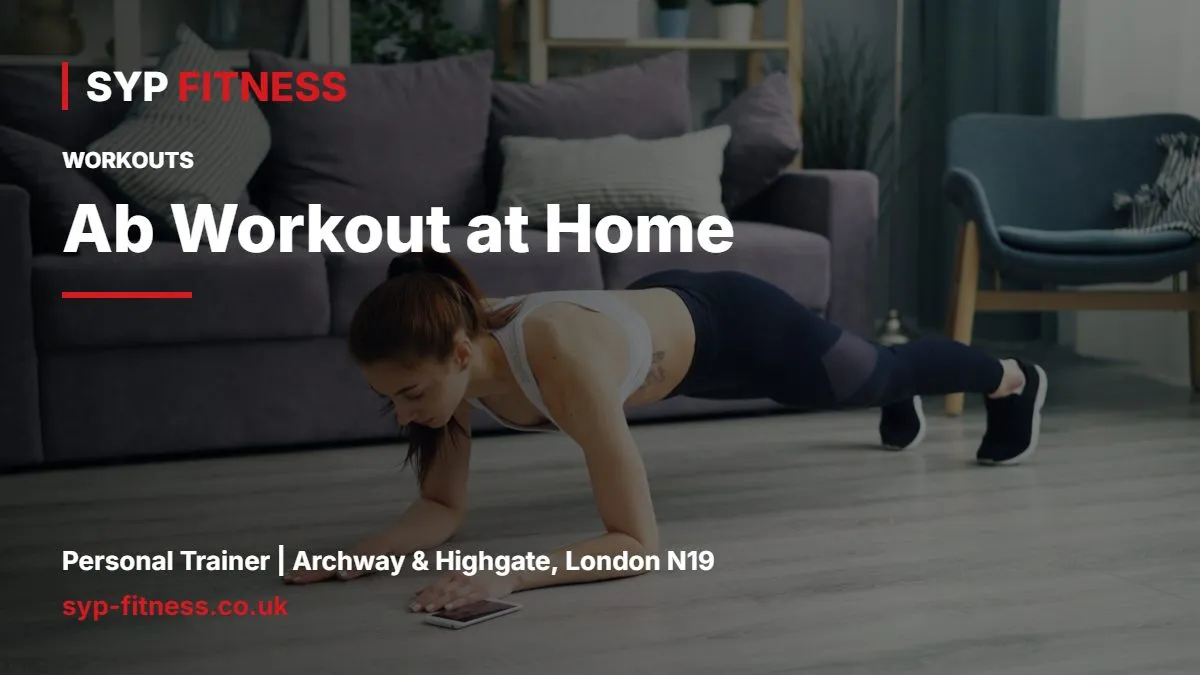
Ab Workout at Home: A 12-Minute Floor Routine That Works
A proper ab workout at home does not need 200 crunches. Your abs are designed mainly to stop movement, to keep your spine still while your arms and legs do the work. Train them that way and you get a stronger core, a happier lower back and better results from everything else you do, in about 12 minutes on the living room floor.
Below is the routine I use as a base with clients, the reasoning behind each move and how to make it harder over time. At the end I will be honest about the part no ab workout can do on its own.
Why "anti" movements beat endless crunches
Your core has a few main jobs, and crunches only cover one of them. The others matter more for strength, posture and back health:
- Anti-extension: stopping your lower back from arching. Planks, dead bugs and hollow holds train this.
- Anti-rotation: stopping your torso from twisting. Bird dogs and shoulder-tap planks train this.
- Anti-lateral flexion: stopping you bending sideways. Side planks train this.
- Flexion: curling your spine forward. Crunches and reverse crunches train this.
A balanced routine covers all four, weighted towards the first three. That is what carries over to lifting shopping, picking up children, and getting through a long day at a desk without your back complaining.
The 12-minute ab workout at home
Do this as a circuit. Move from one exercise to the next with 15-20 seconds of rest, then rest 60 seconds after each round. Complete 2-3 rounds. All you need is a mat or a carpet.
1. Dead bug - 8 slow reps each side
Lie on your back, arms pointing at the ceiling, knees bent at 90 degrees above your hips. Press your lower back gently into the floor. Slowly lower your opposite arm and leg towards the floor, breathe out, return and switch. If your back lifts off the floor, shorten the range. More detail in my dead bug guide.
2. Plank - 20-45 seconds
Forearms under shoulders, body in a straight line, squeeze your glutes and pull your elbows towards your toes without moving them. That squeeze turns an easy plank into a hard one. A 30-second plank done well beats a sloppy 2-minute one. See plank benefits and form.
3. Side plank - 15-30 seconds each side
Elbow under shoulder, hips lifted so your body is straight from head to feet. Bend your knees to make it easier. The side plank is the best way to train the deep muscles along your sides at home.
4. Bird dog - 6 reps each side with a 3-second hold
On hands and knees, extend one arm forward and the opposite leg back until both are in line with your body. Do not let your hips tip. Imagine a glass of water balanced on your lower back. My bird dog exercise guide covers the common faults.
5. Reverse crunch - 8-12 reps
Lie on your back, knees bent, hands by your sides. Curl your hips off the floor towards your ribs using your lower abs, then lower slowly. No swinging. This covers flexion without straining your neck.
6. Hollow body hold - 15-30 seconds
Lower back pressed into the floor, shoulders and legs lifted, arms by your sides or overhead. Start with knees bent. This is the hardest move in the circuit, so it goes last. Read more on the hollow body hold.
Breathing and bracing: the part most people miss
Holding your breath through every plank makes them feel easier than they are and teaches you nothing. Instead:
- Before each rep or hold, take a breath in through your nose into your belly and sides.
- Brace as if someone is about to poke your stomach. Firm, not sucked in.
- Keep that brace and breathe out slowly through pursed lips as you move.
This is the same skill you need for squats and deadlifts, so practising it on the floor pays off in the gym too.
How to progress your home ab routine
Work each move until it feels controlled at the top of the range, then make one change:
- Dead bug: straighten your legs fully, or hold for 3 seconds at full reach.
- Plank: add shoulder taps (anti-rotation) or walk your elbows a few centimetres further forward.
- Side plank: straight legs, then lift the top leg.
- Bird dog: from your knees to a lifted position, knees just off the floor.
- Hollow hold: straight legs, then arms overhead.
Do the routine 2-3 times a week, after a workout or on its own. Your core recovers fairly quickly, but it still needs rest days. If you are newer to this, start with my core training for beginners guide first.
Why an ab workout alone will not show your abs
This is the honest bit. You can have a very strong core and still not see your abs, because they sit under a layer of fat. You cannot spot-reduce stomach fat by training the muscles under it. Visible abs come from lowering your overall body fat through a sensible calorie deficit, enough protein, daily steps and strength training for the whole body.
So treat this routine as building the muscle and the function. The fat loss is a separate job, and it is mostly done in the kitchen. My guide on how to get abs covers that side in detail.
Want help with this? If your goal is a flatter, stronger stomach, the training is usually the easy part. Getting nutrition, steps and sleep right alongside it is where most busy people get stuck. That is what my weight loss personal training is built around, with InBody scans every 4 weeks so you can see fat and muscle change, not just the scales. Book a free consultation to see if it suits you.
If you have back pain, have recently had a baby, have a hernia or diastasis recti, or have had abdominal surgery, check with your GP or a physiotherapist before starting core training.
Frequently asked questions
Can I train abs every day at home?
You can do light core work most days, but you will get better results training hard 2-3 times a week and resting in between. Like any muscle, your abs adapt during recovery. If you want daily movement, a short set of dead bugs and bird dogs on rest days is fine and gentle on your back.
How long should an ab workout be?
Ten to fifteen minutes is enough for most people. Two or three rounds of five or six well-chosen exercises, done with control, will train every part of your core. Longer sessions tend to turn into sloppy reps. Quality and progression matter far more than the total time spent on the floor.
Are planks better than crunches?
For most people, yes. Planks train your core to keep your spine stable, which is its main job and helps protect your lower back. Crunches still have a place for training flexion, but they should not be the whole routine. A mix of planks, dead bugs, side planks and a few reverse crunches covers everything.
Will ab workouts burn belly fat?
Not directly. Ab exercises strengthen the muscles but do not burn fat from your stomach specifically. Belly fat comes down when your overall body fat drops, mainly through a calorie deficit, enough protein, regular walking and full-body strength training. The ab work makes sure there is a strong core underneath when it does.
Start your transformation
SYP Fitness is a private 1-to-1 personal training studio at 2-4 Navigator Square, Archway, London N19 3UB, 2 minutes from Archway tube. Rated 5.0 from 100+ Google reviews.
Apply for a free consultation · WhatsApp Artem · Call 07301 512215 · See prices


