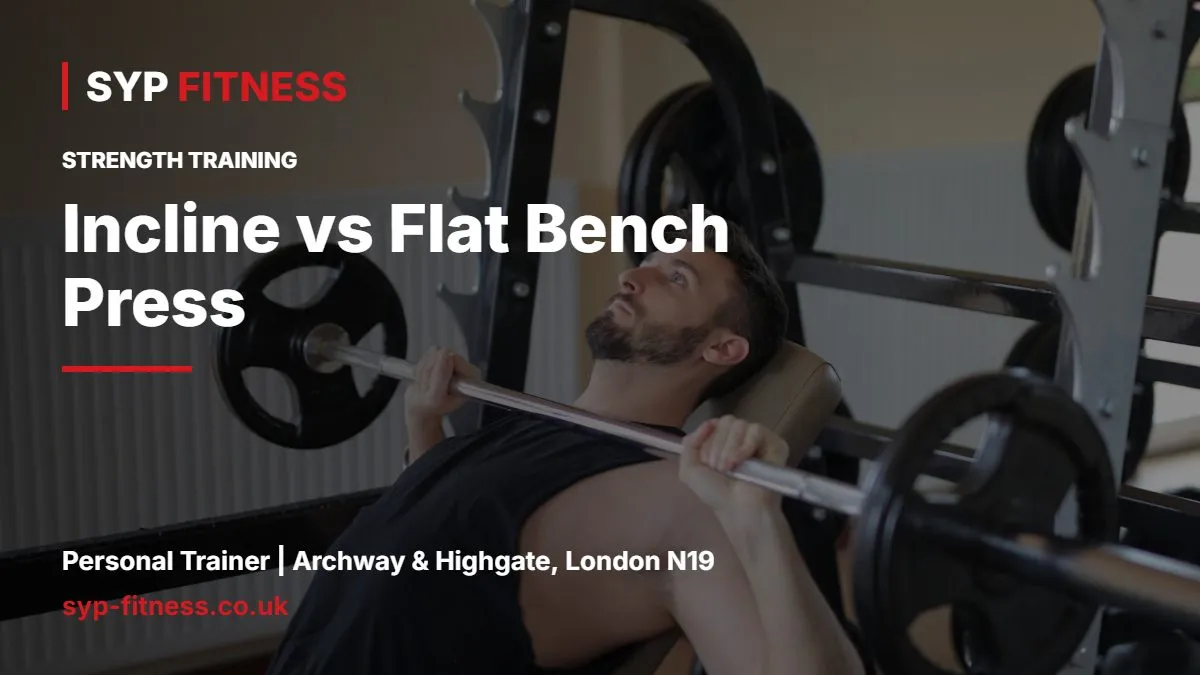
Incline vs Flat Bench Press: Which Builds a Better Chest?
The incline vs flat bench press question really comes down to which part of your chest you want to bias and how your shoulders feel. Both lifts train the chest, shoulders and triceps. Changing the bench angle simply shifts how much of the work goes to the upper chest and the front of the shoulder.
If you want the full rundown on each exercise, I have covered bench press benefits and incline dumbbell press benefits separately. Here I compare them and show you how to fit both into one sensible chest day.
What changes when you incline the bench
Your chest muscle (pectoralis major) has fibres running in slightly different directions. The upper fibres attach near the collarbone, and the larger lower and middle portion attaches along the breastbone and ribs. When you press, the angle of your arms relative to your body decides which fibres do more of the work.
- Flat bench: arms press roughly straight up from the mid chest. The middle and lower chest work hardest, and you can usually lift the most weight.
- Incline bench (around 30 degrees): arms press up and slightly back over the face. More work shifts to the upper chest and the front of the shoulder.
- Steep incline (45 degrees and above): it starts to become more of a shoulder press, with the front delts taking over.
For most people, a low incline of about 15-30 degrees hits the upper chest well without turning it into a shoulder exercise.
Muscles worked: incline vs flat bench press
Flat bench press
- Mid and lower chest as the main movers.
- Triceps for lockout.
- Front shoulders as helpers.
- The heaviest pressing load, so it is the best test of overall upper body pushing strength.
Incline bench press
- More upper chest involvement, which gives the chest a fuller look near the collarbones.
- More front shoulder work.
- Triceps still involved.
- Usually 10-20% less weight than you can flat bench, though this varies a lot between people.
Shoulder comfort
Shoulders are where the choice often gets made for you. Some people find a flat barbell bench press uncomfortable at the bottom, especially with a very wide grip and elbows flared out to 90 degrees. Others find steep inclines pinch the front of the shoulder.
A few adjustments help with either version:
- Tuck the elbows to about 45-70 degrees from your body rather than flaring them straight out.
- Pull the shoulder blades back and down before you unrack, and keep them set.
- Use a moderate grip width, roughly where your forearms are vertical at the bottom.
- Try dumbbells. They let your hands and elbows find their own path, which many shoulders prefer.
My bench press technique guide goes through the setup in detail. If you have ongoing shoulder pain, see your GP or a physio, and have a look at my exercises for shoulder pain once you are cleared.
Which should you prioritise?
Whichever you do first in a session will get your best effort and usually your best progress. So the question is less "which is better" and more "which matters most for you right now".
Prioritise the flat bench if
- You want overall pressing strength and the biggest numbers.
- You are a beginner building a base of strength.
- You are interested in powerlifting, where the flat bench is the competition lift.
Prioritise the incline bench if
- Your main goal is chest shape and size, particularly the upper chest.
- Your flat bench has stalled and you want a fresh stimulus for a few months.
- Flat pressing irritates your shoulders but a low incline feels fine.
For most people training for general fitness and a better physique, a good answer is to alternate: lead with flat one week or block, and with incline the next.
A sample chest day
This works well as the upper body push day in a push pull legs routine or as one of two upper body sessions a week. Warm up properly first, including a couple of lighter sets of your first press.
- Flat barbell bench press: 4 sets of 5-8 reps, 2 minutes rest. Leave 1-2 reps in the tank.
- Incline dumbbell press (around 30 degrees): 3 sets of 8-12 reps, 90 seconds rest.
- Cable or dumbbell chest fly: 3 sets of 12-15 reps, slow on the way down.
- Tricep pushdown: 3 sets of 10-15 reps.
- Face pull or band pull-apart: 3 sets of 15-20 reps to balance all the pressing and look after the shoulders.
Next time, swap the first two: incline barbell press for 4 sets of 5-8, then flat dumbbell press for 3 sets of 8-12. Over a few weeks, aim to add a rep or a small amount of weight to each main lift.
Training at home?
No bench? Feet-raised push-ups (feet on a sofa or step) bias the upper chest, much like an incline press, while hands-raised push-ups are an easier version to build up from. My guide on how to do a push-up has the progressions.
Barbell or dumbbells?
Both angles work with either. The barbell lets you lift heavier and track strength easily. Dumbbells give a slightly longer range, train each side on its own, and are often kinder on the shoulders. A simple rule I use with clients: barbell for the first, heavier press, dumbbells for the second.
Want help with this? Many of the busy professionals I train want a stronger, better-shaped chest without sore shoulders, and getting the bench angle, grip and elbow position right for their body is usually the quickest win. If you want a coach to set that up for you, Book a free consultation or check out private personal training in Archway.
Frequently asked questions
Is incline or flat bench better for chest size?
Both build the chest, and the best results come from using both over time. Flat bench lets you lift heavier and hits the mid chest hardest. Incline bench puts more work on the upper chest, which many people find lags behind. If size is your main goal, include an incline press most weeks alongside a flat press.
What angle should an incline bench press be?
A low incline of about 15-30 degrees is a good choice for most people. It shifts more work to the upper chest without turning the lift into a shoulder press. At 45 degrees and above, the front shoulders take over more of the work. Try a couple of angles and use the one that feels strongest and most comfortable.
Should I do incline or flat bench first?
Do first whichever lift matters most for your current goal, because it gets your freshest effort. For overall strength, that usually means the flat bench. If your upper chest is lagging or flat pressing bothers your shoulders, lead with incline. Swapping the order every few weeks is a simple way to keep both progressing.
Why can I lift less on incline bench?
On an incline, more of the work moves to the upper chest and front shoulders, which are smaller and weaker than the whole chest working together on a flat bench. The range of motion and leverage also change. Lifting around 10-20% less on incline is very common and nothing to worry about.
Start your transformation
SYP Fitness is a private 1-to-1 personal training studio at 2-4 Navigator Square, Archway, London N19 3UB, 2 minutes from Archway tube. Rated 5.0 from 100+ Google reviews.
Apply for a free consultation · WhatsApp Artem · Call 07301 512215 · See prices


