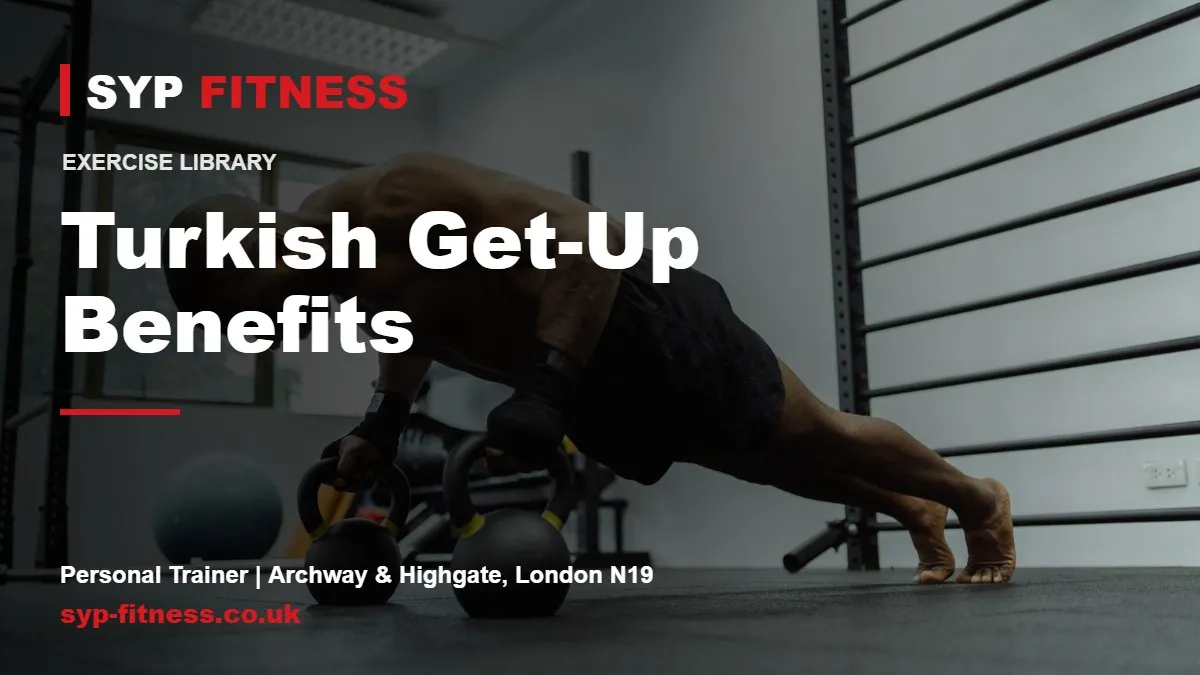
Turkish Get-Up: Benefits, Muscles Worked and How to Do It
The Turkish get-up is a slow, step-by-step movement where you go from lying on the floor to standing, and back down again, while holding a weight straight up above you. The biggest reason to do it is that it trains the most important life skill of all: getting up off the floor with strength and control.
Why the Turkish Get-Up is a must
Getting up from the floor uses almost everything: core, hips, legs, shoulders and balance. Many adults struggle with it long before they notice it in other ways. The Turkish get-up breaks this skill into clear stages and adds a weight overhead, so every position has to be strong and controlled.
It also builds shoulder stability, because your arm has to stay locked out and steady through every change in position. Hip mobility, coordination and focus all improve too. Few single exercises offer so much for so little equipment.
How it helps in everyday life
Getting up off the floor. This is the get-up itself, made stronger and smoother.
Getting out of a low bed, bath or car. You learn to shift your weight and stand with control.
Playing on the floor with children. Moving between lying, sitting, kneeling and standing becomes easy.
Reaching overhead while kneeling or twisting. Your shoulder learns to stay stable in awkward positions.
Recovering after a trip or slip. Better balance and body awareness help you catch yourself.
What it helps prevent
Being able to get down to the floor and back up is a big part of staying independent as we age. The Turkish get-up builds the strength, mobility and balance that make this easier, which helps make falls less likely and helps you get up confidently if you do fall. The NHS falls prevention advice recommends activities that improve strength and balance at least twice a week.
Its slow, overhead arm position also strengthens the shoulder stabilisers, which can help protect against shoulder niggles, and its hip and core work supports a healthier back.
Muscles worked
Shoulders and rotator cuff
Triceps
Rectus abdominis, obliques and transverse abdominis
Glutes and hip muscles
Quads and hamstrings
Upper back and serratus anterior
How to do the Turkish Get-Up
Lie on your back with a light kettlebell or shoe balanced in your right hand, arm straight up. Bend your right knee, foot flat. Keep your left arm and leg out at an angle on the floor.
Keeping your eyes on the weight, push through your right foot and roll onto your left elbow, then press up onto your left hand.
Drive your hips up into a bridge, then sweep your left leg back under you to kneel on your left knee.
Lift your torso upright into a half-kneeling position, with the weight still locked out overhead.
Stand up as if doing a lunge, bringing your back foot forward to meet the front foot.
Reverse each step slowly to return to lying down.
Do all reps on one side, then switch.
Breathing: Take a breath in each new position, then move on the out-breath. Never hold your breath through the whole get-up.
Common mistakes
Taking your eyes off the weight. Watch the weight until you are kneeling, then look ahead.
Bent elbow on the weight arm. Keep it straight and locked the whole time.
Rushing between positions. Pause in each stage. Slow and controlled is the point.
Starting too heavy. Learn the pattern with no weight or a shoe balanced on your fist.
Make it easier or harder
Easier
Practise with no weight, or a shoe balanced on your fist.
Do half get-ups: lying to sitting on your hand, then back down.
Practise each stage separately.
Harder
Use a heavier kettlebell in small steps.
Hold each position for a few seconds.
Hold the kettlebell bottoms-up for extra grip and shoulder control.
Sets, reps and how often
Start with 2-3 get-ups per side, rested well, 2-3 times a week. Treat it as practice, not a workout to rush. It also makes a useful warm-up with a light weight.
Progress by first making each stage smooth with no weight, then adding a light kettlebell, then going heavier. The NHS guidelines for adults recommend strengthening activities that work all the major muscle groups on at least 2 days a week, so this fits neatly into a full-body session.
Who should take care
If you have a current shoulder, wrist, hip, knee or back injury, or recent surgery, check with a GP or physio first. If you have high blood pressure or a heart condition, keep the weight light and keep breathing. If you are pregnant, speak to your midwife or GP, especially about lying on your back later in pregnancy.
Related exercises
Overhead Carry: builds the same locked-out shoulder stability.
Single-Leg Balance: supports the balance the get-up relies on.
Glute Bridge: strengthens the hip bridge stage.
Bear Crawl: another floor-based move for full-body control.
FAQs
Is the Turkish get-up good for beginners?
Yes, as long as you learn it slowly, with no weight first. Break it into stages and only add a kettlebell once each position feels steady.
How heavy should a Turkish get-up be?
Start with no weight or a shoe balanced on your fist. Then use a light kettlebell you can hold straight overhead without any wobble.
How many Turkish get-ups should I do?
Quality matters more than numbers. Two to three slow reps per side, two or three times a week, is plenty for most people.
Want help with your technique?
The get-up has many steps, and a coach makes them simple. Artem coaches the Turkish Get-Up 1-to-1 at his private studio in Archway, North London, so every rep is checked and progressed at the right pace. You can start with the 12-Week Body Transformation, look at personal training prices, or book a free assessment.
Last updated: October 2026


