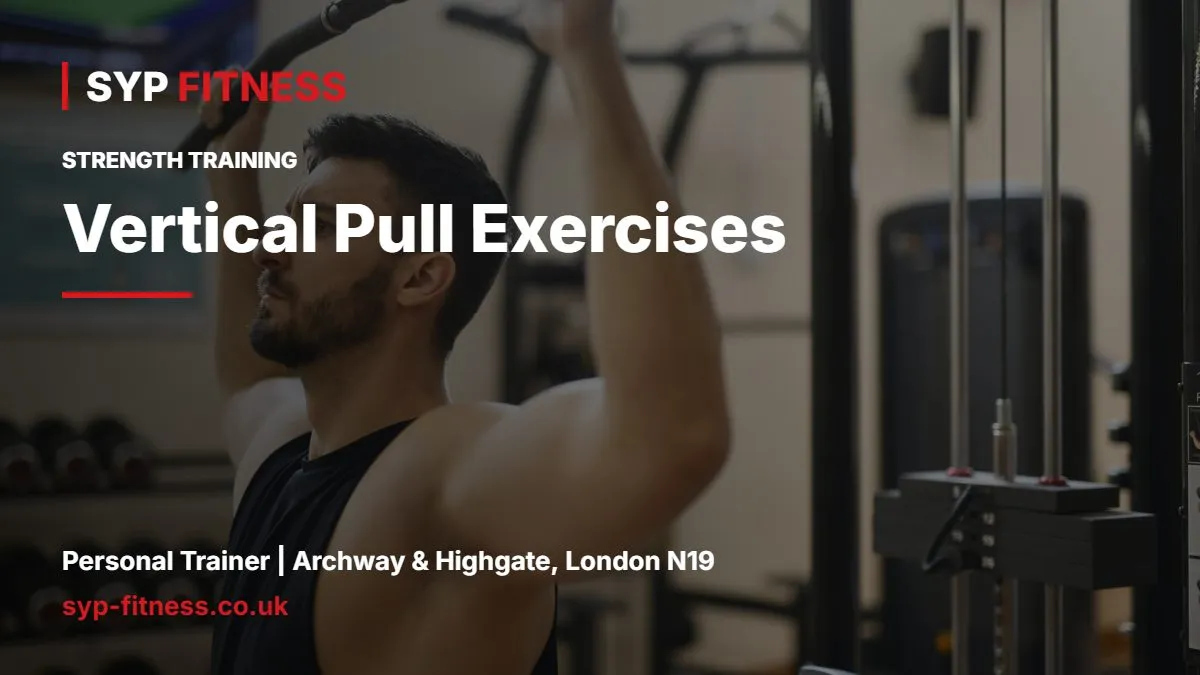
Vertical Pull Exercises: Pulldowns, Pull-Ups and Chin-Ups
Vertical pull exercises are any movements where you pull your elbows down from overhead towards your sides, either by pulling a bar down to you or pulling yourself up to a bar. The lat pulldown, pull-up and chin-up are the classic examples, and they are the main way to build a wider, stronger back.
In this guide I cover the vertical pulls I use most with clients, how to choose between them at each level, assisted options if you cannot do a pull-up yet, and how to balance vertical and horizontal pulling across a training week.
What makes a pull vertical?
Coaches group pulling exercises by the direction of the arms compared with the torso. In a vertical pull your arms start above your head and the elbows travel down towards your ribs. In a horizontal pull, such as a row, the arms start in front of you and the elbows travel backwards. I explain the row side in detail in my guide to the correct way to do rows.
Vertical pulls lean more on the lats, the large fan-shaped muscles down the sides of your back. They also work the lower traps, the teres major, the biceps and forearms, and your core, which has to stop you swinging.
The main vertical pull exercises
Lat pulldown
The vertical pull down most people start with. You sit with your thighs under a pad and pull a bar from overhead to your upper chest. The big advantage is that you can choose the load, so it suits complete beginners as well as advanced lifters chasing volume. If you have searched for a vertical lat pulldown or vertical pulldown machine, this is the one. My lat pulldown benefits post covers grip widths and setup.
Pull-up
Hands slightly wider than shoulders, palms facing away, pulling your chin over the bar from a dead hang. It is the king of bodyweight back exercises and a real test of strength relative to bodyweight. See my pull-up benefits guide.
Chin-up
Palms facing you, hands about shoulder width. The biceps help more, so most people can do a few more chin-ups than pull-ups. It is a great first goal on the bar. More in my post on chin-up benefits.
Neutral grip pull-up
Palms facing each other on parallel handles. Often the most comfortable option for people with cranky shoulders or elbows.
Single-arm cable pulldown
Kneeling or seated, pulling one handle down at a time. Good for evening out a weaker side and for feeling the lat work through a longer range.
Straight-arm pulldown
Arms nearly straight, pulling a bar or rope from head height to your thighs. It isolates the lats without the biceps and works well as a warm-up or finisher.
Assisted options if you cannot do a pull-up yet
Most adults I meet cannot do a full pull-up on day one, and that is completely normal. These are the steps I use to get there:
- Lat pulldown to build base strength. Once you can pull around 70-80% of your bodyweight for 6-8 good reps, you are getting close.
- Assisted pull-up machine or a resistance band looped over the bar. Reduce the help a little each week.
- Negatives: jump or step to the top, then lower yourself as slowly as you can, aiming for 3-5 seconds. 3-5 reps per set.
- Flexed arm hangs: hold the top position for 10-20 seconds to build strength where most people fail.
- Your first full rep, then build to sets of 3-5.
My step-by-step plan for doing your first pull-up goes into this in more depth, with a weekly progression.
How to do vertical pulls with good form
- Start with your shoulders. From a hang, pull your shoulder blades slightly down first, then bend the arms.
- Drive the elbows down to your back pockets. This keeps the lats doing the work, not just the arms.
- Keep your ribs down. A small lean back on the pulldown is fine. A big arch and swing is not.
- Control the way up. Take 2-3 seconds to return to a full stretch.
- Pull to the chest, not behind the neck. Behind-the-neck pulldowns put the shoulder in an awkward spot for most people and offer little extra benefit.
Want help with this? Getting your first pull-up is one of the most popular goals I work on with clients at my Archway studio. I will assess where you are, pick the right vertical pull for you and progress it each session. Book a free consultation to get started.
Lat pulldown or pull-up: which is better?
Both build the same muscles. The pulldown lets you control the load precisely and is easier to add volume with. The pull-up demands more core control and builds strength relative to your bodyweight. Most people do best with both: pull-ups or assisted pull-ups for lower reps early in the session, pulldowns for higher reps later. I compare them side by side in lat pulldown vs pull-up.
Balancing vertical and horizontal pulls in a week
Doing only one direction of pulling leaves gaps. Pulldowns and pull-ups build width and overhead strength. Rows build thickness through the middle of the back and help hold good posture. For most people training 2-4 times a week, I recommend:
- 6-10 hard sets of vertical pulling a week.
- Roughly the same or slightly more sets of horizontal rows.
- At least as much total pulling as pressing.
Sample two-day upper body split
- Day A: pull-up or assisted pull-up 4 x 4-8, seated cable row 3 x 10-12, straight-arm pulldown 2 x 15.
- Day B: barbell or dumbbell row 4 x 6-10, lat pulldown 3 x 10-12, chin-up negatives 2 x 3.
Keep 1-2 reps in reserve on most sets and add a rep or a small amount of weight when you hit the top of the range. If you have shoulder pain, speak to your GP or physio first, and see my guide to exercises for shoulder pain for gentler options.
Frequently asked questions
What are vertical pull exercises?
Vertical pull exercises are movements where your arms start overhead and the elbows pull down towards your sides. The main ones are the lat pulldown, pull-up, chin-up, neutral grip pull-up and straight-arm pulldown. They mainly work the lats, with help from the biceps, rear shoulders and core, and are the best way to build a wider back.
Is a lat pulldown a vertical pull?
Yes. The lat pulldown is the most common vertical pull in the gym. You pull a bar from overhead down towards your upper chest, which is the same movement pattern as a pull-up, just with you seated and the load set on a weight stack. That makes it ideal for beginners and for building up to bodyweight pull-ups.
How many vertical pulls should I do a week?
For most people, 6-10 hard sets of vertical pulling a week, split over two or three sessions, is a good target. Pair it with a similar amount of rowing. Beginners can start at the lower end and add a set every couple of weeks as long as recovery, sleep and joint comfort stay good.
Can I build my back with just pulldowns?
You can build a lot of back with pulldowns, but you will get better results and healthier shoulders by including rows too. Pulldowns favour the lats, while rows hit the middle back and rear shoulders harder. A mix of both directions, alongside some hinge work like deadlifts, covers the whole back properly.
Ready for a plan built around you? Learn more about training with a personal trainer in Archway, or see our personal training across North London.
Start your transformation
SYP Fitness is a private 1-to-1 personal training studio at 2-4 Navigator Square, Archway, London N19 3UB, 2 minutes from Archway tube. Rated 5.0 from 100+ Google reviews.
Apply for a free consultation · WhatsApp Artem · Call 07301 512215 · See prices


